
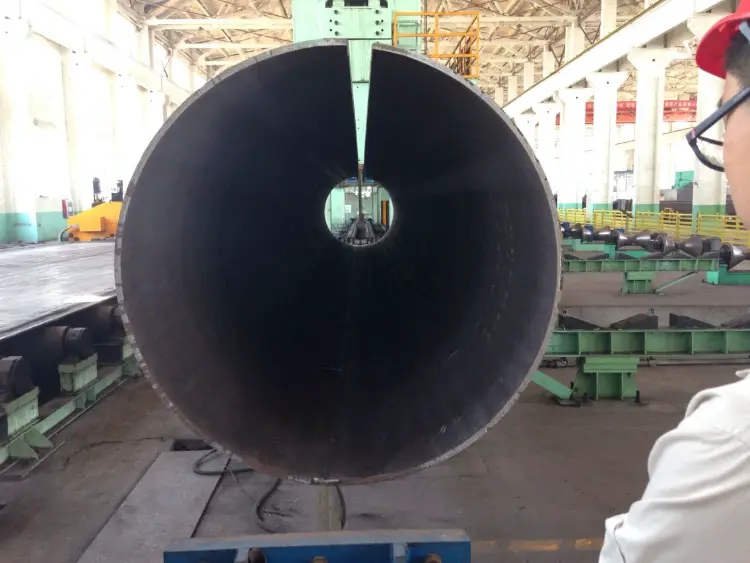
DH36 SSAW Pipe Material
DH36 SSAW Pipe: Marine-Grade High-Strength Steel for Structural and Offshore Applications
Comprehensive material data for DH36 steel used in SSAW pipes, covering chemical composition, mechanical properties, physical properties, international equivalents, and application guidance.
Thermo-mechanical controlled rolling (TMCR), normalized or normalizing rolling; pipe forming by spiral welding with submerged arc process
- Phone : +8618037372205
- Email : [email protected]
- WhatsApp: Contact via Whtsapp
- WeChat: +8618037372205
DH36 SSAW Pipe Introduction
DH36 is a high-strength structural steel grade primarily used in shipbuilding and offshore engineering under classification society rules (e.g., ABS, DNV, LR). It is designed for enhanced weldability and toughness at sub-zero temperatures, with a minimum yield strength of 355 MPa. When formed into SSAW (Spiral Submerged Arc Welded) pipes, DH36 steel provides excellent structural integrity for piling, jackets, risers, and subsea components. The steel is characterized by
- Controlled rolling and normalizing processes that deliver fine-grain microstructure
- Good notch toughness down to -20°C (DH36)
- Excellent formability and weldability for pipe manufacturing
- Resistance to lamellar tearing with low sulfur content
DH36 SSAW Pipe Chemical Composition
The chemical composition of DH36 steel is regulated by classification society rules to ensure high strength, good weldability, and low-temperature toughness. Typical requirements are based on ladle analysis. Microalloying elements such as Niobium (Nb), Vanadium (V), and Titanium (Ti) may be added for grain refinement.
- Carbon equivalent (CEV) is commonly controlled for weldability (typically CEV ≤ 0.38%).
- Strict limits on phosphorus and sulfur ensure cleanliness and resistance to embrittlement.
| Element | Ladle Analysis (typical limits) | Remarks |
|---|---|---|
| C (Carbon) | ≤ 0.18% | Carbon influences strength and weldability |
| Mn (Manganese) | 0.90 – 1.60% | Deoxidizer, improves strength and toughness |
| Si (Silicon) | 0.10 – 0.50% | Deoxidizer, increases strength |
| P (Phosphorus) | ≤ 0.035% | Considered a harmful impurity, limits toughness |
| S (Sulfur) | ≤ 0.035% | Controlled for inclusion control and lamellar tearing resistance |
| Al (Aluminum) acid soluble | ≥ 0.015% (if used) | Grain refining agent |
| Nb (Niobium) | 0.02 – 0.05% | Microalloying for precipitation strengthening and grain refinement |
| V (Vanadium) | 0.05 – 0.10% | Microalloy strengthening element |
| Ti (Titanium) | ≤ 0.02% | Optional grain refiner and precipitation strengthener |
| Cu (Copper) | ≤ 0.35% | Residual element; can contribute to strength but limited for hot shortness |
| Cr (Chromium) | ≤ 0.20% | Residual element; improves hardenability |
| Ni (Nickel) | ≤ 0.40% | Residual element; beneficial for toughness |
| Mo (Molybdenum) | ≤ 0.08% | Residual element; increases hardenability |
| N (Nitrogen) | ≤ 0.009% (if applicable) | Controlled when nitride formers are used |
DH36 SSAW Pipe Physical Properties
The following physical properties are typical for DH36 steel and are provided as reference for engineering calculations. These values are not specific requirements in the material standard but are representative of typical normalized shipbuilding steel. Properties may vary slightly depending on exact composition and heat treatment condition.
- Density is assumed constant for all common carbon-manganese steels.
- Thermal expansion coefficient and thermal conductivity are average values over common service temperature ranges.
| Property | Typical Value | Unit | Test Condition |
|---|---|---|---|
| Density (ρ) | 7.85 | g/cm³ | At 20°C |
| Modulus of elasticity (E) | 210 | GPa | At 20°C, tangent modulus in tension |
| Shear modulus (G) | 81 | GPa | Calculated from E and Poisson's ratio |
| Poisson's ratio (ν) | 0.3 | - | Elastic range |
| Thermal expansion coefficient (α) | 11.5 – 12.5 | 10⁻⁶/°C | Mean value between 20°C and 100°C |
| Thermal conductivity (λ) | 45 – 55 | W/(m·K) | At 20°C; depends on composition and microstructure |
| Specific heat capacity (c) | 460 – 490 | J/(kg·K) | At 20°C |
| Electrical resistivity (ρ_e) | 0.20 – 0.25 | Ω·mm²/m (equivalent to 10⁻⁶ Ω·m) | At 20°C |
DH36 SSAW Pipe Mechanical Properties
Mechanical properties for DH36 plates/strips intended for SSAW pipe production are verified by tensile and impact tests in accordance with classification society standards. Testing is usually performed on transverse specimens in the as-delivered condition.
- Yield strength and tensile strength are specified at room temperature.
- Notch toughness is evaluated by Charpy V-notch impact tests at -20°C.
- Minimum absorbed energy values depend on specimen orientation and product thickness.
| Property | Standard Value | Unit | Test Condition / Remarks |
|---|---|---|---|
| Yield Strength (ReH) | ≥ 355 | MPa | Transverse test, plate thickness ≤ 100 mm (may vary for thicker sections) |
| Tensile Strength (Rm) | 490 – 630 | MPa | Transverse test |
| Elongation after fracture (A) | ≥ 21 | % | Gauge length 5.65√So (proportional test piece), transverse |
| Elongation (50 mm gauge) | ≥ 24 (guide value) | % | For 50 mm gauge length, transverse, thickness ≤ 12.5 mm |
| Charpy V-notch impact (KV, -20°C) | ≥ 27 (longitudinal); ≥ 20 (transverse) | J | Average of three tests; minimum single value 70% of average for longitudinal, 70% for transverse |
| Bend test (bend diameter to thickness ratio) | No cracks after 180° bending | - | Bend diameter = 3a (thickness ≤ 25 mm), 4a (thickness > 25 mm). a = specimen thickness |
DH36 SSAW Pipe Identical Material Standards – Equivalent DH36 Grades by Classification Society
| Country / Region | Standard / Classification Society | Grade | Remarks |
|---|---|---|---|
| International (IACS) | IACS UR W11 | DH36 | Base uniform requirement adopted by member societies |
| USA | ABS (American Bureau of Shipping) | DH36 | Same chemical and mechanical requirements |
| Germany / Norway (DNV) | DNV GL (now DNV) | DH36 | Compliant with DNV OS-B101 and rules for ships |
| UK | LR (Lloyd's Register) | DH36 | Equivalent to LR Rules Grade DH36 |
| France | BV (Bureau Veritas) | DH36 | Equivalent to BV NR216 Grade DH36 |
| China | CCS (China Classification Society) | DH36 | Equivalent to CCS Rules for Materials |
| Korea | KR (Korean Register) | DH36 | Same as KR Rules Grade DH36 |
| Japan | NK (Nippon Kaiji Kyokai) | DH36 | Equivalent to NK Rules KDH36 |
| Russia | RS (Russian Maritime Register) | DH36 | Equivalent to PC Grade D36 (approximately) |
| International (ASTM) | ASTM A131 / A131M | DH36 | Standard specification for structural steel for ships, Grade DH36 |
| China (GB) | GB 712 | DH36 | Chinese national standard for hull structural steel |
DH36 SSAW Pipe Application Introduction
DH36 steel is ideally suited for structural applications requiring a combination of high strength and guaranteed low-temperature toughness. When formed into SSAW (Spiral Submerged Arc Welded) pipes, it is widely used in marine and offshore environments where structural reliability under static and dynamic loads is critical. The spiral welding process allows large-diameter pipes to be produced from coiled plate efficiently.
- Excellent suitability for welding with conventional low-hydrogen procedures.
- Can be designed for both internal and external pressure.
- Corrosion protection typically requires external coating (e.g., 3LPE, FBE) and internal lining for subsea service.
Product Applications: SSAW structural pipes for piling and foundation support, Conductor pipes and surface casings for oil and gas wells, Jacket legs, braces, and nodes for offshore platforms, Riser tubes and J-tubes for subsea installations, Large-diameter flowline pipes (atmospheric pressure, structural), Wind turbine towers (lower sections where high strength and toughness required)
Processed into products: Spiral submerged arc welded pipes (OD typically 219 mm – 3048 mm, wall thickness up to 25.4 mm), Cans and tubular stemplates for platform fabrication, Crane pedestal tubes on offshore vessels, Mooring system components (structural parts), Sheet piles and king piles (fabricated from cut pipe), Structural tubular connections and transition pieces
Application industries: Offshore oil and gas (platforms, jackets, subsea structures), Marine construction (ports, jetties, breakwaters), Renewable energy (offshore wind turbine foundations, monopiles, transition pieces), Shipbuilding (hull reinforcement, stiffeners, longitudinal members), Civil engineering (bridge piers, structural columns, piling), Pipeline infrastructure (water, slurry, and solids transport in abrasive environments)
DH36 SSAW Pipe Similar Steel Grades – Nominal Compositions with Slightly Different Properties
| Standard / Grade | Country / Region | Typical Yield Strength | Remarks |
|---|---|---|---|
| AH36 (IACS) | International | ≥ 355 MPa | Same strength level but lower impact toughness: Charpy test at 0°C instead of -20°C. Can replace DH36 only when service temperature permits. |
| EH36 (IACS) | International | ≥ 355 MPa | Higher toughness: impact tested at -40°C. Superior notch toughness, often used for critical applications. |
| FH36 (IACS) | International | ≥ 355 MPa | Premium toughness: impact tested at -60°C. Used for arctic/cryogenic structures. |
| ASTM A572 Grade 50 (Type 1 or 2) | USA | ≥ 345 MPa | A common structural steel with similar strength but without mandatory low-temperature toughness; requires supplementary requirements for marine service. |
| EN 10025-4 S355ML | EU | ≥ 355 MPa | Thermo-mechanically rolled fine-grain structural steel with guaranteed impact at -50°C (longitudinal). Comparable for structural tubulars but not certified for ship classification. |
| GB/T 1591 Q355D | China | ≥ 355 MPa | High-strength low-alloy structural steel with -20°C impact test; similar strength range but not directly recognized by ship classification societies. |
Notes:
Important Considerations for DH36 SSAW Pipe:
- Steel must be certified by an approved classification society (e.g., ABS, DNV, LR) for marine applications. Mill test certificates (MTC) are required with traceability to heat and plate/coil number.
- Carbon equivalent (CEV) should be controlled per agreed standards (typically ≤ 0.38% for thickness ≤ 50 mm) to assure weldability without excessive preheat.
- Through-thickness (Z-direction) properties may be specified (e.g., Z15, Z25, Z35 according to EN 10164) when the pipe is subject to high restraint or lamellar tearing risk.
- Surface condition: free from surface imperfections detrimental to further processing; ultrasonic testing of pipe seams (UT) is normally performed according to API 5L or equivalent for structural tubulars.
- Low-temperature toughness must be verified after pipe forming and welding if the pipe is used in sour service or low-temperature environments; supplementary impact testing on weld and heat-affected zone (HAZ) is often required.
- Share



