
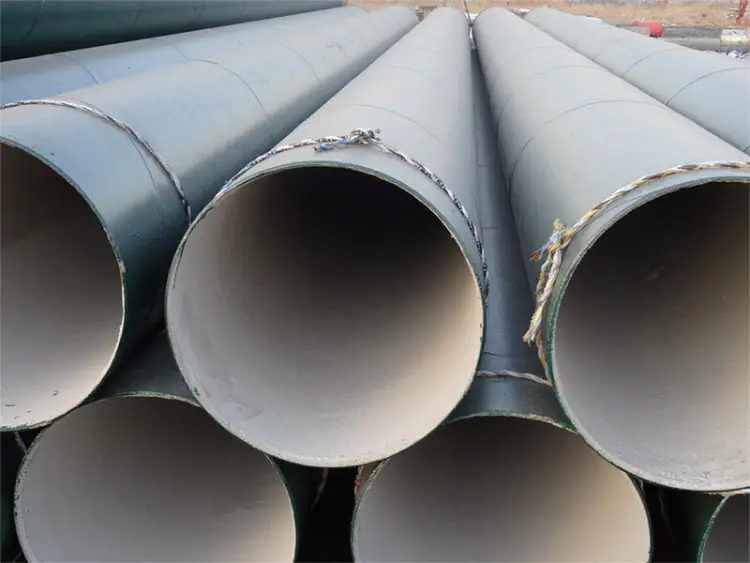
AH36 SSAW Pipe Material
AH36 SSAW Pipe: High-Strength Shipbuilding Steel for Helical Welded Applications
Comprehensive material data for AH36 SSAW pipe, including chemical composition, mechanical and physical properties, international equivalents, and application guidance based on official ship classification society standards.
Hot rolling of steel coil, followed by spiral forming and double-sided submerged arc welding. Post-weld heat treatment (PWHT) may be applied for stress relief. Suitable for cold forming, cutting, and further welding.
- Phone : +8618037372205
- Email : [email protected]
- WhatsApp: Contact via Whtsapp
- WeChat: +8618037372205
AH36 SSAW Pipe Introduction
AH36 is a high-strength hull structural steel grade widely utilized in shipbuilding and offshore engineering. It is defined by the International Association of Classification Societies (IACS) and adopted by major classification societies such as ABS, DNV, LR, BV, and CCS. The designation "AH36" indicates a minimum yield strength of 355 MPa and good notch toughness at 0 °C (A-grade). When supplied as SSAW (Spiral Submerged Arc Welded) pipe, this grade offers excellent weldability, high strength-to-weight ratio, and reliable low-temperature performance in large-diameter pipes for marine and structural applications. SSAW pipes are formed by helically bending and welding hot-rolled steel coils, providing cost efficiency and versatility in pipe diameter and wall thickness.
AH36 SSAW Pipe Chemical Composition
The chemical composition of AH36 steel is regulated by IACS UR W11 and is uniformly adopted by all major classification societies. Carbon equivalent (CEV) is typically controlled to ensure good weldability. Fine-grain practice involves addition of aluminum or microalloying elements such as niobium, vanadium, or titanium. The table below provides the standard ladle analysis limits. Actual mill certificates may show tighter ranges and values for microalloying elements.
| Element | Standard Value (max unless range given) | Remarks |
|---|---|---|
| Carbon (C) | ≤0.18% | Ceq = C + Mn/6 + (Cr+Mo+V)/5 + (Ni+Cu)/15 ≤ 0.38% typically |
| Manganese (Mn) | 0.90–1.60% | For thicknesses ≤ 100 mm; thicker sections may have adjusted limits |
| Silicon (Si) | ≤0.50% | Killed steel, fully deoxidized |
| Phosphorus (P) | ≤0.035% | Lower values often specified for improved toughness |
| Sulfur (S) | ≤0.035% | Low sulfur improves through-thickness properties |
| Chromium (Cr) | ≤0.20% | Residual element, not intentionally added |
| Nickel (Ni) | ≤0.40% | Residual; higher allowed if specified |
| Molybdenum (Mo) | ≤0.08% | Residual |
| Copper (Cu) | ≤0.35% | Residual |
| Aluminum (Al) | ≥0.015% total Al | Grain refining element |
| Niobium (Nb) | ≤0.05% | Microalloying element (optional) |
| Vanadium (V) | ≤0.10% | Microalloying element (optional) |
| Titanium (Ti) | ≤0.02% | Microalloying element (optional) |
| Nitrogen (N) | ≤0.012% | If aluminum is not used, nitrogen-fixing elements must be added |
AH36 SSAW Pipe Thermal, Electrical and Physical Properties
The following values are typical for AH36 steel in the normalized condition and are not controlled by mandatory classification society rules. They are based on generic data for carbon-manganese structural steels and can be used for engineering calculations. Actual values may vary slightly depending on exact composition and heat treatment. Thermal expansion and thermal conductivity data are especially relevant for welding distortion analysis and heat transfer simulation.
| Property | Typical Value (Reference) | Unit | Test Condition / Temperature |
|---|---|---|---|
| Density (ρ) | 7.85 | g/cm³ | Room temperature (20 °C) |
| Elastic Modulus (E) | 205 – 210 | GPa | Room temperature, tensile loading |
| Shear Modulus (G) | ~ 80 | GPa | Calculated from E and ν |
| Poisson's Ratio (ν) | 0.29 – 0.30 | — | Elastic range, room temperature |
| Thermal Expansion Coefficient (α) | 11.7 × 10⁻⁶ | 1/K | 20 °C to 100 °C |
| Thermal Expansion Coefficient (α) | 12.2 × 10⁻⁶ | 1/K | 20 °C to 200 °C |
| Thermal Expansion Coefficient (α) | 12.9 × 10⁻⁶ | 1/K | 20 °C to 400 °C |
| Thermal Conductivity (λ) | ~ 51 | W/(m·K) | At 20 °C |
| Thermal Conductivity (λ) | ~ 48 | W/(m·K) | At 100 °C |
| Thermal Conductivity (λ) | ~ 43 | W/(m·K) | At 300 °C |
| Specific Heat Capacity (cₚ) | ~ 460 | J/(kg·K) | At 20 °C |
| Specific Heat Capacity (cₚ) | ~ 500 | J/(kg·K) | At 200 °C |
| Electrical Resistivity (ρₑ) | ~ 0.18 × 10⁻⁶ | Ω·m | At 20 °C (typical for structural steel) |
| Melting Range | ~ 1450 – 1520 | °C | Approximate solidus and liquidus |
AH36 SSAW Pipe Mechanical Properties
Mechanical properties are specified for the base material in delivery condition. For SSAW pipe, the properties of the weld seam are verified by separate welding procedure qualification. Tensile and impact tests are performed in accordance with the relevant classification society rules. The Charpy V-notch impact test temperature for grade A is 0 °C. Values below represent minimum requirements unless a range is indicated.
| Property | Standard Required Value | Unit | Test Condition |
|---|---|---|---|
| Yield Strength (ReH) | ≥355 | MPa | Transverse or longitudinal test piece, ambient temperature |
| Tensile Strength (Rm) | 490 – 620 | MPa | Ambient temperature, gauge length according to standard |
| Elongation (A) | ≥21 | % | Gauge length 5.65√S₀ (L0 = 5.65√S₀) |
| Yield-to-Tensile Ratio | ≤0.85 | — | For some offshore applications; not mandatory for all rules |
| Charpy V-notch Impact Energy (KV) | ≥34 (longitudinal) | J | 0 °C, standard 10×10 mm specimen |
| Charpy V-notch Impact Energy (KV) | ≥24 (transverse) | J | 0 °C, standard 10×10 mm specimen |
| Bend Test (180°) | No cracks | — | Diameter of mandrel = 2a (a=thickness) for tensile side |
| Hardness | Not specified; typically 120-180 | HBW | Optional; for sour service additional limits apply |
AH36 SSAW Pipe Fully Equivalent Material Standards & Substitutable Grades
| Country / Region | Standard / Society | Grade | Remarks |
|---|---|---|---|
| International | IACS UR W11 | AH36 | Base specification for all member societies |
| United States | ABS (American Bureau of Shipping) | AH36 | Identical requirements to IACS |
| Norway / International | DNV (Det Norske Veritas) | VL A36 | DNV notation for AH36 equivalent; also NV A36 in older rules |
| United Kingdom | LR (Lloyd's Register) | AH36 | Grade AH36; sometimes LR AH36 |
| France | BV (Bureau Veritas) | AH36 | Full equivalence |
| China | CCS (China Classification Society) | AH36 | Chinese shipbuilding steel standard |
| South Korea | KR (Korean Register) | AH36 | Same as IACS |
| Japan | NK (ClassNK) | AH36 | Japan's classification society |
| Italy | RINA (Registro Italiano Navale) | AH36 | Italian grade identical |
| Germany / Europe | EN 10025-3:2019 (not directly equivalent) | S355N/NL (for reference only) | S355N (normalized) with additional toughness requirements can approach AH36, but CEV and impact test conditions differ; approval by class society required for substitution |
AH36 SSAW Pipe Application Introduction
AH36 SSAW pipe is primarily used in shipbuilding, offshore oil & gas, marine civil engineering, and structural applications that require high strength and good weldability at moderate temperatures. The spiral welded pipe format allows economical production of large-diameter (from 219 mm up to over 3000 mm) and long-length pipes with wall thicknesses ranging from approximately 6 mm to 25.4 mm, depending on the coil thickness capacity. It is widely adopted for stub columns, chord members, tubular piles, and conductor pipes. Because of its guaranteed notch toughness at 0 °C, it is safe for low-temperature service in marine environments where the design temperature is not below freezing. When used for pressure-containing components, the pipe must also comply with supplementary testing per the applicable classification society rules.
Product Applications: Spiral submerged arc welded (SSAW) pipes in various diameters and schedules, Jacket legs and bracing members for offshore platforms, Tubular monopiles and transition pieces for wind turbines, King piles, sheet piles and tubular piles for quay walls, Structural hollow sections for heavy steelwork, Casing pipes for deep foundations, Pipe piles for retaining walls and bridge abutments, Steel pipe culverts and drainage systems
Processed into products: Welded tubular nodes and K-joints in jacket structures, Stiffened pipe columns in high-rise buildings, Conductor pipes in offshore drilling, Riser protection pipes, Flanges and end connectors attached to SSAW pipe, Bends and elbows formed from AH36 pipe sections, Support frames and equipment foundations, Shafts and struts subject to axial compression and bending
Application industries: Shipbuilding and ship repair, Offshore oil & gas platforms (jackets, topsides, decks), Renewable energy (offshore wind turbine foundations, monopiles, transition pieces), Marine civil works (jetties, berthing dolphins, combi-walls), Structural steel construction (columns, trusses, towers), Port and harbor engineering (piles, fender systems, mooring structures), Pipeline systems (conveying water, slurry, or non-hazardous fluids where structural strength is primary requirement)
AH36 SSAW Pipe Similar or Comparable Materials
| Country / Region | Standard / Grade | Grade / Designation | Comparative Analysis & Remarks |
|---|---|---|---|
| International | API 5L / ISO 3183 | L360 or X52 (PSL1 or PSL2) | Similar yield strength (~360 MPa). For non-shipbuilding structural applications, X52 pipe may be used, but impact toughness and certification differ. Not accepted for shipbuilding without full class approval. |
| Europe | EN 10225:2019 (weldable structural steels for fixed offshore structures) | S355G10+N | Yield strength 355 MPa, normalized, with Charpy V-notch at -20 °C or -40 °C. CEV ≤ 0.43. Suitable for offshore structures; may replace AH36 in offshore fixed platform design with proper certification. |
| Europe | EN 10025-3 | S355N, S355NL | Normalized structural steels with 355 MPa yield. S355NL has minimum impact energy 27 J at -50 °C, exceeding AH36 toughness. Useful for bridges and buildings. In marine use, require additional documentation for guarantee of notch toughness. |
| United States | ASTM A572/A572M | Grade 50 [345] (Type 1) | Min yield 345 MPa, higher than AH36. Not specifically for shipbuilding; requires supplementary requirements for impact testing. Commonly used in structural applications. |
| United States | ASTM A709/A709M | Grade 50 [345] | Highway bridge steel, similar strength. Can be used for offshore structural members with additional qualification. |
| United States / International | ASTM A139/A139M | Grade B or C (structural welded pipe) | Standard for electric-fusion-welded pipe for structural use. Grade B minimum yield 241 MPa; Grade C 275 MPa. Lower strength than AH36 but commonly used for SSAW pipes. AH36 SSAW pipe vastly superior in strength and toughness. |
| Classification Societies | DH36, EH36, FH36 | Higher toughness grades | DH36 impact tested at -20 °C, EH36 at -40 °C, FH36 at -60 °C. They are not substitutes but enhancements for lower service temperatures. AH36 may be substituted by a higher grade with owner's consent. |
Notes:
Welding considerations: AH36 steel has excellent weldability with all common arc welding processes (SMAW, SAW, GMAW, FCAW). Preheating is generally not required for thicknesses below 30 mm, but low-hydrogen electrodes and proper welding procedures must be followed to avoid hydrogen-induced cracking. Post-weld heat treatment (PWHT) may be required for thick walls to relieve stresses, but must be evaluated to prevent reduction in HAZ toughness. Corrosion protection: In marine environments, AH36 SSAW pipes are typically coated (epoxy, polyethylene, or zinc-based paints) or used with cathodic protection. For severe corrosion conditions such as splash zones, additional corrosion allowance (typically 2-5 mm) is added to the wall thickness. Certification: SSAW pipes for marine use must be certified by an authorized classification society inspector, with stamping and mill test reports covering chemical and mechanical properties, weld tests, hydrostatic tests, and non-destructive examination (NDE) of the weld seam. Dimensional tolerances: Tolerances of outer diameter, wall thickness, and out-of-roundness shall comply with API 5L or the specified purchase order requirements; classification societies often reference API 5L for pipe dimensions and tolerances.
- Share



