
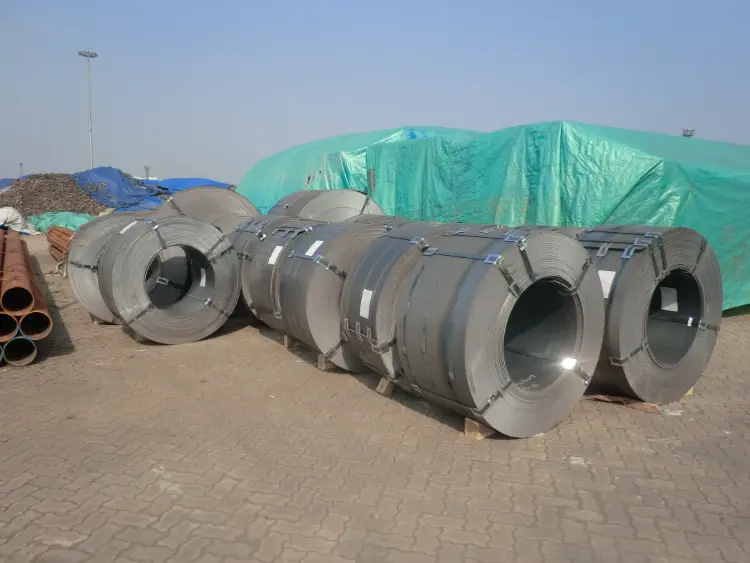
CCS Grade E Shipbuilding Steel Coil
CCS Grade E Shipbuilding Steel Coil - Comprehensive Material Analysis
In-depth technical analysis of CCS Grade E shipbuilding steel coil covering chemical composition, mechanical and physical properties, equivalent grades, and application guidelines.
Hot rolling, cold forming, welding, cutting, straightening
- Phone : +8618037372205
- Email : [email protected]
- WhatsApp: Contact via Whtsapp
- WeChat: +8618037372205
CCS Grade E Shipbuilding Steel Coil Introduction
CCS Grade E is a normal strength hull structural steel certified by the China Classification Society (CCS). It is designed for use in ship and offshore structures where good toughness at low temperatures is essential. The steel is produced in compliance with CCS Rules for Materials and Welding, ensuring reliable performance in marine environments. Key features include excellent weldability, uniform mechanical properties, and satisfactory impact resistance at -40°C. It is delivered as hot-rolled coil, typically in normalized or controlled rolled condition, and is widely applied in hull plates, decks, and structural components.
CCS Grade E Shipbuilding Steel Coil Chemical Composition
The chemical composition conforms to CCS requirements for Grade E normal strength hull structural steel. All values are maximum unless a range is indicated. Grain refining elements such as aluminum are mandatory to ensure fine grain structure. Residual elements are controlled to ensure weldability and toughness. The carbon equivalent (Ceq) shall not exceed 0.38% for thicknesses up to 100 mm.
| Chemical Element | Standard Value (%) | Remarks |
|---|---|---|
| C | ≤0.18 | Maximum |
| Si | 0.10 – 0.50 | Range |
| Mn | 0.70 – 1.50 | Range |
| P | ≤0.035 | Maximum |
| S | ≤0.035 | Maximum |
| Al (acid soluble) | ≥0.015 | Minimum; total Al ≥0.020 acceptable |
| Cr* | ≤0.30 | Residual element, max. |
| Ni* | ≤0.30 | Residual element, max. |
| Cu* | ≤0.30 | Residual element, max. |
| Mo* | ≤0.08 | Residual element, max. |
| Nb* | ≤0.05 | Optional microalloy; if added, contributes to Ceq |
| V* | ≤0.10 | Optional microalloy; if added, contributes to Ceq |
| Ti* | ≤0.02 | Optional microalloy; if added, contributes to Ceq |
CCS Grade E Shipbuilding Steel Coil Thermal and Electrical Physical Properties
Typical physical properties for CCS Grade E steel at ambient conditions. These values are provided for general guidance and may vary slightly with manufacturing route. Thermal expansion data is given for two temperature ranges.
| Property | Typical Value | Unit | Test Condition |
|---|---|---|---|
| Density (ρ) | 7.85 | g/cm³ | at 20°C |
| Elastic Modulus (E) | 205 | GPa | at room temperature |
| Shear Modulus (G) | 80 | GPa | at room temperature |
| Poisson's Ratio (ν) | 0.3 | — | at room temperature |
| Thermal Expansion Coefficient (α) | 11.2 × 10⁻⁶ | /K | 20°C – 100°C |
| Thermal Expansion Coefficient (α) | 12.5 × 10⁻⁶ | /K | 20°C – 200°C |
| Thermal Conductivity (λ) | 53 | W/(m·K) | at 20°C |
| Specific Heat Capacity (c_p) | 486 | J/(kg·K) | at 20°C |
| Electrical Resistivity (ρ_e) | 0.15 | µΩ·m | at 20°C |
CCS Grade E Shipbuilding Steel Coil Mechanical Properties
Mechanical properties are guaranteed for flat products in the as-delivered condition. Test specimens are taken transverse to the rolling direction. Charpy V-notch impact tests at -40°C are mandatory for Grade E. Bending properties ensure formability. The following values apply to thicknesses ≤ 100 mm unless otherwise specified.
| Property | Standard Requirement | Unit | Test Condition |
|---|---|---|---|
| Yield Strength (ReH) | ≥235 | MPa | t ≤ 100 mm, transverse |
| Tensile Strength (Rm) | 400 – 520 | MPa | t ≤ 100 mm, transverse |
| Elongation (A) | ≥22 | % | t ≤ 100 mm, gauge L0=5.65√So, transverse |
| Charpy Impact Energy (KV) at -40°C | ≥27 (average), ≥20 (single) | J | Transverse, full-size specimen |
| Bend Test (180°) | d=2t | — | t ≤ 10 mm, no cracks |
| Bend Test (180°) | d=3t | — | 10 mm < t ≤ 20 mm, no cracks |
| Bend Test (180°) | d=4t | — | t > 20 mm, no cracks |
CCS Grade E Shipbuilding Steel Coil Fully Equivalent Material Standards and Replaceable Grades
| Country/Region | Standard | Grade | Remarks |
|---|---|---|---|
| China | CCS Rules | CCS Grade E | Base standard |
| Worldwide (IACS) | IACS UR W11 | Normal Strength Grade E | Unified requirements for classification societies |
| USA | ABS Rules | ABS Grade E | Identical requirements |
| Norway/Germany | DNV Rules | NV E (former), DNV Grade E | Identical properties |
| UK | LR Rules | LR Grade E | Identical |
| France | BV Rules | BV Grade E | Identical |
| Germany | GL Rules (now DNV) | GL Grade E | Identical |
| Italy | RINA Rules | RINA Grade E | Identical |
| Japan | NK (ClassNK) Rules | NK Grade E | Identical |
| South Korea | KR Rules | KR Grade E | Identical |
| International | ASTM A131 / A131M | Grade E | Also specified for shipbuilding |
CCS Grade E Shipbuilding Steel Coil Application Introduction
CCS Grade E steel coil is extensively utilized in the marine sector for fabricating critical structural components. Its good combination of strength, ductility, and low-temperature toughness makes it suitable for cold-region ship operations. The steel can be formed, cut, and welded using standard shipyard practices. Typical delivery condition ensures consistent properties and surface quality.
Product Applications: Hull plates, Deck and bottom shells, Bulkheads and longitudinal stiffeners, Offshore platform decks and modules, Ship sections and blocks
Processed into products: Channels and angles, T-beams and bulb flats, Pipe supports and brackets, Tank boundaries and watertight doors, Structural sections for marine cranes
Application industries: Shipbuilding, Offshore and marine engineering, Port and harbor infrastructure, Oil and gas (offshore structures)
CCS Grade E Shipbuilding Steel Coil Similar / Alternative Material Recommendations
| Country/Region | Standard | Grade | Remarks |
|---|---|---|---|
| International | ASTM A131 | Grade D | Normal strength with lower toughness (-20°C impact) |
| EU | EN 10025-2 | S235J2+N | Comparable strength and -20°C impact, but not marine certified |
| Japan | JIS G3106 | SM400B / SM400C | Similar strength, impact properties at 0°C / -10°C, not marine certified |
| China | GB/T 700 | Q235D | Similar strength, impact at -20°C, non-marine |
| International | ASTM A36 | — | Slightly lower yield (250 MPa), general structural, no low-temp impact |
Notes:
Certification: Material must be supplied with CCS certificate of compliance. Marking: Each coil shall bear the grade, heat number, and class mark. Surface condition: Coils are typically hot rolled and pickled or oiled as required. Additional testing: Ultrasonic testing may be specified for thicknesses above 12 mm. Thickness tolerance: In accordance with applicable dimensional standards.
- Share



