
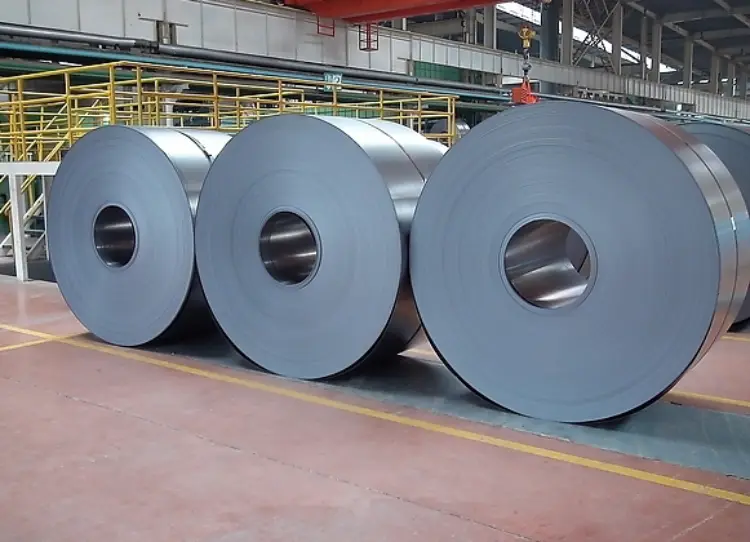
CCS Grade D Shipbuilding Steel Coil
CCS Grade D Shipbuilding Steel Coil: Certified Marine-Grade Structural Steel
Explore CCS Grade D shipbuilding steel coil, a normal-strength hull structural steel certified by China Classification Society, ideal for marine and offshore constructions with guaranteed impact toughness at 0°C.
Hot rolling, cold forming, cutting, welding, bending, levelling, and conventional machining (drilling, milling). Pre-heat treatment not required for typical thicknesses.
- Phone : +8618037372205
- Email : [email protected]
- WhatsApp: Contact via Whtsapp
- WeChat: +8618037372205
CCS Grade D Shipbuilding Steel Coil Introduction
CCS Grade D is a normal-strength hull structural steel governed by the China Classification Society (CCS) Rules for Materials and Welding. It belongs to the series of CCS general shipbuilding steels (A, B, D, E) with a minimum yield strength of 235 MPa and excellent weldability. Grade D specifically provides guaranteed Charpy V-notch impact toughness at 0°C, making it suitable for hull structures, frames, and stiffeners in shipbuilding. It is commonly supplied as hot-rolled coils, plates, and sections, featuring fine grain killing practice and excellent cold-forming and welding characteristics, compliant with international marine standards.
CCS Grade D Shipbuilding Steel Coil Chemical Composition
The chemical composition for CCS Grade D is controlled to ensure good weldability and toughness. Fine grain practice (e.g., using aluminium) is mandatory.
- Carbon equivalent (CEV) ≤ 0.38% (typical for weldability).
- Residual elements such as Cr, Ni, Cu are generally ≤ 0.30% each unless otherwise agreed.
- All values as per CCS Rules for Hull Structural Steels.
| Element | Required Value (%) | Remarks |
|---|---|---|
| Carbon (C) | ≤ 0.21 | maximum, improves strength |
| Manganese (Mn) | ≥ 2.5×C | minimum 0.80%; often 0.80-1.50 |
| Silicon (Si) | ≤ 0.35 | deoxidation element |
| Phosphorus (P) | ≤ 0.030 | maximum, harmful for toughness |
| Sulfur (S) | ≤ 0.030 | maximum, improves machinability but impair toughness |
| Aluminium (Al, acid-soluble) | ≥ 0.015 | required for fine grain practice |
| Chromium (Cr) | ≤ 0.20 | residual (optional) |
| Nickel (Ni) | ≤ 0.40 | residual (optional) |
| Copper (Cu) | ≤ 0.35 | residual (optional) |
| Molybdenum (Mo) | ≤ 0.08 | residual (optional) |
| Vanadium (V) | ≤ 0.05 | micro-alloying not typical for Grade D |
| Niobium (Nb) | ≤ 0.05 | micro-alloying not typical |
| Titanium (Ti) | ≤ 0.05 | micro-alloying not typical |
| Nitrogen (N) | ≤ 0.009 | when Al present, higher N may require fixing |
| Carbon Equivalent (CEV) | ≤ 0.38 | CEV = C + Mn/6 + (Cr+Mo+V)/5 + (Ni+Cu)/15 |
CCS Grade D Shipbuilding Steel Coil Thermal and Electrical Physical Properties
Physical properties are not specified in CCS rules but are characteristic of carbon-manganese structural steel with ferritic-pearlitic microstructure. Values are applicable at room temperature (20°C) unless otherwise indicated.
- Properties can vary slightly with exact composition and heat treatment condition.
- Used for engineering calculations such as weight, thermal expansion, and heat transfer.
| Property | Typical Value | Unit | Test Condition / Remarks |
|---|---|---|---|
| Density (ρ) | 7.85 | g/cm³ | at 20°C |
| Modulus of Elasticity (E) | 200 – 210 | GPa | at 20°C |
| Shear Modulus (G) | 80 – 83 | GPa | at 20°C, calculated from E and Poisson's ratio |
| Poisson's Ratio (ν) | 0.28 – 0.30 | — | elastic region |
| Thermal Expansion Coefficient (α) | 11.5 – 12.5 | 10⁻⁶/K | range 20°C to 100°C; average value ~12.0 |
| Thermal Expansion Coefficient (α) | 12.5 – 13.5 | 10⁻⁶/K | range 20°C to 200°C |
| Thermal Expansion Coefficient (α) | 13.0 – 14.0 | 10⁻⁶/K | range 20°C to 300°C |
| Thermal Conductivity (λ) | 45 – 52 | W/(m·K) | at 20°C, typical for carbon steel |
| Specific Heat Capacity (c) | 460 – 500 | J/(kg·K) | at 20°C |
| Electrical Resistivity (ρ_e) | 0.17 – 0.23 | µΩ·m | at 20°C, typical for carbon steel |
CCS Grade D Shipbuilding Steel Coil Mechanical Properties
Mechanical properties are determined on tensile and Charpy V-notch impact test specimens taken transverse to the rolling direction.
- Yield strength (ReH): For plate thickness ≤100 mm.
- Impact energy (KV): Longitudinal test values are higher, but transverse values are standard.
- Properties in coil plates conform to the same requirements after levelling/flattening as specified.
| Property | Required Value | Unit | Test Condition |
|---|---|---|---|
| Yield Strength (ReH) | ≥ 235 | MPa | Thickness ≤ 50 mm |
| Yield Strength (ReH) | ≥ 215 | MPa | Thickness > 50 mm to 70 mm |
| Yield Strength (ReH) | ≥ 195 | MPa | Thickness > 70 mm to 100 mm |
| Tensile Strength (Rm) | 400 – 520 | MPa | All thicknesses ≤ 100 mm |
| Elongation (A, 5.65√S0) | ≥ 22 | % | Longitudinal (l = 5.65√S0) |
| Charpy V-notch Impact (KV2, transverse) | ≥ 27 (average of 3) | J | Test temperature 0°C |
| Charpy V-notch Impact (KV2, transverse) | ≥ 20 (individual min) | J | Test temperature 0°C |
| Bend Test (180°) | No cracks | — | Bend diameter = 3a (a = thickness) for thickness ≤ 25 mm |
CCS Grade D Shipbuilding Steel Coil Exact Equivalent Materials and Substitutable Grades
CCS Grade D fully aligns with the IACS Uniform Requirement (UR W11) for normal-strength hull structural steel Grade D. Therefore, the following grades from major classification societies and national standards are considered direct equivalents and can be substituted, subject to rule-specific processing and traceability conditions.
| Country/Region | Standard | Grade | Remarks |
|---|---|---|---|
| International (IACS) | IACS UR W11 | Grade D | Direct equivalent, all IACS members |
| USA | ASTM A131 / ABS Rules | Grade D / ABS D | American Bureau of Shipping Grade D |
| UK | Lloyd's Register Rules | Grade D / LR D | Lloyd's Register normal-strength structural steel |
| Norway/Germany | DNV Rules | NVA / DNV D | DNV GL (now DNV) Grade D |
| France | Bureau Veritas Rules | BV D | Bureau Veritas Grade D |
| Italy | RINA Rules | RINA D | Registro Italiano Navale Grade D |
| Japan | ClassNK Rules | KA / NK D | Nippon Kaiji Kyokai Grade D |
| South Korea | Korean Register Rules | KR D | Korean Register Grade D |
| China (National Standard) | GB 712-2011 | D | Chinese National Standard for ship steel, Grade D |
| Russia | RS Rules / GOST 5521 | D (or analogous RS D) | Russian Maritime Register of Shipping Grade D |
CCS Grade D Shipbuilding Steel Coil Application Introduction
CCS Grade D steel coil is engineered for medium-temperature marine environments where good toughness at 0°C is required. It is widely used in shipbuilding and offshore engineering because of its balance of strength, formability, and weldability. The material guidelines below illustrate typical usage.
Product Applications: Hull shell plates (side and bottom), Deck plates and stringer plates, Bulkhead plates, Transverse and longitudinal frames, Stiffeners (angles, bulb flats), Web frames and floor plates, Hatch coamings and covers, Tanks within hull structure
Processed into products: Fabricated stiffened panels, Flared and dished ends of pressure hulls, Welded beams and girders, Cut and profiled brackets, Foundation plates for machinery, Pipe supports and equipment pads, Corrosion-resistant clad backing plates
Application industries: Shipbuilding and ship repair yards, Offshore oil and gas platform construction, Marine engineering (barges, floating docks, pontoons), Coastal and inland waterway vessel manufacturing, Container and bulk carrier construction, Wind turbine support structures (offshore)
CCS Grade D Shipbuilding Steel Coil Similar and Alternative Materials – Normal Strength Hull Structural Steels
These grades belong to the same family and are often considered in design, but differ primarily in impact test temperature or manufacturing route. Material selection depends on design temperature requirements. All have minimum 235 MPa yield strength.
| Country/Region | Standard/Grade | Grade | Remarks |
|---|---|---|---|
| China/CCS | CCS Grade A | A | No impact test required; general structural application in non-critical low-stress areas |
| China/CCS | CCS Grade B | B | Impact test at 0°C but less stringent than D; often thicker plates |
| China/CCS | CCS Grade E | E | Impact test at -40°C; high-toughness grade for cold-water operations |
| International | IACS AH32, DH32, EH32 | Higher-strength 315 MPa yield steels | Higher strength (315 MPa) variants corresponding to same temperature toughness classes |
| General Engineering | EN 10025 S235JR/J0/J2 | S235J0 / S235J2 | Non-marine structural steels with similar strength but less controlled toughness; not certified for shipbuilding |
Notes:
Delivery Condition: Usually hot-rolled and may be delivered in coil form (for thinner gauges up to approx. 25 mm). Heavier thicknesses are supplied as normalized plates. Weldability: Excellent; preheating generally not required for thickness under 30 mm with standard low-hydrogen welding consumables. Tolerance: Dimensional and flatness tolerances as per CCS or agreed international standards (e.g., EN 10029). Surface: Mill scale finish; can be supplied shot-blasted and primed upon request. Casting: Fully killed and fine-grain treated. Non-destructive Testing: Ultrasonic testing can be ordered per CCS rules for critical applications.
- Share



