
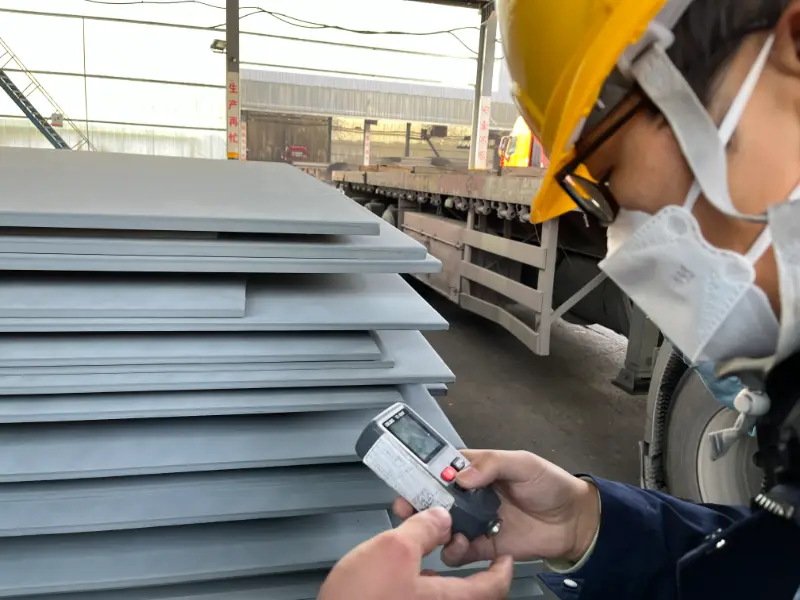
Austenitic 304N (S30451) Stainless Steel
Austenitic 304N (S30451) Stainless Steel - High Strength Nitrogen Enhanced 304 Grade
Explore the properties and applications of 304N (UNS S30451) austenitic stainless steel, a nitrogen-enhanced variant of 304 offering higher strength while maintaining excellent corrosion resistance.
Hot rolling, cold rolling, forming, welding, machining
- Phone : +8618037372205
- Email : [email protected]
- WhatsApp: Contact via Whtsapp
- WeChat: +8618037372205
Austenitic 304N Stainless Steel Introduction
Austenitic 304N (UNS S30451) is a nitrogen-strengthened version of the widely used 304 stainless steel. The deliberate addition of nitrogen (0.10–0.16%) increases the yield and tensile strengths without significantly compromising ductility or corrosion resistance. This grade retains the excellent formability, weldability, and oxidation resistance characteristic of 304, making it suitable for applications requiring higher mechanical properties than standard 304, such as chemical processing equipment, fasteners, and structural components in moderate corrosive environments. It is commonly supplied as plate, sheet, and coil under ASTM A240/A240M. The material is non-magnetic in the annealed condition and can be hardened only by cold working.
Austenitic 304N Stainless Steel Chemical Composition Table
The chemical composition complies with ASTM A240/A240M for grade S30451. Nitrogen is intentionally added to enhance strength while preserving the austenitic structure. All values are maximum unless a range is given. Trace elements are not intentionally added but may be present as residuals.
| Element | Standard Value | Notes |
|---|---|---|
| Carbon (C) | ≤ 0.08 | |
| Manganese (Mn) | ≤ 2.00 | |
| Silicon (Si) | ≤ 0.75 | |
| Phosphorus (P) | ≤ 0.045 | |
| Sulfur (S) | ≤ 0.030 | |
| Chromium (Cr) | 18.0 - 20.0 | |
| Nickel (Ni) | 8.0 - 11.0 | |
| Nitrogen (N) | 0.10 - 0.16 | Critical strengthening element |
Austenitic 304N Stainless Steel Thermal and Electrical Physical Properties
The physical properties are typical for austenitic stainless steel 304N in the annealed condition. These values are not part of the ASTM A240 specification but are derived from standard reference data. They are useful for design calculations involving thermal and electrical performance.
| Property | Typical Value | Unit | Condition |
|---|---|---|---|
| Density (ρ) | 8.0 | g/cm³ | Room temperature |
| Elastic Modulus (E) | 193 | GPa | Room temperature |
| Shear Modulus (G) | 78 | GPa | Calculated |
| Poisson's Ratio (ν) | 0.30 | - | |
| Thermal Expansion Coefficient (α) | 17.2 | µm/m·°C | 0-100°C |
| Thermal Conductivity (λ) | 16.2 | W/m·K | At 100°C |
| Specific Heat Capacity | 500 | J/kg·K | At 20°C |
| Electrical Resistivity (ρe) | 0.72 | µΩ·m | At 20°C |
Austenitic 304N Stainless Steel Mechanical Properties
The mechanical properties below are minimum requirements for annealed plate per ASTM A240/A240M. Tensile testing is performed at room temperature. Higher strengths can be achieved through cold working. The yield strength is measured at 0.2% offset. Elongation is measured in 2 inches (50 mm) gauge length. Hardness values are typical for annealed condition and are not mandatory requirements in the standard.
| Property | Required Value | Unit | Test Condition |
|---|---|---|---|
| Tensile Strength (Rm) | ≥ 515 | MPa | Room temperature, annealed |
| Yield Strength (ReH) 0.2% | ≥ 205 | MPa | Room temperature, annealed |
| Elongation (A) | ≥ 40 | % | In 2 in. (50 mm) gauge |
| Hardness, Brinell | ≤ 201 | HB | Typical reference value, annealed |
| Hardness, Rockwell B | ≤ 92 | HRB | Typical reference value, annealed |
Austenitic 304N Stainless Steel Fully Equivalent Material Standards and Replaceable Grade Recommendations
| Country/Region | Standard | Grade | Remarks |
|---|---|---|---|
| USA | ASTM A240 | S30451 | Original UNS designation |
| Japan | JIS G4304 | SUS304N | Fully equivalent |
| China | GB/T 20878 | 06Cr19Ni10N | Fully equivalent |
| International | ISO 15510 | X5CrNiN19-8 | Matching chemical composition for 304N |
Austenitic 304N Stainless Steel Application Introduction
304N (S30451) combines enhanced strength with good formability and corrosion resistance, making it suitable for a wide range of industries and products. The material can be readily formed, welded, and machined using standard practices for austenitic stainless steel. It is often selected when component design requires higher load-bearing capacity than standard 304, without the added cost and complexity of high-alloy grades. The nitrogen addition also provides improved pitting corrosion resistance in some environments.
Product Applications: Storage tanks and vessels, Heat exchangers, Process piping and equipment, Fasteners (bolts, nuts, screws), Pump and valve components, Architectural panels and cladding, Kitchen equipment and sinks, Dairy and brewing tanks
Processed into products: Flanges, Gaskets, Spring washers, Shaft sleeves, Valve seats, Pressure vessel shells, Structural brackets, Mixing blades
Application industries: Chemical and Petrochemical, Oil and Gas, Food Processing, Dairy, Architectural and Construction, Automotive, Marine, Power Generation
Austenitic 304N Stainless Steel Similar/Alternative Materials Recommendation
| Country/Region | Standard | Grade | Remarks |
|---|---|---|---|
| USA | ASTM A240 | S30400 (304) | Lower strength, no deliberate nitrogen addition; suitable where high strength is not critical |
| USA | ASTM A240 | S30453 (304LN) | Low carbon variant with nitrogen; better sensitization resistance for welding while maintaining strength |
| EU | EN 10088-2 | 1.4315 (X2CrNiN18-7) | Low carbon, nitrogen-bearing; similar corrosion resistance, slightly different strength |
| EU | EN 10088-2 | 1.4301 (X5CrNi18-10) | Standard 304 without nitrogen; lower yield strength |
| USA | ASTM A240 | S31651 (316N) | Molybdenum-bearing variant with nitrogen; higher corrosion resistance and strength |
Notes:
304N may be susceptible to intergranular corrosion if sensitized; avoid prolonged exposure in the 425-850°C range unless low carbon grades are used. For optimal welding results, use of 308N filler metal is recommended. Post-weld annealing may restore corrosion resistance in severe environments. The material is generally non-magnetic in the annealed condition but may become slightly magnetic after cold working.
- Share



