
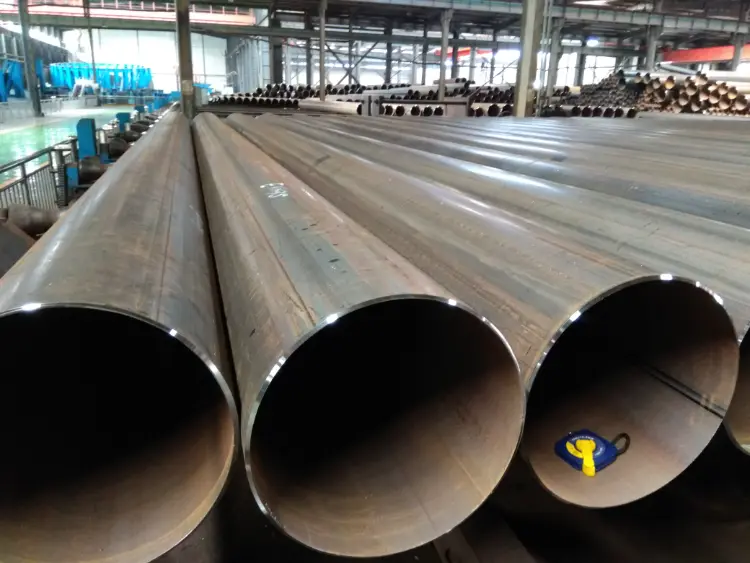
JIS G3101 SS330 LSAW Pipe Material
JIS G3101 SS330 LSAW Pipe Material Data Sheet | General Structural Steel Properties
Comprehensive technical data for JIS G3101 SS330 steel used in LSAW pipe, including chemical composition, mechanical properties, thermal & electrical properties, international equivalents, and application guide.
Welding (LSAW, SAW), cold/hot forming, bending, machining, drilling, flame cutting
- Phone : +8618037372205
- Email : [email protected]
- WhatsApp: Contact via Whtsapp
- WeChat: +8618037372205
JIS G3101 SS330 LSAW Pipe Material Introduction
SS330 is a hot-rolled general structural carbon steel specified in JIS G3101 (Japan). It is characterized by a minimum tensile strength of 330 MPa and excellent weldability, making it suitable for a wide range of structural and engineering applications. The SS330 grade is extensively used as the base material for manufacturing LSAW (Longitudinal Submerged Arc Welded) pipes, serving as columns, piles, penstocks, and pressure piping. It offers good formability, ductility, and machinability, with no strict compositional limits except for maximum phosphorus and sulfur contents, ensuring consistent performance in welded structures.
JIS G3101 SS330 LSAW Pipe Material Chemical Composition
According to JIS G3101, the chemical composition for SS330 is not specified except for phosphorus and sulfur. Other elements such as carbon, manganese, and silicon are generally at levels typical of low-carbon steel but are not controlled by the standard. The loose specifications aid weldability and formability, while keeping costs low.
| Element | Standard Value (max, %) | Remarks |
|---|---|---|
| P | 0.050 | Maximum allowed |
| S | 0.050 | Maximum allowed |
| Others (C, Si, Mn, etc.) | Not specified | Typically low carbon (<0.15%) and moderate manganese |
JIS G3101 SS330 LSAW Pipe Material Thermal & Electrical Physical Properties
The table below provides typical physical property data for low-carbon structural steels similar to SS330. These values are not mandated by JIS G3101 but are widely accepted engineering references. Actual properties may vary slightly with exact composition and manufacturing route.
| Property | Typical Value | Unit | Test Condition |
|---|---|---|---|
| Density (ρ) | 7.85 | g/cm³ | At 20°C |
| Elastic Modulus (E) | 200 – 210 | GPa | At 20°C, static loading |
| Shear Modulus (G) | ~ 80 | GPa | Calculated from E and ν |
| Poisson's Ratio (ν) | 0.29 – 0.30 | - | At 20°C |
| Thermal Expansion Coefficient (α) | 11.7 – 12.1 | ×10⁻⁶ /K | 20°C to 100°C |
| Thermal Conductivity (λ) | 48 – 54 | W/(m·K) | At 20°C |
| Specific Heat Capacity | 480 – 510 | J/(kg·K) | At 20°C |
| Electrical Resistivity (ρₑ) | 0.16 – 0.20 | μΩ·m | At 20°C |
JIS G3101 SS330 LSAW Pipe Material Mechanical Properties
Mechanical properties for SS330 sheets, plates, and strips as specified in JIS G3101. The tensile test is mandatory, while the bend test is required for thicknesses ≤ 16 mm unless otherwise agreed. Yield strength is not a standard requirement but is typically in the range 205–245 MPa for design purposes.
| Property | Standard Required Value | Unit | Test Condition |
|---|---|---|---|
| Tensile Strength (Rm) | 330 – 430 | MPa | At room temperature, full-section or flat specimen |
| Elongation (A) – thickness ≤ 5 mm | ≥ 26 | % | No. 5 specimen, gauge length 50 mm |
| Elongation (A) – thickness > 5 mm to ≤ 16 mm | ≥ 21 | % | No. 1A specimen, gauge length 200 mm |
| Elongation (A) – thickness > 16 mm to ≤ 50 mm | ≥ 26 | % | No. 1A specimen (thickness reduction not applied) |
| Bend Test (Bend Radius, Thickness ≤ 16 mm) | 180° bent around a mandrel of diameter equal to plate thickness without cracking | - | No tension side cracks allowed |
| Impact Energy (KV) | Not required by standard | - | - |
JIS G3101 SS330 LSAW Pipe Material Completely Equivalent Material Standards & Replaceable Grades
| Country/Region | Standard | Grade | Remarks |
|---|---|---|---|
| Japan | JIS G3101 | SS330 | Original designation; also former JIS SS34 |
| ISO (obsolete) | ISO 630 | HR330 (Fe330) | Old ISO grade; replaced by current structural steel standards. Not fully identical. |
JIS G3101 SS330 LSAW Pipe Material Application Introduction
SS330 LSAW pipe is employed where a reliable, weldable structural steel with a guaranteed tensile strength of 330 MPa is needed. Its liberal compositional limits and inherent toughness suit a variety of fabrication processes. The following industries and applications are typical:
Product Applications: LSAW steel pipes (Line pipes, piling pipes), Structural tubular sections, Pressure vessels & storage tanks, Building columns & beams, Bridge caissons & substructures, Hydro-power penstocks, Steel sheet piling
Processed into products: Pipe spools & elbows, Flanges & fittings, Gusset plates & stiffeners, Brackets & support frames, Manholes, Wind tower shell segments, Pile guide frames
Application industries: Construction & Infrastructure, Shipbuilding & Marine Structures, Oil & Gas (onshore/offshore piping), Water & Sewage Transmission, Mechanical Engineering & Machinery, Bridge Engineering, Renewable Energy (wind turbine towers, penstocks)
JIS G3101 SS330 LSAW Pipe Material Recommended Similar / Alternative Materials
| Country/Region | Standard | Grade | Remarks |
|---|---|---|---|
| China | GB/T 700 | Q235B | Tensile strength 370–500 MPa, widely used for general structures; often weldable equivalent. |
| USA | ASTM A283/A283M | Grade C | Tensile strength 380–515 MPa; slightly higher strength class, suitable for similar applications. |
| USA | ASTM A36/A36M | A36 | Tensile strength 400–550 MPa; common structural steel, may need derating for SS330 specification. |
| EU | EN 10025-2 | S235JR | Minimum yield 235 MPa, tensile 360–510 MPa; widely accepted substitute with property adjustments. |
| India | IS 2062 | E250 (Fe 410) Type A | Tensile strength ~410 MPa, close in weldability but stronger. |
Notes:
LSAW pipe specific remarks: When SS330 plates are formed and welded into LSAW pipes, the pipe standard (e.g., API 5L, JIS G3444, JIS G3452) may impose additional testing such as hydrostatic pressure tests, non-destructive examination, and impact requirements that are not part of JIS G3101. For critical applications, supplementary requirements on carbon equivalent (CEV) and notch toughness are recommended. Always consult the relevant pipe delivery specification for complete requirements.
- Share



