
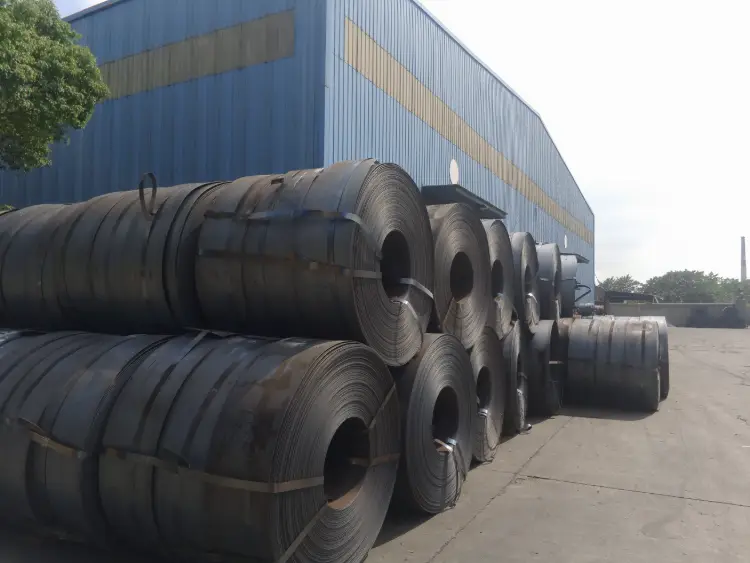
CCS FQ70 Shipbuilding Steel Coil
CCS FQ70 Shipbuilding Steel Coil: Ultra-High Strength Q&T Marine Structural Plate
Complete data sheet for CCS FQ70 shipbuilding steel coil: chemical composition, mechanical properties, physical properties, equivalent grades and application guide for 690 MPa yield strength quenched & tempered plate used in hulls and offshore structures.
Quenching and tempering (Q+T), hot rolling, cutting, bending, welding (with proper procedures)
- Phone : +8618037372205
- Email : [email protected]
- WhatsApp: Contact via Whtsapp
- WeChat: +8618037372205
CCS FQ70 Shipbuilding Steel Coil Introduction
CCS FQ70 is an ultra-high-strength structural steel approved by China Classification Society (CCS), intended for critical shipbuilding and offshore applications. Supplied in the quenched and tempered condition, it features a minimum yield strength of 690 MPa and tensile strength of 770–940 MPa for thicknesses up to 50 mm. The steel is characterized by a low carbon content (C ≤ 0.18) and a microalloyed design (Nb, V, Ti) that ensures fine-grained microstructure, high strength, and excellent low-temperature toughness. Impact energy of at least 46 J at -60 °C (longitudinal) guarantees reliable performance in arctic and harsh marine environments. Good weldability is achieved when proper preheating and interpass temperature control are applied.
This grade is equivalent to FH690 under GB 712-2011 and is recognized by major classification societies (DNV, ABS, LR). Typical delivery condition is coil, plate, or strip in quenched and tempered state. It is used for decks, bulkheads, leg sections of jack-up rigs, and heavy-duty crane booms, where high strength combined with weight savings and low-temperature toughness is essential.
CCS FQ70 Shipbuilding Steel Coil Chemical Composition
The chemical composition of CCS FQ70 steel is controlled to meet the requirements of CCS Rules for Materials and Welding. The low carbon content ensures good weldability, while additions of manganese, nickel, chromium, molybdenum, and microalloying elements (niobium, vanadium, titanium) contribute to grain refinement, precipitation strengthening, and excellent toughness. Nitrogen and aluminum are controlled to obtain fine austenite grain size. Carbon equivalent (Ceq) shall be in accordance with the specification, typically ≤0.53% for thickness ≤50 mm.
| Element | Specified Value (max or range) | Remarks |
|---|---|---|
| C | ≤ 0.18 | Ladle analysis |
| Si | ≤ 0.55 | |
| Mn | ≤ 1.60 | |
| P | ≤ 0.025 | |
| S | ≤ 0.025 | |
| Cr | ≤ 0.20 | |
| Ni | ≤ 0.40 | |
| Mo | ≤ 0.08 | |
| Cu | ≤ 0.35 | |
| Nb | ≤ 0.05 | |
| V | ≤ 0.10 | |
| Ti | ≤ 0.02 | |
| Al (acid soluble) | ≥ 0.015 | For grain refinement |
| N | ≤ 0.012 | |
| Ceq | ≤ 0.53 (typical) | Depending on thickness and standard |
CCS FQ70 Shipbuilding Steel Coil Physical Properties
Typical physical properties for Q&T high-strength low-alloy steel of this grade. Values are indicative and may vary slightly depending on the exact composition and heat treatment. These data are useful for design calculations, thermal analysis, and welding simulation.
| Property | Typical Value | Unit | Condition / Temperature |
|---|---|---|---|
| Density (ρ) | 7850 | kg/m³ | At 20 °C |
| Modulus of elasticity (E) | 210 | GPa | At 20 °C |
| Shear modulus (G) | approx. 80 | GPa | Calculated |
| Poisson's ratio (ν) | 0.3 | — | |
| Thermal expansion (α) | 11.5 × 10⁻⁶ | K⁻¹ | 20–100 °C |
| Thermal conductivity (λ) | 45 | W/(m·K) | At 20 °C |
| Specific heat capacity | 460 | J/(kg·K) | At 20 °C |
| Electrical resistivity (ρ_e) | 0.25 × 10⁻⁶ | Ω·m | At 20 °C |
CCS FQ70 Shipbuilding Steel Coil Mechanical Properties
The mechanical properties below are specified in CCS Rules. Yield strength and tensile strength values depend on the product thickness. Elongation is measured on a gauge length of 5.65√So (or 200 mm) in the longitudinal direction. Bending test is performed with a mandrel diameter of 3 times the specimen thickness (180° bend). Charpy V-notch impact energy is guaranteed at -60 °C in the longitudinal direction. For thicknesses >100 mm, properties are subject to agreement.
| Property | Standard Requirement | Unit | Test Condition / Remarks |
|---|---|---|---|
| Yield strength (ReH) | ≥ 690 | MPa | t ≤ 50 mm, transverse test piece |
| Yield strength (ReH) | ≥ 670 | MPa | 50 mm < t ≤ 100 mm, transverse test piece |
| Tensile strength (Rm) | 770 – 940 | MPa | t ≤ 50 mm, transverse test piece |
| Tensile strength (Rm) | 700 – 930 | MPa | 50 mm < t ≤ 100 mm, transverse test piece |
| Elongation (A) | ≥ 14 | % | Longitudinal, gauge length 5.65√So (or 200 mm), all thicknesses |
| Bending test (180°) | d = 3a | — | Mandrel diameter = 3× thickness, no cracks |
| Impact energy (KV2) | ≥ 46 | J | At -60 °C, longitudinal Charpy V-notch, average of 3 specimens |
CCS FQ70 Shipbuilding Steel Coil Fully Equivalent Material Standards and Substitutable Grades
The following grades are recognized as direct equivalents to CCS FQ70 (or FH690) with the same strength level and low-temperature impact toughness requirement at -60 °C. Slight differences in chemical composition limits may exist, but mechanical properties are essentially interchangeable for shipbuilding and offshore applications.
| Country / Region | Standard | Grade | Remarks |
|---|---|---|---|
| China / CCS | CCS Rules | FQ70 / FH690 | Original specification, quenched & tempered |
| China / GB | GB 712-2011 | FH690 | Equivalent national standard grade |
| International (DNV) | DNV Rules | FH690 | Det Norske Veritas classification |
| International (ABS) | ABS Rules | FH690 | American Bureau of Shipping classification |
| International (LR) | LR Rules | FH690 | Lloyd's Register classification |
| Europe | EN 10025-6 | S690QL1 | Quenched & tempered, impact at -60 °C; consult chemical limits |
| USA | ASTM A514/A514M | Grade S (modified) | Quenched & tempered, may require supplementary requirement for -60 °C impact |
CCS FQ70 Shipbuilding Steel Coil Application Introduction
CCS FQ70 steel is engineered for heavy-duty marine and offshore constructions that require high strength-to-weight ratio and reliable low-temperature toughness. Its combination of minimum yield strength of 690 MPa and guaranteed impact energy at -60 °C makes it suitable for critical structural components in harsh environments. Proper welding practices, including low-hydrogen processes, preheating, and controlled interpass temperature, are essential to maintain the steel's properties in welded joints.
Product Applications: Container ship and bulk carrier hulls, Jack-up rig legs and spudcans, Semi-submersible platform columns and braces, Crane booms and heavy-lift structures, Ice-breaker reinforcement plates
Processed into products: Main deck and shell plates, Longitudinal and transverse bulkheads, Bottom and side stiffeners, Bracket plates and stringers, Welded leg sections (box-type or tubular), Transition pieces in offshore wind foundations
Application industries: Shipbuilding, Offshore Engineering, Heavy Lifting Equipment, Port Machinery, Arctic and Cold-Region Structures
CCS FQ70 Shipbuilding Steel Coil Near-Similar / Alternative Grades with Comparable Strength
The following grades offer similar minimum yield strength (690 MPa) but may differ in impact test temperature or other properties. They can be considered as alternatives where full CCS certification is not mandatory, provided the service temperature and toughness requirements are satisfied.
| Country / Region | Standard | Grade | Remarks |
|---|---|---|---|
| Europe | EN 10025-6 | S690Q | Minimum impact at -20 °C, lower toughness |
| Europe | EN 10025-6 | S690QL | Minimum impact at -40 °C |
| USA | ASTM A514/A514M | Grade Q | Impact typically at -46 °C, may need verification for -60 °C |
| China | GB/T 16270 | Q690D | Minimum impact at -20 °C, high strength structural steel |
| China | GB/T 16270 | Q690E | Minimum impact at -40 °C, high strength structural steel |
Notes:
Welding: Low hydrogen processes (SMAW, SAW, FCAW, GMAW) are recommended with suitable welding consumables matching the base metal strength. Typical preheat temperature is 100–150 °C, and interpass temperature should be maintained below 200 °C to avoid excessive grain growth. Post-weld heat treatment (PWHT) is generally not required for thicknesses up to 50 mm but may be applied for thicker sections after qualified procedure tests. The steel can be supplied with through-thickness property requirements (Z35) for improved lamellar tearing resistance when specified. During forming and bending, adequate bend radii shall be observed to avoid cracking. Consult the CCS rules and plate manufacturer's recommendations for detailed fabrication guidelines.
- Share



