
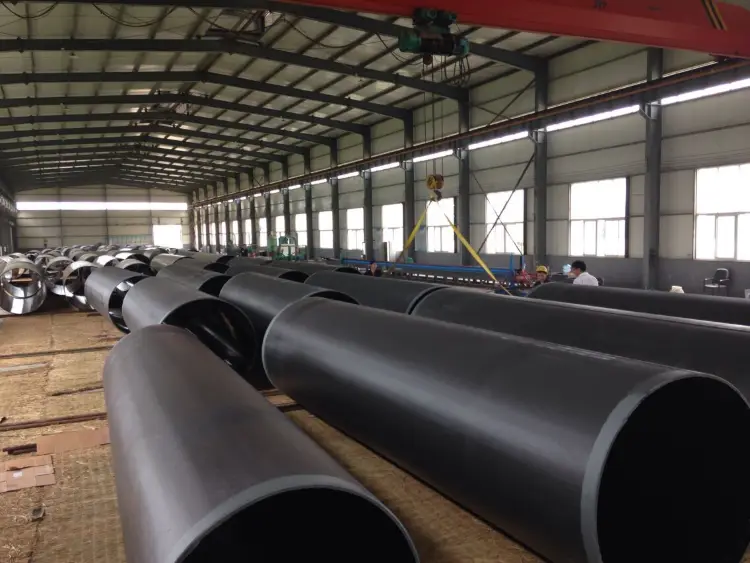
ASTM A500 Grade C SHS/RHS Pipe
ASTM A500 Grade C SHS/RHS Pipe: Superior Structural Hollow Sections for Global Engineering
In-depth technical profile of ASTM A500 Grade C cold-formed welded steel structural tubing in square (SHS) and rectangular (RHS) shapes. Explore chemical composition, mechanical & thermal properties, equivalent grades, and application insights.
Cold-formed, electric-resistance welded (ERW) or seamless; can be further processed by cutting, drilling, welding, galvanizing, and coating.
- Phone : +8618037372205
- Email : [email protected]
- WhatsApp: Contact via Whtsapp
- WeChat: +8618037372205
ASTM A500 Grade C SHS/RHS Pipe Introduction
ASTM A500 Grade C is a high-strength, cold-formed welded and seamless carbon steel structural tubing widely available in square (SHS) and rectangular (RHS) hollow sections. Key characteristics:
- Minimum yield strength of 345 MPa (50 ksi) and tensile strength of 425 MPa (62 ksi), making it suitable for demanding structural applications.
- Excellent weldability, formability, and tight dimensional tolerances inherent to the cold-forming process.
- Enhanced resistance to deformation under load, commonly used in building columns, bridges, machinery frames, and general construction.
- Can be supplied with optional copper content (min 0.20%) to improve atmospheric corrosion resistance when specified.
It is produced to meet strict requirements for chemical composition, tensile properties, and, when required, flattening and flare tests, ensuring reliable performance in diverse environments.
ASTM A500 Grade C SHS/RHS Pipe Chemical Composition
The chemical requirements for ASTM A500 Grade C are designed to ensure consistent mechanical properties and weldability. Key points:
- Maximum carbon and manganese contents are limited to maintain ductility and toughness.
- Phosphorus and sulfur are kept low to avoid brittleness.
- Copper is not mandatory but when copper-bearing steel is specified, a minimum of 0.20% improves atmospheric corrosion resistance.
Values shown are heat analysis limits according to ASTM A500/A500M.
| Element | Standard Value (max, unless range given) | Remarks |
|---|---|---|
| Carbon (C) | 0.23% | Maximum |
| Manganese (Mn) | 1.35% | Maximum |
| Phosphorus (P) | 0.035% | Maximum |
| Sulfur (S) | 0.035% | Maximum |
| Copper (Cu) | 0.20% min (when specified) | Optional; required only if copper-bearing steel is ordered |
ASTM A500 Grade C SHS/RHS Pipe Physical and Electrical Properties
The data below are typical for carbon steels in the as-rolled or normalized condition and are provided for general design guidance. Note: These values are not specified in ASTM A500 and may vary slightly with actual mill practice and temperature.
- Density standard for carbon steel is 7.85 g/cm³.
- Elastic moduli and Poisson's ratio are applicable at room temperature.
- Thermal expansion coefficient and thermal conductivity are average values over the indicated temperature ranges.
| Property | Typical Value | Unit | Condition / Temperature |
|---|---|---|---|
| Density (ρ) | 7.85 | g/cm³ | Room temperature |
| Modulus of Elasticity (E) | 200 | GPa | Room temperature |
| Shear Modulus (G) | 77.2 | GPa | Room temperature (calculated from E and ν) |
| Poisson's Ratio (ν) | 0.29 | - | Room temperature |
| Coefficient of Thermal Expansion (α) | 11.7 | 10⁻⁶/K | 20–100 °C |
| Coefficient of Thermal Expansion (α) | 12.6 | 10⁻⁶/K | 20–300 °C |
| Thermal Conductivity (λ) | 51.9 | W/(m·K) | Room temperature |
| Specific Heat Capacity | 486 | J/(kg·K) | Room temperature |
| Electrical Resistivity (ρe) | 0.159 | µΩ·m | Room temperature |
ASTM A500 Grade C SHS/RHS Pipe Mechanical Properties
Tensile properties are the primary acceptance criteria for ASTM A500 Grade C. The minimum values apply to the full section and are determined in accordance with ASTM A370.
- Yield strength is the stress at 0.5% total extension under load.
- Elongation is measured over a 2 in. (50.8 mm) gauge length and varies with wall thickness.
- The cold-formed tubing exhibits some increase in strength due to work hardening; however, the tabulated minima are guaranteed.
Bend tests are not mandatory for tube intended for structural use unless supplementary requirements are invoked, hence no standard values are listed.
| Property | Standard Requirement (min) | Unit | Test Condition |
|---|---|---|---|
| Yield Strength (ReH) | 345 | MPa | Transverse or longitudinal strip test, 0.5% extension under load |
| Yield Strength (ReH) | 50 | ksi | Transverse or longitudinal strip test, 0.5% extension under load |
| Tensile Strength (Rm) | 425 | MPa | Transverse or longitudinal strip test |
| Tensile Strength (Rm) | 62 | ksi | Transverse or longitudinal strip test |
| Elongation (A) | 21 | % | Gauge length 2 in. (50.8 mm); wall thickness ≤ 0.750 in. (19.0 mm) |
| Elongation (A) | 23 | % | Gauge length 2 in. (50.8 mm); wall thickness > 0.750 in. (19.0 mm) |
ASTM A500 Grade C SHS/RHS Pipe Fully Equivalent Material Standards and Replacement Grades
| Country/Region | Standard | Grade/Designation | Remarks |
|---|---|---|---|
| United States | ASTM A500/A500M | Grade C | Original specification; SHS/RHS tubing |
| European Union | EN 10210-1 | S355J2H | Hot-finished structural hollow sections; equivalent strength and typical chemistry match when Charpy limits (J2) are met |
| Japan | JIS G 3466 | STKR490 | Square/Rectangular carbon steel tubes; tensile properties similar; verify dimensional tolerances |
| China | GB/T 6728 | Q345D (SHS/RHS) | Cold-formed hollow sections; 345 MPa yield category; ensure Charpy and dimension requirements align |
ASTM A500 Grade C SHS/RHS Pipe Application Introduction
ASTM A500 Grade C SHS/RHS tubing delivers an optimal balance of strength, ductility, and fabrication versatility. Selection guidelines:
- Ideal for columns, trusses, and frames where weight reduction is critical while maintaining load-bearing capacity.
- Excellent for dynamic and fatigue loaded structures due to its uniform wall thickness and absence of sharp corners.
- Can be confidently welded with common processes (SMAW, GMAW, FCAW) using matching strength electrodes (e.g., E70XX series).
- For corrosive environments, specify copper-bearing chemistry or apply protective coatings (galvanizing, painting).
Product Applications: Building columns and truss chords, Telescopic boom sections for cranes, Trailer and truck chassis members, Solar tracker torque tubes and mounting structures, Stadium canopies and airport terminal frameworks, Pedestrian and vehicular bridge girders
Processed into products: Welded beam-to-column connections, End plates and base plates for hollow section columns, Truss nodes and bracing elements, Machinery frames subjected to bending and torsion, Drilling rig substructures, Automated storage and retrieval system (AS/RS) rack legs
Application industries: Commercial and industrial building construction, Bridge and highway infrastructure, Agricultural and construction equipment manufacturing, Renewable energy (wind turbine towers, solar support structures), Offshore and marine structural components, Railway rolling stock and heavy vehicle frames
ASTM A500 Grade C SHS/RHS Pipe Near-Equivalent and Substitute Materials
| Country/Region | Standard | Grade/Designation | Remarks |
|---|---|---|---|
| International | ISO 630-2 | S355J0 / S355J2 (plates) | Plate grades used for fabricated box sections; comparable strength but need to consider weld procedures |
| India | IS 4923 | YSt 355 (hollow sections) | Similar yield strength; chemistry may differ slightly; confirm with mill certificate |
| United States | ASTM A501 | Grade C | Hot-formed structural tubing; similar strength but different manufacturing route; may need design adjustments |
| United States | ASTM A1085 | Grade 50 | Improved toughness and tighter chemistry; can replace A500 Grade C with enhanced performance |
Notes:
Supplementary Requirements: ASTM A500 Grade C tubing may be ordered with optional Charpy V-notch impact tests (e.g., at -20 °C, 27 J minimum) if required for low-temperature service. Dimensional tolerances (wall thickness, straightness, twist, corner radii) are defined in the standard and are critical for fabrication. When welding pre-galvanized or copper-bearing steel, special procedures may be needed to prevent porosity. Certification: Mill test reports are mandatory, showing chemical analysis and tensile results traceable to the heat. For international projects, it is recommended to cross-check the specific requirements of the structural design code (e.g., AISC 360, Eurocode 3) before substitution.
- Share



