
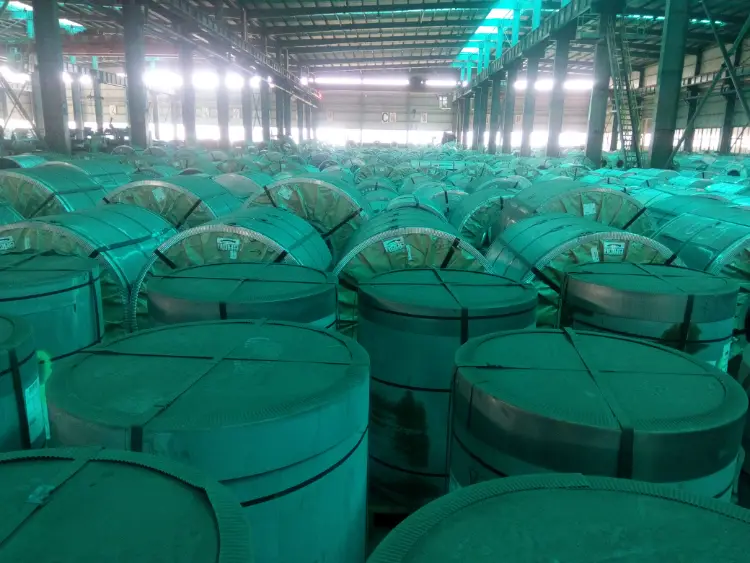
CCS FQ63 Shipbuilding Steel Coil
CCS FQ63 Shipbuilding Steel Coil - High-Strength Quenched & Tempered Marine Steel for Extreme Cold Environments
Explore the comprehensive data sheet of CCS FQ63 shipbuilding steel coil: chemical composition, mechanical properties, physical characteristics, international equivalents, and typical applications in ship hulls and offshore structures under low-temperature service conditions.
Hot rolling, cold forming, welding, cutting, machining, heat treatment (quenching and tempering applied at the mill)
- Phone : +8618037372205
- Email : [email protected]
- WhatsApp: Contact via Whtsapp
- WeChat: +8618037372205
CCS FQ63 Shipbuilding Steel Coil Introduction
CCS FQ63 is a high-strength, quenched and tempered shipbuilding structural steel grade certified by the China Classification Society (CCS). It belongs to the F-series of extra-high-strength steels with a minimum yield strength of 620 MPa (63 kgf/mm²). The prefix "F" indicates that the steel has been proven to meet stringent impact toughness requirements down to -60°C, making it ideal for critical components in Arctic-class vessels and offshore platforms. The material is delivered in the quenched and tempered (Q+T) condition, offering an excellent combination of high strength, low-temperature toughness, and weldability. It is typically supplied as plates, strips, or coils for the fabrication of hull structures, decks, and high-stress joints. The balanced chemistry with controlled micro-alloying elements such as niobium, vanadium, and titanium ensures fine grain size and superior mechanical properties after proper heat treatment. Its performance is strictly governed by the CCS Rules for Materials and Welding, ensuring full compliance with international marine safety standards.
CCS FQ63 Shipbuilding Steel Coil Chemical Composition
The chemical composition of CCS FQ63 is carefully designed to achieve high strength and excellent low-temperature toughness. The ladle analysis conforms to CCS requirements. The steel is micro-alloyed with Nb, V, and Ti for grain refinement and precipitation strengthening. Additionally, the carbon equivalent (CEV) is typically controlled to ensure good weldability, usually ≤ 0.50% by the IIW formula.
| Element | Specified Value (max unless range) | Remarks |
|---|---|---|
| Carbon (C) | 0.18% | Ladle analysis |
| Silicon (Si) | 0.10 – 0.55% | Ladle analysis |
| Manganese (Mn) | 0.90 – 1.60% | Ladle analysis |
| Phosphorus (P) | 0.025% | Ladle analysis |
| Sulfur (S) | 0.025% | Ladle analysis |
| Chromium (Cr) | 0.20% | Due to delivery condition, may be restricted further |
| Nickel (Ni) | 0.40% | May be increased for improved toughness |
| Molybdenum (Mo) | 0.08% | Residual element |
| Copper (Cu) | 0.35% | Residual element |
| Aluminium (Al) total | ≥ 0.015% | Grain refining element |
| Niobium (Nb) | 0.02 – 0.05% | Grain refinement and precipitation strengthening |
| Vanadium (V) | 0.05 – 0.10% | Precipitation strengthening |
| Titanium (Ti) | 0.02% | Grain refinement and nitrogen fixation |
| Nitrogen (N) | 0.012% | Residual element |
| Boron (B) | ≤ 0.0005% | Optional, may be used for hardenability |
CCS FQ63 Shipbuilding Steel Coil Thermal and Electrical Physical Properties
The physical property data are typical values for quenched and tempered low-alloy carbon steels and can be used for engineering calculations. Properties such as thermal expansion coefficient and thermal conductivity vary with temperature; representative values at room temperature and at elevated temperatures are provided. These data are not part of the mandatory classification requirements but are derived from published material handbooks.
| Property | Typical Value | Unit | Test Condition / Temperature |
|---|---|---|---|
| Density (ρ) | 7.85 | g/cm³ | Room temperature |
| Elastic Modulus (E) | 205 | GPa | Room temperature |
| Shear Modulus (G) | 80 | GPa | Room temperature |
| Poisson's Ratio (ν) | 0.3 | — | Room temperature |
| Thermal Expansion Coefficient (α) | 11.7 × 10⁻⁶ | 1/K | 20–100°C |
| Thermal Expansion Coefficient (α) | 12.5 × 10⁻⁶ | 1/K | 20–200°C |
| Thermal Expansion Coefficient (α) | 13.2 × 10⁻⁶ | 1/K | 20–300°C |
| Thermal Conductivity (λ) | 42 | W/(m·K) | Room temperature |
| Specific Heat Capacity (Cp) | 475 | J/(kg·K) | Room temperature |
| Electrical Resistivity (ρe) | 0.22 × 10⁻⁶ | Ω·m | Room temperature |
CCS FQ63 Shipbuilding Steel Coil Mechanical Properties
The mechanical properties are valid for quenched and tempered material with thickness up to 100 mm. Transverse specimens may show slightly lower elongation values. Impact testing at -60°C ensures that the steel retains its toughness under extreme cold, which is essential for ice-strengthened ships. The bending test is performed with a mandrel diameter of 3t, and the surface must be free from cracks after 180° bending.
| Property | Specified Value | Unit | Test Condition |
|---|---|---|---|
| Yield Strength (ReH) | ≥ 620 | MPa | Ambient temperature, longitudinal direction |
| Tensile Strength (Rm) | 720 – 890 | MPa | Ambient temperature, longitudinal direction |
| Elongation (A5) | ≥ 15 | % | Longitudinal, gauge length L0 = 5.65√So |
| Elongation (A5) | ≥ 13 | % | Transverse |
| Bend Test (180°) | No cracks | — | Mandrel diameter = 3 × thickness (t) |
| Charpy V-notch (KV2) | ≥ 31 | J | Longitudinal, -60°C |
| Charpy V-notch (KV2) | ≥ 22 | J | Transverse, -60°C |
| Charpy V-notch (KV2) | ≥ 41 | J | Some classification societies may require minimum single value of 41 J for longitudinal |
CCS FQ63 Shipbuilding Steel Coil Completely Equivalent Material Standards and Replaceable Grades
| Country / Region | Standard / Society | Grade | Remarks |
|---|---|---|---|
| International | DNV | FQ63 | Det Norske Veritas – same property requirements |
| International | ABS | FQ63 | American Bureau of Shipping – identical classification |
| International | LR | FQ63 | Lloyd's Register – fully compatible |
| International | BV | FQ63 | Bureau Veritas – equivalent specifications |
| International | NK | FQ63 | ClassNK – same yield strength and toughness level |
| International | KR | FQ63 | Korean Register – interchangeable for marine structures |
| International | RINA | FQ63 | Registro Italiano Navale – same strength class |
CCS FQ63 Shipbuilding Steel Coil Application Introduction
CCS FQ63 steel is specifically developed for the most demanding marine and offshore applications where high strength and outstanding low-temperature notch toughness are mandatory. It is widely accepted by all major classification societies for use in Arctic-class vessels, icebreakers, and deep-water platforms. The material offers good weldability when appropriate low-hydrogen welding consumables and preheat procedures are employed, making it suitable for large welded structures. Typical fabrication methods include thermal cutting, cold forming, and machining. Post-weld heat treatment is generally not required for this grade if the proper welding parameters are followed.
Product Applications: Hull plates and stiffeners, Deck panels and bulkheads, Structural sections (angles, channels, built-up girders), Pressure hulls for submersibles, Sea-fastening and lifting points, Flame-cut parts for ship frames and brackets
Processed into products: Shell plating for ice belts, Transverse frames, floors, and girders, Hatch coamings and covers, Bracket connections for high stress concentration areas, Rudder horns and skegs, Offshore crane pedestal rings, Connections in flare booms or helideck supports, Fatigue-critical nodes in tubular structures
Application industries: Shipbuilding (Arctic cargo ships, LNG carriers, ice-going tankers), Offshore oil & gas (jack-up rigs, semi-submersibles, production platforms), Naval and defense (ice-strengthened patrol vessels, military icebreakers), Heavy engineering (crane structures, mining equipment operating in cold regions), Renewable energy (offshore wind turbine foundations in sub-arctic seas)
CCS FQ63 Shipbuilding Steel Coil Similar or Closely Matching Alternative Materials
| Country / Region | Standard / Society | Grade | Remarks |
|---|---|---|---|
| China | GB/T 712 | EH620 | Similar yield strength, but delivery condition may be TMCP or QT; toughness at -40°C |
| Europe | EN 10025-6 | S690QL | Structural steel with 690 MPa tensile; Q+T condition; comparable toughness (down to -40°C or -60°C with special agreement) |
| International | ASTM / AISI | A514 Grade E / A517 | High-strength quenched and tempered plate, but no specific marine classification unless approved |
| Russia | GOST R 52927 | F620W | Russian analogue for low-temperature high-strength hull steel; equivalent tensile class |
Notes:
- All values comply with the latest edition of the CCS Rules for Materials and Welding.
- When ordering, the steelmaker should be informed about any supplementary requirements (e.g., Z-grade thickness reduction, ultrasonic testing, toughness at -70°C).
- For thicknesses above 50 mm, additional testing or a more restricted chemistry may be required by the classification society.
- Welding should be carried out in accordance with approved procedures using consumables that match the strength and toughness requirements of the base metal.
- The carbon equivalent (CEV) is typically ≤0.50% to ensure cold-cracking resistance during welding.
- Share



