
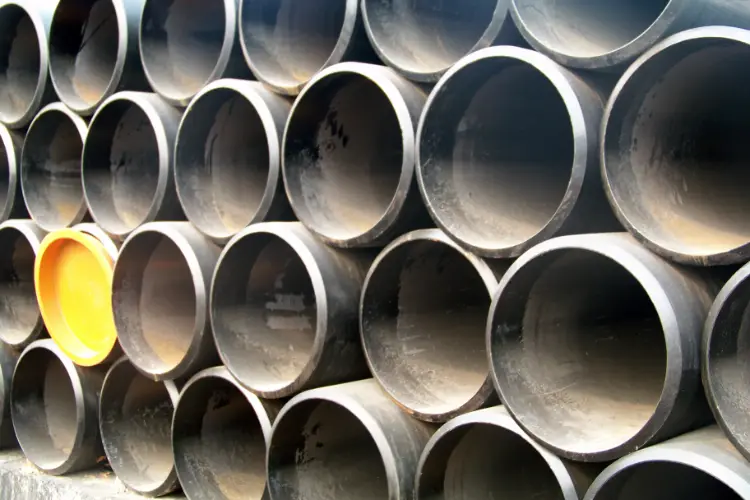
EN 10219 S460MLH SHS/RSH Pipe
EN10219 S460MLH SHS/RSH Pipe: High-Strength Fine-Grain Structural Steel for Cold-Formed Welded Hollow Sections
Explore EN10219 S460MLH steel for SHS/RSH pipes: chemical composition, mechanical and physical properties, international equivalents, and application guide.
Suitable for cold forming, welding (all common methods), hot-dip galvanising. Machining and cutting processes can be applied. Due to thermomechanical rolling, hot forming above 580°C may alter mechanical properties.
- Phone : +8618037372205
- Email : [email protected]
- WhatsApp: Contact via Whtsapp
- WeChat: +8618037372205
EN 10219 S460MLH SHS/RSH Pipe Introduction
S460MLH is a weldable fine-grain structural steel grade defined in EN 10219-1 for cold-formed welded structural hollow sections. The designation S indicates structural steel, 460 specifies the minimum yield strength in MPa, M stands for thermomechanical rolling, L denotes low-temperature impact testing at -50°C, and H confirms suitability for hollow sections. Produced from hot-rolled strip/plate via cold forming and welding, this steel offers an excellent combination of high strength, good weldability, and guaranteed toughness down to -50°C.
Key characteristics:
- Minimum yield strength: 460 MPa (t ≤ 16 mm)
- Tensile strength range: 540–720 MPa
- Good ductility with elongation ≥17%
- Reliable impact energy of ≥27 J at -50°C
- Fine-grain structure achieved by thermomechanical processing (no normalising required after welding under proper conditions)
Typical delivery condition is as-rolled and welded, with hollow sections available in square (SHS) and rectangular (RSH) profiles. S460MLH is widely used in demanding structural applications such as bridges, offshore platforms, cranes, and high-rise buildings where weight savings and low-temperature toughness are critical.
EN 10219 S460MLH SHS/RSH Pipe Chemical Composition
The chemical composition of S460MLH is inherited from the parent strip/plate conforming to EN 10025-4 S460ML. Fine-grain elements (Nb, V, Ti) are controlled to ensure the required strength and toughness. The maximum carbon content is limited to provide good weldability, and the carbon equivalent (CEV) is typically ≤ 0.45 for thicknesses ≤ 16 mm. Total aluminium is specified to guarantee sufficient nitrogen fixation.
| Element | Standard Value (Heat Analysis, max %) | Remarks |
|---|---|---|
| Carbon (C) | ≤ 0.16 | Depending on thickness; for t ≤ 16 mm |
| Silicon (Si) | ≤ 0.60 | Max for fine-grain steel |
| Manganese (Mn) | ≤ 1.70 | Contributes to strength and hardenability |
| Phosphorus (P) | ≤ 0.030 | |
| Sulfur (S) | ≤ 0.025 | |
| Niobium (Nb) | ≤ 0.05 | Grain refiner |
| Vanadium (V) | ≤ 0.12 | Further grain refinement and precipitation strengthening |
| Aluminium (Al total) | ≥ 0.020 | Minimum for nitrogen binding |
| Titanium (Ti) | ≤ 0.05 | Optional grain refiner |
| Chromium (Cr) | ≤ 0.30 | Residual element |
| Nickel (Ni) | ≤ 0.80 | Residual, may improve toughness |
| Molybdenum (Mo) | ≤ 0.20 | |
| Copper (Cu) | ≤ 0.55 | |
| Nitrogen (N) | ≤ 0.025 | Maximum for bound and free nitrogen |
EN 10219 S460MLH SHS/RSH Pipe Thermal and Electrical Physical Properties
The following physical properties are approximate room-temperature values for thermomechanically rolled structural steel. Actual values may vary slightly depending on the exact chemical composition and processing route. These data are not part of the mandatory requirements of EN 10219 but serve as practical design references.
| Property | Typical Value | Unit | Test Condition / Remarks |
|---|---|---|---|
| Density (ρ) | 7850 | kg/m³ | Room temperature |
| Modulus of Elasticity (E) | 210 | GPa | 20°C |
| Shear Modulus (G) | ≈ 81 | GPa | Estimated from E and ν |
| Poisson's Ratio (ν) | 0.3 | — | In elastic range |
| Thermal Expansion Coefficient (α) | 12 × 10⁻⁶ | K⁻¹ | 20 – 100°C |
| Thermal Conductivity (λ) | 50 | W/(m·K) | At 20°C |
| Specific Heat Capacity (c) | 460 | J/(kg·K) | At 20°C |
| Electrical Resistivity (ρ_e) | 0.25 × 10⁻⁶ | Ω·m | At 20°C, typical for carbon-manganese steel |
EN 10219 S460MLH SHS/RSH Pipe Mechanical Properties
Mechanical properties are specified according to EN 10219-1 for hollow sections at delivery condition. Values depend on the wall thickness (t). The yield strength decreases with increasing thickness, while elongation is measured on a gauge length L₀ = 5.65√S₀ (proportional test piece). Charpy impact tests are carried out on longitudinal specimens at -50°C (ML quality). Bending test requirements ensure formability.
| Property | Standard Required Value | Unit | Test Condition / Wall Thickness |
|---|---|---|---|
| Yield Strength (ReH) | 460 (min) | MPa | t ≤ 16 mm |
| Yield Strength (ReH) | 440 (min) | MPa | 16 < t ≤ 40 mm |
| Yield Strength (ReH) | 420 (min) | MPa | 40 < t ≤ 63 mm |
| Yield Strength (ReH) | 400 (min) | MPa | 63 < t ≤ 80 mm |
| Yield Strength (ReH) | 400 (min) | MPa | 80 < t ≤ 100 mm |
| Yield Strength (ReH) | 390 (min) | MPa | 100 < t ≤ 120 mm |
| Tensile Strength (Rm) | 540 – 720 | MPa | All thicknesses |
| Elongation (A) | 17 (min) | % | L₀ = 5.65√S₀; t ≤ 40 mm |
| Elongation (A) | 16 (min) | % | L₀ = 5.65√S₀; 40 < t ≤ 63 mm |
| Elongation (A) | 16 (min) | % | L₀ = 5.65√S₀; 63 < t ≤ 100 mm |
| Elongation (A) | 15 (min) | % | L₀ = 5.65√S₀; 100 < t ≤ 120 mm |
| Charpy Impact Energy (KV₂) | 27 (min) | J | Longitudinal, -50°C; 10x10 mm specimen, or subsize as per standard |
| Bend Test (Bend Angle 180°) | D = 3a; no cracks | – | t ≤ 16 mm; D = mandrel diameter, a = specimen thickness |
| Bend Test | D = 4a; no cracks | – | 16 < t ≤ 40 mm |
EN 10219 S460MLH SHS/RSH Pipe Fully Equivalent Material Standards and Substitutable Grades
| Country/Region | Standard | Grade | Remarks |
|---|---|---|---|
| Europe | EN 10025-4 | S460ML | Base product for hollow section S460MLH; identical chemical and mechanical requirements for flat products |
| International | ISO 630-3 | S460ML | Equivalent fine-grain thermomechanical rolled structural steel |
| Germany | DIN EN 10025-4 | S460ML | Direct adoption of European standard |
| UK | BS EN 10025-4 | S460ML | Direct adoption of European standard |
| France | NF EN 10025-4 | S460ML | Direct adoption of European standard |
EN 10219 S460MLH SHS/RSH Pipe Application Introduction
S460MLH hollow sections are designed for lightweight yet highly resilient structures. The thermomechanical rolling process delivers high strength without sacrificing weldability or low-temperature ductility. Users should follow welding procedures suitable for fine-grain steels (e.g., heat input 1.5–3.5 kJ/mm, preheat may be required for thicker sections) to avoid softening in the heat-affected zone. This grade is ideal where a combination of static strength, fatigue resistance, and toughness is needed, enabling weight reduction compared to S355 grades.
Product Applications: Welded square hollow sections (SHS) and rectangular hollow sections (RHS), Structural frames and space trusses, Support columns and lattice towers, Offshore jacket structures and subsea templates, Crane booms and lattice sections, Bridges: arch ribs, truss chords, cross-beams, Solar plant support structures and agricultural buildings
Processed into products: Cold-formed SHS/RHS profiles for columns, beams, and bracings, Welded nodes and gusset plate connections, End plates and flange connections machined from plate (S460ML equivalent), Lifting lugs and padeyes, Stiffeners and diaphragm plates inside hollow sections, Telescopic boom sections for mobile cranes, Chords and web members of large-span trusses
Application industries: Civil engineering and construction (high-rise buildings, stadiums, exhibition halls), Bridge engineering (road and railway bridges), Offshore engineering (platform structures, flare booms, modules), Crane and heavy lifting equipment (mobile cranes, gantry cranes), Wind energy (towers, foundations, transition pieces), Shipbuilding and marine structures (limited to non-classed areas unless approved), Mining and earth-moving machinery (arm frames, booms), Transportation (trailers, rail vehicles, ROPS/FOPS structures)
EN 10219 S460MLH SHS/RSH Pipe Similar / Alternative Material Recommendations
| Country/Region | Standard | Grade | Remarks |
|---|---|---|---|
| USA | ASTM A572 / A572M | Grade 65 (Type 5) | Comparable minimum yield strength 450 MPa, but impact requirement not guaranteed at -50°C; not fully equivalent |
| USA | ASTM A913 / A913M | Grade 65 (450 MPa) | High-strength low-alloy structural steel; similar mechanical properties, thermomechanical processed, but impact test temperature differs |
| Europe | EN 10025-3 | S460NL / S460N | Normalised / normalised rolled fine-grain steel; S460NL has -50°C impact, close in strength but different delivery condition |
| Europe | EN 10210-1 | S460NH / S460NLH | Hot-finished hollow sections, normalised condition; similar strength and toughness, alternative if hot forming is acceptable |
| Japan | JIS G3106 | SM570 | Weldable structural steel with min yield 460 MPa for t ≤ 16 mm; not directly guaranteed at -50°C impact |
Notes:
Important considerations:
- Maximum carbon equivalent value (CEV) is typically ≤ 0.45 for t ≤ 16 mm and ≤ 0.47 for thicker sections, in accordance with EN 10025-4.
- Welding consumables should be chosen to match the strength and toughness (e.g., E 50 4–6 / ER80S-Ni1 for SMAW/GMAW).
- Post-weld heat treatment is not normally required, but a stress relief treatment between 530-580°C may be applied; prolonged time above 580°C can reduce strength.
- For hot-dip galvanising, the steel is compatible; however, the galvanising bath temperature (~450°C) does not significantly alter properties of the base metal.
- UT / NDT testing is advised for critical weld seams; the hollow section manufacturer's quality certificates should confirm compliance with EN 10219-1.
- Actual availability of sizes depends on the supplier; always request a 3.1 or 3.2 certificate according to EN 10204.
- Share



