
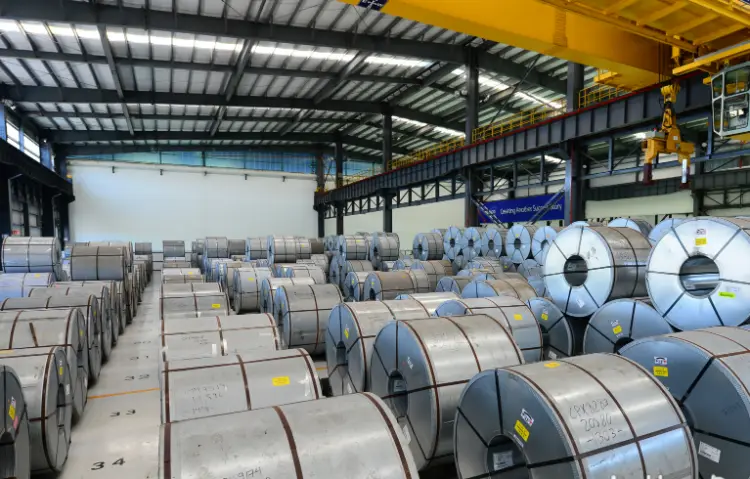
CCS FH32 Shipbuilding Steel Coil
CCS FH32 Shipbuilding Steel Coil: High-Strength Hull Structural Steel with Exceptional Low-Temperature Toughness
Comprehensive material data for CCS FH32 shipbuilding steel coil, including chemical composition, mechanical and physical properties, international equivalents, and typical applications in ship and offshore structures.
Hot rolling, controlled rolling, normalizing, cold forming, welding, machining
- Phone : +8618037372205
- Email : [email protected]
- WhatsApp: Contact via Whtsapp
- WeChat: +8618037372205
CCS FH32 Shipbuilding Steel Coil Introduction
CCS FH32 is a high-strength hull structural steel grade certified by the China Classification Society (CCS). It belongs to the series of higher-strength steels for shipbuilding, specifically designed for welded structures that operate in extremely low-temperature environments. With a minimum yield strength of 315 MPa and guaranteed impact toughness at -60°C, FH32 exhibits outstanding resistance to brittle fracture. The material is typically supplied as hot-rolled coils or plates in normalized or controlled-rolled condition, offering excellent weldability, formability, and consistent mechanical properties. It is widely used in the construction of ice-class vessels, offshore platforms, and marine equipment working in polar or cold regions, where reliable low-temperature performance is critical.
CCS FH32 Shipbuilding Steel Coil Chemical Composition
The chemical composition of CCS FH32 complies with the requirements of CCS Rules for high-strength hull structural steels. The steel is fully killed and refined with fine grain practice. Residual elements and optional grain-refining elements (Nb, V, Ti) may be added to meet the specified mechanical properties. The typical analysis is shown below.
| Chemical Element | Standard Value (max. unless range given) | Remarks |
|---|---|---|
| Carbon (C) | ≤ 0.18 | Main strengthening element |
| Silicon (Si) | ≤ 0.50 | Deoxidizer |
| Manganese (Mn) | 0.90 – 1.60 | Improves strength and toughness |
| Phosphorus (P) | ≤ 0.025 | Impurity, controlled low |
| Sulfur (S) | ≤ 0.025 | Impurity, controlled low |
| Chromium (Cr) | ≤ 0.20 | Residual element |
| Nickel (Ni) | ≤ 0.40 | Residual element |
| Copper (Cu) | ≤ 0.35 | Residual element |
| Molybdenum (Mo) | ≤ 0.08 | Residual element |
| Aluminium (Al) acid-soluble | ≥ 0.015 | Grain refinement |
| Niobium (Nb) | 0.02 – 0.05 | Optional grain-refining element |
| Vanadium (V) | 0.05 – 0.10 | Optional grain-refining element |
| Titanium (Ti) | ≤ 0.02 | Optional grain-refining element |
CCS FH32 Shipbuilding Steel Coil Thermal and Electrical Physical Properties
The physical properties listed below are typical for CCS FH32 steel at room temperature and are based on general data for low-carbon high-strength structural steels. These values are useful for design calculations involving thermal stress, heat transfer, and electrical behavior.
| Property | Typical Value | Unit | Test Condition / Remarks |
|---|---|---|---|
| Density (ρ) | 7.85 | g/cm³ | At 20°C |
| Modulus of Elasticity (E) | 210 | GPa | At 20°C, longitudinal |
| Shear Modulus (G) | 80 | GPa | At 20°C, calculated from E and ν |
| Poisson's Ratio (ν) | 0.3 | – | At 20°C |
| Thermal Expansion Coefficient (α) | 12.0 | 10⁻⁶/K | 20–100°C |
| Thermal Expansion Coefficient (α) | 12.8 | 10⁻⁶/K | 20–200°C |
| Thermal Expansion Coefficient (α) | 13.5 | 10⁻⁶/K | 20–300°C |
| Thermal Conductivity (λ) | 50 | W/(m·K) | At 20°C |
| Specific Heat Capacity (cₚ) | 460 | J/(kg·K) | At 20°C |
| Electrical Resistivity (ρₑ) | 0.20 | μΩ·m | At 20°C |
CCS FH32 Shipbuilding Steel Coil Mechanical Properties
The following mechanical properties apply to CCS FH32 steel in the as-delivered condition. Tensile test pieces are taken transverse to the rolling direction. Charpy V-notch impact tests are performed at -60°C to ensure superior low-temperature toughness. Values depend on product thickness; those for thickness ≤ 50 mm are given as typical.
| Property | Standard Requirement | Unit | Test Condition |
|---|---|---|---|
| Yield Strength (ReH) | ≥ 315 | MPa | Transverse, thickness ≤ 50 mm |
| Yield Strength (ReH) | ≥ 315 | MPa | Transverse, thickness 50–70 mm |
| Yield Strength (ReH) | ≥ 295 | MPa | Transverse, thickness 70–100 mm |
| Tensile Strength (Rm) | 440 – 590 | MPa | Transverse, all thicknesses |
| Elongation (A) | ≥ 22 | % | Gauge length = 5.65√S₀, transverse |
| Charpy Impact Energy (KV₂) | ≥ 31 | J | -60°C, longitudinal |
| Charpy Impact Energy (KV₂) | ≥ 24 | J | -60°C, transverse |
| Bend Test (180°) – bend diameter | 3a | – | Thickness ≤ 25 mm, a = specimen thickness |
| Bend Test (180°) – bend diameter | 4a | – | Thickness > 25 mm, a = specimen thickness |
CCS FH32 Shipbuilding Steel Coil Fully Equivalent Material Standards and Replaceable Grades
| Country / Region | Standard / Classification Society | Grade | Remarks |
|---|---|---|---|
| International | ABS (American Bureau of Shipping) | FH32 | Identical low-temperature toughness and strength |
| International | DNV (Det Norske Veritas) | FH32 | DNV rules; fully interchangeable |
| International | LR (Lloyd's Register) | FH32 | LR certified; equivalent in all applications |
| International | BV (Bureau Veritas) | FH32 | BV grade with same -60°C impact requirement |
| International | NK (ClassNK) | FH32 | Japanese class; directly equivalent |
| International | KR (Korean Register) | FH32 | Korean class; same properties |
| International | RINA (Registro Italiano Navale) | FH32 | Italian class; equivalent |
| International | RS (Russian Maritime Register) | F32 | Often specified as F32 with identical toughness |
| China | GB/T 712 (Chinese national standard) | FH32 | Domestic standard aligned with CCS requirements |
CCS FH32 Shipbuilding Steel Coil Application Introduction
CCS FH32 steel is specifically engineered for welded structures in ships and offshore units that must retain excellent toughness at temperatures as low as -60°C. Its combination of good weldability, high strength, and reliable notch toughness makes it a primary choice for critical components in ice-class vessels, Arctic offshore platforms, and other cryogenic applications.
Product Applications: Hull side and bottom plates, Main deck and stringer plates, Bulkhead and web frame structures, Offshore platform legs and bracing, Ice belt reinforcement areas, LNG storage tank secondary barriers
Processed into products: Ship stiffeners (longitudinals, frames, girders), Bracket plates and floor plates, Rudder horns and stern frames, Offshore module structural supports, Padeyes and lifting lugs for cold environments, Foundations for machinery and deck equipment
Application industries: Shipbuilding (cargo ships, tankers, icebreakers, LNG carriers), Offshore engineering (fixed platforms, semi-submersibles, jack-up rigs), Marine equipment manufacturing, Pressure vessel and storage tank fabrication (low-temperature service), Harbor and port construction machinery
CCS FH32 Shipbuilding Steel Coil Similar / Alternative Material Recommendations
| Country / Region | Standard / Classification Society | Grade | Remarks |
|---|---|---|---|
| All | All major classification societies | AH32 | Same strength level but impact test at 0°C; suitable for non-cold regions |
| All | All major classification societies | DH32 | -20°C impact test; moderate low-temperature service |
| All | All major classification societies | EH32 | -40°C impact test; good for cold environments |
| All | All major classification societies | FH36 | Higher strength (yield ≥355 MPa) with -60°C toughness, usable if higher strength needed |
| All | All major classification societies | EH36 | -40°C + higher strength (≥355 MPa); alternative when both strength and moderate toughness are required |
Notes:
Welding: Due to the low-temperature toughness requirements, welding consumables and procedures must be selected to match the base metal properties. Preheating is generally not required for thicknesses below 50 mm, but low-hydrogen practices are essential. Traceability: CCS FH32 steel must be produced at CCS-approved mills and be accompanied by inspection certificates (class 3.1 or 3.2) confirming chemical analysis and mechanical test results. Surface condition: Coils are usually supplied with a blast-cleaned and shop-primed surface unless otherwise agreed.
- Share



