
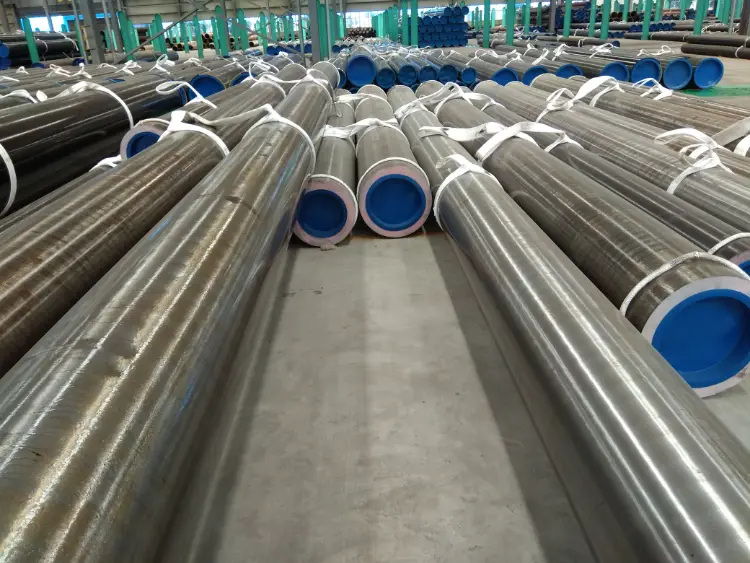
GB/T 3094 Q510 SHS/RSH Pipe
GB/T 3094 Q510 SHS/RSH Pipe - High-Strength Structural Hollow Sections
Detailed material data for Q510 square and rectangular hollow sections per GB/T 3094, including chemical composition, mechanical and thermal properties, equivalent grades, and application guidance.
Cold forming, welding, machining, hot-dip galvanizing
- Phone : +8618037372205
- Email : [email protected]
- WhatsApp: Contact via Whtsapp
- WeChat: +8618037372205
GB/T 3094 Q510 SHS/RSH Pipe Introduction
Q510 is a high-strength low-alloy structural steel grade primarily used for cold-formed square (SHS) and rectangular (RSH) hollow sections under Chinese standard GB/T 3094. It provides a minimum yield strength of 510 MPa, offering an excellent strength-to-weight ratio for demanding structural applications.
Main characteristics:
- High yield and tensile strength, suitable for heavily loaded frameworks
- Good weldability with proper preheating and consumable selection
- Improved toughness, especially in fine-grain variants (normalized or thermomechanically rolled)
- Uniform dimensional accuracy and surface quality as required for hollow sections
Typical delivery condition: normalized or as-rolled, depending on thickness. The chemical composition is designed to achieve the required mechanical properties while maintaining adequate ductility for cold-forming processes. International equivalents are often sought in EN 10219 (S500J2H, S550J2H) or ASTM A500 Grade C.
GB/T 3094 Q510 SHS/RSH Pipe Chemical Composition
The chemical composition of Q510 is controlled to achieve high yield strength and good weldability. Typical limits are derived from comparable low-alloy grades (Q500/Q550) under GB/T 1591. For SHS/RSH pipes, additional restrictions on sulfur and phosphorus improve formability. Values are representative; the exact specification should be confirmed with the material certificate. Notes:
- Nb, V, Ti are added individually or in combination for grain refinement
- CEV (carbon equivalent) is typically ≤0.47 for good weldability
| Element | Standard Value (wt%) | Remarks |
|---|---|---|
| Carbon (C) | ≤ 0.18 | Ladle analysis |
| Silicon (Si) | ≤ 0.60 | |
| Manganese (Mn) | ≤ 1.80 | Higher Mn content for strength |
| Phosphorus (P) | ≤ 0.025 | Stringent limit |
| Sulfur (S) | ≤ 0.020 | Improves cleanliness |
| Chromium (Cr) | ≤ 0.30 | Optional element |
| Nickel (Ni) | ≤ 0.50 | Optional |
| Copper (Cu) | ≤ 0.30 | |
| Niobium (Nb) | ≤ 0.06 | Microalloying for grain refinement |
| Vanadium (V) | ≤ 0.12 | Microalloying |
| Titanium (Ti) | ≤ 0.05 | Microalloying |
| Aluminium (Al) | ≥ 0.015 | Total Al, for deoxidation |
| Nitrogen (N) | ≤ 0.015 |
GB/T 3094 Q510 SHS/RSH Pipe Thermal and Electrical Physical Properties
Physical properties are typical for low-alloy structural steels and are valid for room temperature unless otherwise noted. Values may vary slightly depending on exact composition and processing. Sources: published data for similar steels such as Q500.
| Property | Standard Requirement | Unit | Test Condition |
|---|---|---|---|
| Density (ρ) | 7.85 | g/cm³ | at 20°C |
| Modulus of elasticity (E) | 206 | GPa | at 20°C |
| Shear modulus (G) | 79.3 | GPa | Approximately, at 20°C |
| Poisson's ratio (ν) | 0.30 | — | At 20°C |
| Thermal expansion coefficient (α) | 11.5 | 10⁻⁶/K | 20–100°C |
| Thermal expansion coefficient (α) | 12.2 | 10⁻⁶/K | 20–200°C |
| Thermal expansion coefficient (α) | 12.8 | 10⁻⁶/K | 20–300°C |
| Thermal conductivity (λ) | 45 | W/(m·K) | At 20°C |
| Thermal conductivity (λ) | 43 | W/(m·K) | At 100°C |
| Specific heat capacity | 470 | J/(kg·K) | At 20°C |
| Electrical resistivity (ρ_e) | 0.25 | µΩ·m | At 20°C |
GB/T 3094 Q510 SHS/RSH Pipe Mechanical Properties
Mechanical properties depend on wall thickness and heat treatment condition. The following values are based on a wall thickness ≤ 16 mm in normalized or as-rolled condition, consistent with requirements for Q500/Q510 structural hollow sections. Impact values are valid for longitudinal Charpy V-notch specimens at specified temperature (if ordered with notch toughness).
Tests are performed according to GB/T 228.1 and GB/T 229.
| Property | Standard Requirement | Unit | Test Condition |
|---|---|---|---|
| Yield strength (ReH) | ≥ 510 | MPa | Min. yield, t ≤ 16 mm |
| Yield strength (ReH) | ≥ 470 | MPa | 16 < t ≤ 40 mm |
| Tensile strength (Rm) | 610 – 770 | MPa | t ≤ 100 mm |
| Elongation (A) | ≥ 17 | % | Longitudinal, gauge length 5.65√S0 |
| Bend test | D = 3a | — | Bend angle 180°, a = specimen thickness |
| Impact energy (KV2) | ≥ 40 | J | At +20°C (Q510B) |
| Impact energy (KV2) | ≥ 34 | J | At 0°C (Q510C) |
| Impact energy (KV2) | ≥ 34 | J | At -20°C (Q510D) |
GB/T 3094 Q510 SHS/RSH Pipe Complete Equivalent Standards and Substitutable Grades
| Region | Standard | Grade | Remarks |
|---|---|---|---|
| China | GB/T 3094 | Q510 | Base grade, not covered in EN or ASTM with exact match |
| Europe | EN 10219 | S500J2H | Close in strength, but yield min. 500 MPa; impact J2 at -20°C |
| Europe | EN 10219 | S550J2H | Higher strength (yield ≥550 MPa), may be considered as an upgrade |
| USA | ASTM A500 | Grade C | Lower strength (yield ≥345 MPa), not a direct equivalent but widely used |
| Japan | JIS G 3466 | STKR490 | Yield ≥325 MPa, insufficient for Q510 strength level |
GB/T 3094 Q510 SHS/RSH Pipe Application Introduction
Q510 SHS/RSH pipes are ideally suited for applications where high strength, reduced weight, and good formability are required. Typical uses include:
- Structural columns and beams in high-rise buildings
- Bridges, pedestrian walkways, and supporting structures
- Offshore platforms and marine structures
- Heavy-duty machinery frames and crane booms
- Transmission towers and wind turbine supports
- Architectural frameworks requiring slender profiles
The hollow sections can be bolted, welded, or joined using end-plate connections. Hot-dip galvanizing is commonly applied for corrosion protection in outdoor environments.
Product Applications: Structural columns and beams, Trusses and space frames, Crane girders, Tower structures (telecom, wind turbines), Shipbuilding stiffeners, Scaffolding and temporary structures
Processed into products: Welded fabrications (nodes, joints), Machined connectors and brackets, Bolted end-plate assemblies, Trailer chassis elements, Excavator booms and arms, Railway wagon structural members
Application industries: Construction and civil engineering, Bridge building, Offshore and marine engineering, Heavy machinery manufacturing, Power generation and transmission, Transportation and infrastructure
GB/T 3094 Q510 SHS/RSH Pipe Similar / Alternative Materials
| Region | Standard | Grade | Remarks |
|---|---|---|---|
| China | GB/T 1591 | Q500D/E | Similar chemical and mechanical properties; used for plates and sections |
| China | GB/T 1591 | Q550D/E | Higher strength alternative (yield ≥550 MPa) |
| Europe | EN 10025-3 | S460N/NL | Lower strength but excellent toughness; normalized |
| Europe | EN 10025-6 | S500Q/QL | Quenched & tempered, yield ≥500 MPa, suitable for heavy sections |
| International | ISO 4950-2 | S500 | High yield strength steel for structural purposes, comparable to Q510 |
| USA | ASTM A572 | Grade 65 | Yield minimum 450 MPa, lower than Q510; widely used |
| USA | ASTM A913 | Grade 65 | Yield ≥450 MPa, similar chemistry but not identical |
Notes:
Welding: Preheating (100–150°C) is recommended for thick sections. Use low-hydrogen consumables matching the strength level.
Galvanizing: Q510 can be hot-dip galvanized, but silicon content should be controlled to avoid excessive coating thickness.
Availability: Q510 SHS/RSH are produced in a wide range of sizes (e.g., 50x50 mm to 400x400 mm for SHS, 50x30 mm to 500x300 mm for RSH). Custom lengths are available upon request.
Certification: Mill test certificates in accordance with EN 10204 Type 3.1 or 3.2 can be provided.
- Share



