
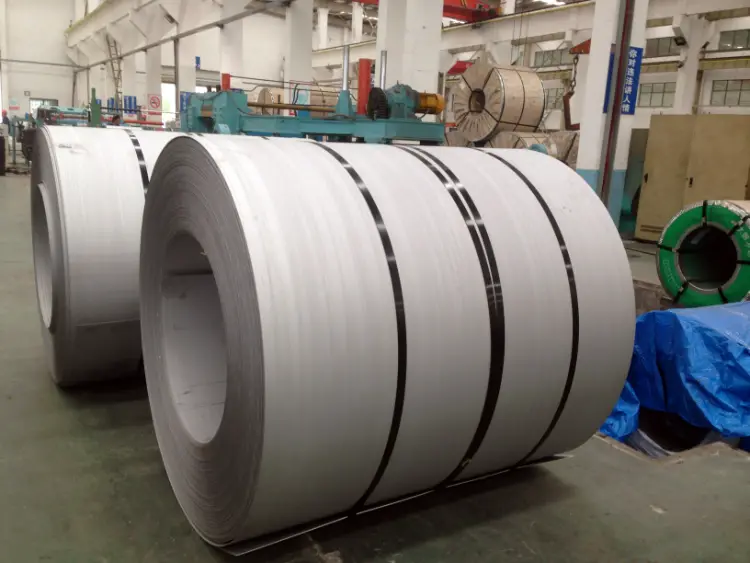
CCS AH36 Shipbuilding Steel Coil
CCS AH36 Shipbuilding Steel Coil: High-Strength Marine Structural Material for Ship Construction
Explore CCS AH36 shipbuilding steel coil: chemical composition, mechanical and thermal properties, international equivalents, and application guide for marine engineering and shipbuilding.
Hot rolling, controlled rolling, normalizing (as required), welding, bending, cutting
- Phone : +8618037372205
- Email : [email protected]
- WhatsApp: Contact via Whtsapp
- WeChat: +8618037372205
CCS AH36 Shipbuilding Steel Coil Introduction
CCS AH36 is a high-strength hull structural steel grade certified by the China Classification Society (CCS), designed for shipbuilding and offshore engineering. It falls under the strength category of 355 MPa yield strength, offering excellent weldability, toughness, and corrosion resistance in marine environments. As a normalized or controlled rolled steel, AH36 exhibits good formability and is widely utilized in the construction of ships, barges, and offshore structures. The 'A' indicates it is a grade with impact test temperature at 0°C, ensuring reliable toughness. This steel is supplied in coils, plates, or sections, and complies with the CCS Rules for Materials and Welding, which align with IACS UR W11 standards. Its balanced chemical composition and mechanical properties make it an essential material for safe and durable marine vessels.
CCS AH36 Shipbuilding Steel Coil Chemical Composition
The chemical composition of CCS AH36 is defined by the CCS Rules for Materials and Welding and IACS UR W11. The values below are the ladle analysis limits. Carbon equivalent (CEV) is controlled to ensure weldability.
- Maximum CEV = 0.38%
- Tramp elements are restricted to maintain toughness
| Chemical Element | Specified Value (wt%) | Remarks |
|---|---|---|
| Carbon (C) | ≤0.18 | Ladle analysis |
| Manganese (Mn) | 0.90–1.60 | - |
| Silicon (Si) | ≤0.50 | - |
| Phosphorus (P) | ≤0.035 | Maximum |
| Sulfur (S) | ≤0.035 | Maximum |
| Aluminum (Al) | ≥0.015 (total) | Minimum acid-soluble, for grain refinement |
| Chromium (Cr) | ≤0.20 | Residual element |
| Nickel (Ni) | ≤0.40 | Residual element |
| Copper (Cu) | ≤0.35 | Residual element |
| Molybdenum (Mo) | ≤0.08 | Residual element |
| Nitrogen (N) | ≤0.009 | If not killed with sufficient Al, not always specified |
| Vanadium (V) | ≤0.10 | Micro-alloy element; may be added |
| Niobium (Nb) | ≤0.05 | Micro-alloy element; may be added |
| Titanium (Ti) | ≤0.02 | Micro-alloy element; may be added |
CCS AH36 Shipbuilding Steel Coil Thermal and Electrical Physical Properties
Physical properties are not part of the CCS specification but are typical for carbon‑manganese structural steel with similar composition. Values are provided for general engineering guidance at room temperature unless otherwise indicated.
- Density is approximately 7,850 kg/m³
- Thermal properties are valid up to about 100°C; they may vary slightly with temperature
| Property | Typical Value | Unit | Test Condition |
|---|---|---|---|
| Density (ρ) | 7,850 | kg/m³ | At 20°C |
| Elastic Modulus (E) | 210 | GPa | Room temperature |
| Shear Modulus (G) | 80 | GPa | Room temperature |
| Poisson's Ratio (ν) | 0.3 | – | Room temperature |
| Thermal Expansion Coefficient (α) | 11.7 × 10⁻⁶ | K⁻¹ | 20–100°C |
| Thermal Conductivity (λ) | 48 | W/(m·K) | At 100°C |
| Specific Heat Capacity | 480 | J/(kg·K) | At 20°C |
| Electrical Resistivity (ρ_e) | 0.23 × 10⁻⁶ | Ω·m | At 20°C |
CCS AH36 Shipbuilding Steel Coil Mechanical Properties
The following tensile and impact properties are required by CCS Rules for plates and coils of AH36. Testing is conducted on transverse specimens for plates and longitudinal for coils unless otherwise agreed. Impact test temperature is 0°C. The values are valid for thicknesses ≤50 mm; for thicknesses above, some reduction in strength is allowed per standard.
- Yield strength minimum 355 MPa for thickness ≤100 mm
- Tensile strength range 490–620 MPa for all thicknesses
| Property | Specified Value | Unit | Test Condition |
|---|---|---|---|
| Yield Strength (ReH, min) | 355 | MPa | Thickness ≤50 mm, transverse |
| Tensile Strength (Rm) | 490–620 | MPa | Thickness ≤50 mm, transverse |
| Elongation (A5, min) | 21 | % | Gauge length 5.65√So, transverse |
| Impact Energy (KV2, min) | 34 | J | Charpy V-notch, 0°C, longitudinal specimen |
| Impact Energy (KV2, min) | 24 | J | Charpy V-notch, 0°C, transverse specimen |
| Bend Test (180° bend) | d=2a | – | Bend diameter d, specimen thickness a, no cracks outside of tension face |
CCS AH36 Shipbuilding Steel Coil Full Equivalent Material Standards and Replaceable Grades
| Country/Region | Standard/Society | Grade | Remarks |
|---|---|---|---|
| International | IACS UR W11 | AH36 | Unified requirement for ship hull structural steel |
| USA | ABS (American Bureau of Shipping) | AH36 | Part 2, Chapter 1 |
| France | BV (Bureau Veritas) | AH36 | Rules for the Classification of Steel Ships |
| Norway/Germany | DNV (Det Norske Veritas) | AH36 | Offshore standard DNV-OS-B101 |
| UK | LR (Lloyd's Register) | AH36 | Rules for the Manufacture, Testing and Certification of Materials |
| South Korea | KR (Korean Register) | AH36 | Rules for the Classification of Steel Ships |
| Japan | NK (ClassNK) | AH36 | Rules for the Survey and Construction of Steel Ships |
| Italy | RINA (Registro Italiano Navale) | AH36 | Rules for the Classification of Ships |
| China | GB 712 | AH36 | National standard for hull structural steel; CCS references this |
CCS AH36 Shipbuilding Steel Coil Application Introduction
CCS AH36 steel coil and plate are widely employed in the construction of marine vessels and offshore structures where high strength and good toughness at ambient down to 0°C are essential. Typical applications include:
- Main hull structures such as shell plating, deck plating, and bottom plating.
- Internal structural members like floors, longitudinals, girders, and bulkheads.
- Offshore platform decks and jackets (when certified for offshore).
- Shipbuilding modules, hatch coamings, and superstructures.
Product Applications: Cargo ships (bulk carriers, tankers, container ships), Passenger ships and ferries, Barges and tugs, Offshore supply vessels (OSV), FPSO (Floating Production Storage and Offloading) hulls, Ice‑class ships (for hull areas not requiring Arctic grades), Dredgers and workboats
Processed into products: Shell plating (side, bottom, deck), Longitudinal stiffeners and web frames, Transverse bulkheads and watertight doors, Deck houses and superstructure panels, Hatches and hatch covers, Engine room foundations and seatings, Mast houses and crane pedestals
Application industries: Commercial and naval shipbuilding, Offshore oil and gas platform construction, Marine equipment manufacturing, Port and harbor structure fabrication, Renewable energy (offshore wind turbine foundations)
CCS AH36 Shipbuilding Steel Coil Similar/Near-Equivalent Material Alternatives
| Country/Region | Standard/Society | Grade | Remarks |
|---|---|---|---|
| Multiple | IACS UR W11 | DH36 | Higher impact test temperature (‑20°C); same strength |
| Multiple | IACS UR W11 | EH36 | Impact test at ‑40°C; same strength |
| Multiple | IACS UR W11 | FH36 | Impact test at ‑60°C; same strength |
| Multiple | IACS UR W11 | A36 | General strength hull steel, lower yield (≥235 MPa) |
| USA | ASTM A131 | AH36 | Structural steel for ships - Grade AH36 |
| China | GB 712 | AH36 | Same grade, same specification requirements |
| Europe | EN 10025‑4 | S355ML | Thermomechanical rolled weldable fine grain structural steel, yield 355 MPa (not restricted to ship use) |
Notes:
- AH36 steel can be supplied with through‑thickness properties (Z‑quality) upon request to improve lamellar tearing resistance.
- Welding consumables should be matched to the strength and toughness requirements; preheat may be needed for thick sections depending on CEV.
- Delivery condition can be either as‑rolled, controlled rolled, or normalized; the choice influences toughness and weldability.
- Certification includes mill test certificate (MTC) in accordance with EN 10204 3.1 type, bearing CCS stamp.
- Maximum CEV (Carbon Equivalent) value is 0.38% as per IACS, unless specially agreed.
- Share



