
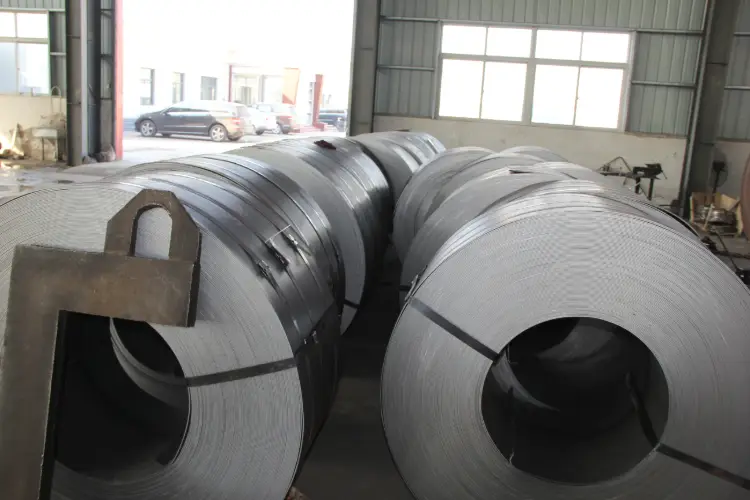
CCS DH36 Shipbuilding Steel Coil
CCS DH36 Shipbuilding Steel Coil Data Sheet: Properties, Equivalents & Applications
Explore the comprehensive material analysis of CCS DH36 shipbuilding steel coil, including chemical composition, mechanical and thermal properties, international equivalents from ABS, DNV, LR, and its primary applications in hull and offshore structures.
Controlled Rolling (CR), Normalizing (NR), Thermomechanical Control Process (TMCP)
- Phone : +8618037372205
- Email : [email protected]
- WhatsApp: Contact via Whtsapp
- WeChat: +8618037372205
CCS DH36 Shipbuilding Steel Coil Introduction
CCS DH36 is a high-strength hull structural steel grade certified by the China Classification Society (CCS). As part of the higher-strength group for shipbuilding, it is designed to provide superior yield strength (minimum 355 MPa) and good weldability for critical structural components. The designation 'D' indicates its suitability for service at temperatures as low as -20°C with guaranteed impact toughness, while 'H36' specifies a high-strength grade with a minimum yield strength of 355 MPa. This steel is widely utilized in ship and marine engineering, offering an excellent balance between strength, toughness, and fabrication properties. It is typically supplied in a normalized or controlled rolled condition, ensuring a fine-grain microstructure that enhances both strength and resistance to brittle fracture in cold marine environments.
CCS DH36 Shipbuilding Steel Coil Chemical Composition
The chemical composition for CCS DH36 steel is strictly defined by the China Classification Society to ensure optimal weldability and mechanical properties. The ladle analysis limits for each element are provided below. Carbon Equivalent (CEV) is typically controlled to ensure good weldability, usually calculated as CEV = C + Mn/6 + (Cr+Mo+V)/5 + (Ni+Cu)/15. All values are maximum unless a range is specified.
| Chemical Element | Standard Value (%) | Remarks |
|---|---|---|
| Carbon (C) | ≤ 0.18 | Heat analysis, max limit |
| Manganese (Mn) | 0.90 – 1.60 | Heat analysis range |
| Silicon (Si) | 0.10 – 0.50 | Heat analysis range |
| Phosphorus (P) | ≤ 0.035 | Heat analysis, max limit |
| Sulfur (S) | ≤ 0.035 | Heat analysis, max limit |
| Chromium (Cr) | ≤ 0.20 | Residual element, max |
| Molybdenum (Mo) | ≤ 0.08 | Residual element, max |
| Nickel (Ni) | ≤ 0.40 | Residual element, max |
| Copper (Cu) | ≤ 0.35 | Residual element, max |
| Aluminum (Al) | ≥ 0.015 | Total aluminum, acid soluble |
| Niobium (Nb) | 0.02 – 0.05 | Micro-alloying element |
| Vanadium (V) | 0.05 – 0.10 | Micro-alloying element |
| Titanium (Ti) | ≤ 0.02 | Max limit |
CCS DH36 Shipbuilding Steel Coil Thermal and Electrical Physical Properties
These thermal, elastic, and electrical properties are typical for DH36 grade steel and are essential for design and manufacturing calculations, including welding preheat requirements and structural deformation analysis. Values are representative for low-carbon structural steels at room temperature unless otherwise specified.
| Property | Standard Required Value | Unit | Test Condition / Remarks |
|---|---|---|---|
| Density (ρ) | 7.85 | g/cm³ | Nominal value at 20°C |
| Elastic Modulus (E) | 205 – 210 | GPa | Typical value at 20°C |
| Shear Modulus (G) | 80 – 82 | GPa | Calculated typical value at 20°C |
| Poisson's Ratio (ν) | 0.29 – 0.30 | – | Typical value at 20°C |
| Thermal Expansion Coefficient (α) | 11.5 – 12.1 | 10⁻⁶/K | For range 20°C to 100°C |
| Thermal Expansion Coefficient (α) | 12.6 – 13.2 | 10⁻⁶/K | For range 20°C to 200°C |
| Thermal Expansion Coefficient (α) | 13.5 – 14.0 | 10⁻⁶/K | For range 20°C to 400°C |
| Thermal Conductivity (λ) | 43 – 46 | W/(m·K) | Typical value at 20°C |
| Specific Heat Capacity | 460 – 490 | J/(kg·K) | Typical value at 20°C |
| Electrical Resistivity (ρ_e) | 0.22 – 0.26 | Ω·mm²/m | Typical value at 20°C |
CCS DH36 Shipbuilding Steel Coil Mechanical Properties
The mechanical properties for CCS DH36 steel are guaranteed for the specified thickness ranges. Tensile testing must comply with CCS rules, demonstrating minimum levels of yield strength, tensile strength, and elongation. Charpy V-notch impact testing is mandatory at -20°C to confirm low-temperature toughness. All properties are for the transverse direction unless otherwise noted.
| Property | Standard Required Value | Unit | Test Condition / Remarks |
|---|---|---|---|
| Yield Strength (ReH) | ≥ 355 | MPa | For thicknesses (t) ≤ 50 mm, transverse |
| Yield Strength (ReH) | ≥ 355 | MPa | For thicknesses 50 < t ≤ 70 mm, transverse |
| Yield Strength (ReH) | ≥ 355 | MPa | For thicknesses 70 < t ≤ 100 mm, transverse |
| Tensile Strength (Rm) | 490 – 630 | MPa | For thicknesses (t) ≤ 100 mm, transverse |
| Elongation (A) | ≥ 21 | % | Gauge length 5.65√S₀ (L₀=200mm), transverse |
| Elongation (A) | ≥ 21 | % | Gauge length 50mm (L₀=50mm), transverse |
| Impact Energy (KV) | ≥ 34 | J | Charpy V-Notch, longitudinal, at -20°C |
| Impact Energy (KV) | ≥ 24 | J | Charpy V-Notch, transverse, at -20°C |
| Bending Test (180°) | No cracks | – | Mandrel diameter 3 x specimen thickness (3a) for t ≤ 25 mm |
CCS DH36 Shipbuilding Steel Coil Completely Equivalent Material Standards and Replaceable Grades
| Country/Region | Standard | Grade | Remarks |
|---|---|---|---|
| International | IACS | DH36 | Unified requirement by the International Association of Classification Societies for high strength hull steel, Class D (-20°C impact test). |
| United States | ABS (American Bureau of Shipping) | ABS DH36 | Full equivalent for high strength structural steel for ships. Certified by ABS. |
| Norway/Germany | DNV (Det Norske Veritas) | DNV DH36 | Full equivalent for hull structural steel. Certified by DNV. |
| United Kingdom | LR (Lloyd's Register) | LR DH36 | Full equivalent for marine structural application. Certified by LR. |
| France | BV (Bureau Veritas) | BV DH36 | Full equivalent for shipbuilding steels. Certified by BV. |
| Japan | NK (Nippon Kaiji Kyokai) | NK DH36 | Full equivalent from ClassNK for high strength hull structural steel. |
| South Korea | KR (Korean Register) | KR DH36 | Full equivalent for use in ship and offshore structures. Certified by KR. |
| Italy | RINA (Registro Italiano Navale) | RINA DH36 | Full equivalent for marine applications. Certified by RINA. |
| China | GB/T 712 | DH36 | Chinese national standard for shipbuilding steel, identical in technical requirements to CCS DH36. |
CCS DH36 Shipbuilding Steel Coil Application Introduction
CCS DH36 steel coil and plates are the workhorse materials for modern shipbuilding, specifically engineered for critical structural components that demand high strength, excellent weldability, and guaranteed toughness at sub-zero temperatures. Its controlled rolled or normalized delivery condition refines the grain structure, enhancing strength without compromising ductility. The material's micro-alloying with Niobium and Vanadium provides precipitation strengthening and grain refinement, which is crucial for resisting brittle fracture in North Atlantic transit routes. Primary fabrication includes cutting, bending, and high-heat-input welding, with the CEV carefully controlled to prevent heat-affected zone (HAZ) cracking. Typical applications range from main hull decks and bottom shells to complex offshore structural nodes.
Product Applications: Container Ships, Bulk Carriers, and Oil Tankers, Roll-on/Roll-off (Ro-Ro) Vessels and Passenger Ferries, Self-Elevating Platform Legs (Jack-up Rig Hulls), Floating Production Storage and Offloading (FPSO) Units, Harbor Crane Booms and Heavy Dock Gates
Processed into products: Main Deck Plating and Stringers, Bottom Shell and Bilge Keel Plates, Transverse Bulkheads and Corrugated Structures, Longitudinal Stiffeners and Girder Webs, Hatch Coamings and Corner Castings in Containerships
Application industries: Shipbuilding and Ship Repair, Offshore Oil & Gas Platform Construction, Maritime Engineering and Coastal Structures, Heavy Civil Engineering (Bridges, Lock Gates), Wind Turbine Tower and Sub-structure Fabrication (Marine)
CCS DH36 Shipbuilding Steel Coil Similar or Comparable Alternative Material Recommendations
| Country/Region | Standard | Grade | Remarks |
|---|---|---|---|
| China | CCS Rules | AH36 | Similar high-strength hull steel but certified for less severe cold service (impact test at 0°C instead of -20°C). Can be substituted if operating temperature is higher. |
| China | CCS Rules | EH36 | Higher toughness variant of DH36 requiring impact testing at -40°C. Suitable replacement for DH36 if more demanding low-temperature toughness is needed. |
| International | IACS | AH40 | Higher minimum yield strength grade (390 MPa) with similar chemistry. This overqualified, less economical substitute provides extra strength capacity. |
| International | API 2H / 2W | Gr. 42 or Gr. 50 | Steel grades for offshore structural tubulars and plates. Gr. 50 (min 345-360 MPa yield) offers comparable strength but is specified for offshore platform construction, not ships. |
| European Union | EN 10025-4 | S355ML / S355M | Thermomechanically rolled structural steel with a minimum 355 MPa yield and impact testing down to -50°C. Not certified by a classification society but similar mechanical properties for non-marine use. |
Notes:
Special Note: The actual properties may slightly exceed these minimum requirements depending on the mill's specific practice and final heat treatment. All materials supplied under CCS DH36 certification must be marked with the Registrar's stamp and fully traceable to the heat number. Weldability testing (including higher heat input welding for TMCP steels) is strictly enforced through classification society surveys. For thicknesses above 40mm, properties in the thickness (Z-direction) are often specified to avoid lamellar tearing, requiring through-thickness testing and low sulfur levels. Ensure that processing, especially flame cutting and welding, follows the recommended preheat and interpass temperature guidelines to maintain low-temperature impact properties in the final structure.
- Share



