
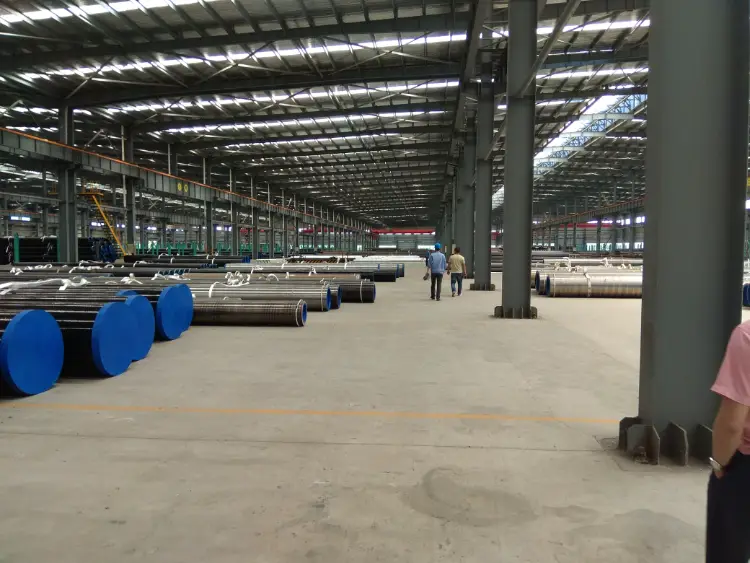
API 5L Grade B LSAW Pipe
API 5L Grade B LSAW Pipe: Comprehensive Material Properties and Specifications
In-depth material analysis of API 5L Grade B LSAW pipe, covering chemical composition, mechanical properties, thermal and electrical performance, international equivalents, similar materials, and application guidance.
Longitudinal Submerged Arc Welding (LSAW), expanded, cold formed from plates, seam welding
- Phone : +8618037372205
- Email : [email protected]
- WhatsApp: Contact via Whtsapp
- WeChat: +8618037372205
API 5L Grade B LSAW Pipe Introduction
API 5L Grade B LSAW pipe is a widely used carbon steel line pipe manufactured by the Longitudinal Submerged Arc Welding (LSAW) process. It conforms to the American Petroleum Institute (API) specification 5L, which covers seamless and welded steel line pipes for conveying gas, water, and oil in the petroleum and natural gas industries. Grade B (also designated L245) offers a good balance of strength, weldability, and toughness.
- Minimum yield strength of 245 MPa (35.5 ksi)
- Excellent formability and weldability for large-diameter pipes
- Cost-effective choice for moderate pressure pipelines
- Available in Product Specification Level 1 (PSL1) and PSL2 with tighter requirements
API 5L Grade B LSAW Pipe Chemical Composition
Chemical requirements for API 5L Grade B PSL2 pipe. For LSAW pipe, the composition applies to the plate/coil prior to welding. Carbon equivalent (CE) limits may also apply to ensure weldability.
| Element | Standard Value (max unless range given) | Remarks |
|---|---|---|
| Carbon (C) | 0.22 | max; PSL1: 0.26 |
| Manganese (Mn) | 1.15 | max; for pipe with specified min yield ≤ 359 MPa, Mn max 1.30 |
| Phosphorus (P) | 0.025 | max |
| Sulfur (S) | 0.015 | max |
| Silicon (Si) | 0.45 | max |
| Niobium (Nb) | 0.05 | max |
| Vanadium (V) | 0.05 | max |
| Titanium (Ti) | 0.04 | max |
| Copper (Cu) | 0.50 | max; if Cu + Ni + Cr + Mo exceed specified limits, additional requirements apply |
| Nickel (Ni) | 0.50 | max |
| Chromium (Cr) | 0.50 | max |
| Molybdenum (Mo) | 0.15 | max |
| Nitrogen (N) | 0.012 | max; for Nb+V+Ti microalloyed steels |
| Carbon Equivalent (CE) | 0.43 | max, based on formula CE = C + Mn/6 + (Cr+Mo+V)/5 + (Ni+Cu)/15; may be lower depending on thickness |
API 5L Grade B LSAW Pipe Thermal and Electrical Physical Properties
Representative physical properties for API 5L Grade B steel at room temperature (20 °C) and elevated temperatures. These are typical values for low-carbon manganese steels and may vary slightly depending on exact composition and heat treatment.
| Property | Standard Value | Unit | Test Condition |
|---|---|---|---|
| Density (ρ) | 7.85 | g/cm³ | at 20 °C |
| Elastic Modulus (E) | 205 | GPa | at 20 °C, static tensile |
| Shear Modulus (G) | 79 | GPa | at 20 °C, calculated |
| Poisson's Ratio (ν) | 0.29 | at 20 °C, typical | |
| Thermal Expansion Coefficient (α) | 11.7 x 10⁻⁶ | /K | 20 °C to 100 °C |
| Thermal Expansion Coefficient (α) | 12.2 x 10⁻⁶ | /K | 20 °C to 200 °C |
| Thermal Expansion Coefficient (α) | 13.0 x 10⁻⁶ | /K | 20 °C to 300 °C |
| Thermal Conductivity (λ) | 51.9 | W/(m·K) | at 20 °C |
| Thermal Conductivity (λ) | 48.5 | W/(m·K) | at 100 °C |
| Thermal Conductivity (λ) | 44.4 | W/(m·K) | at 200 °C |
| Specific Heat Capacity (cp) | 0.46 | J/(g·K) | at 20 °C (approx. 486 J/(kg·K)) |
| Electrical Resistivity (ρe) | 0.159 | µΩ·m | at 20 °C, typical for carbon steel |
API 5L Grade B LSAW Pipe Mechanical Properties
Tensile and toughness requirements for API 5L Grade B line pipe. Properties are tested on the pipe body transverse to the weld (base metal) and, when required, on the weld seam. Values vary with wall thickness; listed below are common minimums for wall thicknesses ≤ 25 mm (1 in).
| Property | Standard Requirement | Unit | Test Condition |
|---|---|---|---|
| Yield Strength (Rt0.5) | 245 - 450 | MPa | Transverse, base metal, room temperature |
| Tensile Strength (Rm) | 415 - 760 | MPa | Transverse, base metal, room temperature |
| Elongation (A) | 22 (for 0.75 in2 area) | % | in 2 in (50.8 mm); formula: A = 1950*S^0.2/U^0.9, min 21% |
| Elongation (A) | 21 (for smaller cross-section) | % | Based on specimen area per API 5L Table 8 |
| Yield to Tensile Ratio (Rt0.5/Rm) | 0.93 max | PSL2 requirement; PSL1 no limit | |
| Charpy Impact Energy (base metal) | 27 average, 18 single | J | At 0 °C (32 °F) or lower as agreed, transverse specimen |
| Charpy Impact Energy (weld) | 27 average, 18 single | J | At 0 °C, notch in weld metal |
| Bend Test | No cracks | Guided bend test over 180° mandrel per API 5L | |
| Hardness | 250 HV10 | HV | Weld and heat-affected zone, PSL2 max |
API 5L Grade B LSAW Pipe Fully Equivalent Material Standards and Substitute Grades
| Country/Region | Standard | Grade/Designation | Remarks |
|---|---|---|---|
| International | ISO 3183 | L245 | Identical to API 5L Grade B |
| European Union | EN 10208-2 | L245GA / L245NB | GA: for gas; NB: normalized rolled; match Grade B |
| China | GB/T 9711 | L245 | PSL1 equivalent, GB/T 9711-2017 |
| Russia | GOST R 52079 | K42 (approximate) | Grade B maps to strength class K42 |
| Canada | CSA Z245.1 | Grade 245 | Equivalent strength class |
| Brazil | ABNT NBR 15776 | L245 | Petroleum industry line pipe |
API 5L Grade B LSAW Pipe Application Introduction
API 5L Grade B LSAW pipe is primarily used in the transportation of hydrocarbons and other fluids over long distances. It also finds structural applications. Key application areas include:
- Cross-country oil and gas trunk lines
- Gas gathering and distribution networks
- Water transmission mains
- Offshore risers and flowlines (subject to additional testing)
- Sour service applications with supplementary HIC/SSC testing
- Structural piling and casing pipes
Product Applications: Transmission pipelines (oil, gas, water), Flowlines and gathering lines, Compressor station piping, Refinery and plant pipe systems, Piling pipe for foundation structures, Casing and conductor pipe for oil wells
Processed into products: Line pipe segments (straight and bends), Pipe fittings (tees, elbows, reducers) when fabricated from same grade, Flanges and connectors (in conjunction with Grade B material), Structural support legs and braces (offshore platforms), Storage tank inlet/outlet piping, Vent stacks and flare headers (non-critical temperature)
Application industries: Oil & Gas (Upstream, Midstream, Downstream), Petrochemical and Refining, Water and Wastewater Infrastructure, Construction and Civil Engineering, Marine and Offshore Engineering
API 5L Grade B LSAW Pipe Similar or Nearby Alternative Material Recommendations
| Country/Region | Standard | Grade/Designation | Remarks |
|---|---|---|---|
| USA | ASTM A53 | Grade B | Seamless and welded pipe; similar strength, used in structural and pressure applications |
| USA | ASTM A106 | Grade B | Seamless carbon steel pipe for high-temperature service; slightly higher Mn and Si |
| USA | API 5L | X42 (L290) | Higher strength grade; common substitute when increased pressure rating is acceptable |
| European Union | EN 10210-1 | S235JRH / S275JRH | Structural hollow sections, lower or comparable yield strength |
| European Union | EN 10217-1 | P235TR1 | Welded steel tubes for pressure purposes, similar composition |
Notes:
- LSAW pipes are typically produced from controlled-rolled or thermo-mechanically controlled processed (TMCP) plates to achieve the required properties.
- For sour service (H2S environments), supplementary requirements per NACE MR0175/ISO 15156 must be specified, including hardness control (max 250 HV) and HIC/SSC testing.
- Welding consumables for LSAW must be selected to match the base metal strength and toughness; post-weld heat treatment (PWHT) may be applied for thicknesses above 38 mm.
- Hydrostatic testing is mandatory per API 5L: each pipe must be tested to a pressure that produces a hoop stress equal to a specified percentage of the specified minimum yield strength.
- Non-destructive examination (NDE) of the weld seam (ultrasonic or radiographic) is standard for LSAW pipes.
- Share



