
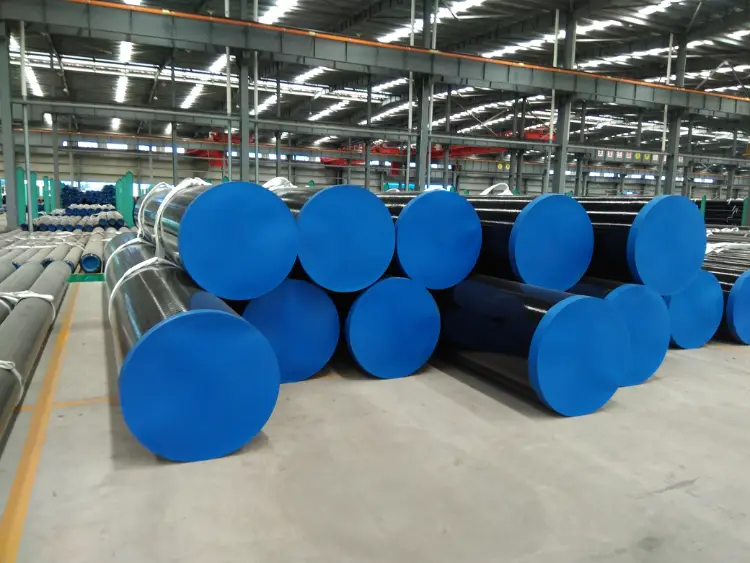
API 5L Grade A LSAW Pipe
API 5L Grade A LSAW Pipe: Chemical Composition, Mechanical & Physical Properties, Equivalents
Detailed technical data for API 5L Grade A LSAW pipe including chemical elements, yield and tensile strength, elongation, thermal & electrical properties, international equivalent grades, and applications in oil & gas pipelines.
Longitudinal Submerged Arc Welding (LSAW), SAW, electric welding
- Phone : +8618037372205
- Email : [email protected]
- WhatsApp: Contact via Whtsapp
- WeChat: +8618037372205
API 5L Grade A LSAW Pipe Introduction
API 5L Grade A is a carbon steel grade primarily used for longitudinal submerged arc welded (LSAW) line pipes in the transportation of gas, water, and oil in the petroleum and natural gas industries. It belongs to the PSL 1 category of API 5L, offering good weldability and moderate strength. The steel exhibits a minimum yield strength of 205 MPa (30 ksi) and minimum tensile strength of 331 MPa (48 ksi), making it suitable for low to medium pressure pipeline applications. Its simple chemistry with low carbon content ensures ease of fabrication and bending. The LSAW manufacturing process provides consistent pipe dimensions and excellent structural integrity for onshore and offshore projects.
API 5L Grade A LSAW Pipe Chemical Composition
The chemical composition of API 5L Grade A (PSL 1) is tightly controlled to ensure weldability and basic mechanical properties. The maximum limits for carbon and manganese are set to provide a balance of strength and ductility. Phosphorus and sulfur are minimized to improve toughness and resistance to cracking. No intentional additions of microalloying elements are required. The values below are for product analysis as per API 5L standard.
| Element | Standard Value (wt%) | Remarks |
|---|---|---|
| Carbon (C) | 0.22 max | Heat analysis |
| Manganese (Mn) | 0.90 max | Heat analysis |
| Phosphorus (P) | 0.025 max | Maximum; for improved toughness may be lower |
| Sulfur (S) | 0.015 max | Maximum |
API 5L Grade A LSAW Pipe Thermal and Electrical Physical Properties
The following physical properties are typical for low-carbon steel similar to API 5L Grade A and are provided for general engineering calculations. They are not part of the API 5L specification but are widely accepted for design and simulation. Slight variations may occur depending on exact composition and manufacturing route.
| Property | Typical Value | Unit | Test Condition |
|---|---|---|---|
| Density (ρ) | 7.85 | g/cm³ | At 20°C |
| Elastic Modulus (E) | 200 | GPa | Room temperature |
| Shear Modulus (G) | 77 | GPa | Room temperature, calculated from E and ν |
| Poisson's Ratio (ν) | 0.29 | – | Room temperature |
| Thermal Expansion Coefficient (α) | 11.7 | 10⁻⁶/K | 20–300°C |
| Thermal Conductivity (λ) | 50 | W/(m·K) | At 20°C |
| Specific Heat Capacity (cp) | 0.486 | J/(g·K) | At 20°C |
| Electrical Resistivity (ρe) | 0.15 | µΩ·m | At 20°C |
API 5L Grade A LSAW Pipe Mechanical Properties
The mechanical properties are determined on test specimens taken from the pipe body in the transverse direction. The yield strength and tensile strength represent minimum requirements for base metal. Elongation is calculated according to the API 5L equation that depends on the cross-sectional area of the strip specimen and the specified tensile strength. Impact testing is not required for PSL 1 Grade A, but may be agreed upon. Bending test requires no cracks.
| Property | Standard Requirement | Unit | Test Condition |
|---|---|---|---|
| Yield Strength (Rt0.5 or ReL) | ≥ 205 (30,000 psi) | MPa | Room temperature, transverse, 0.5% extension under load (Rt0.5) or lower yield |
| Tensile Strength (Rm) | ≥ 331 (48,000 psi) | MPa | Room temperature, transverse |
| Elongation after fracture (A) | Calculated per API 5L: e = 625,000 A^0.2 / U^0.9 (example: ~35% for 12 mm wall thickness, 1.5 in. wide specimen) | % | Gauge length 50 mm (2 in.), strip specimen |
| Bend Test | No cracks or openings in weld > 3 mm | – | 180° bend around mandrel diameter as per standard |
API 5L Grade A LSAW Pipe Fully Equivalent Material Standards and Designations
| Country/Region | Standard | Grade | Remarks |
|---|---|---|---|
| International (ISO) | ISO 3183 | L210 | Identical chemical and mechanical requirements under PSL1 |
| Europe | EN 10208-1 | L210GA | European standard for steel pipes for flammable fluids; matches Grade A |
| Canada | CSA Z245.1 | Grade 210 | Canadian standard; yield strength 210 MPa, similar to Grade A |
| Russia | GOST 20295 | K52 | Russian standard for welded pipes; approximately 207 MPa yield |
| US (previous) | API 5L (old) | Grade A25 | Historical grade with lower strength; Grade A superseded it |
API 5L Grade A LSAW Pipe Application Introduction
API 5L Grade A LSAW pipe is widely used in the construction of long-distance pipelines for transporting oil, natural gas, and water. Its good weldability allows for efficient field joining, and the LSAW process ensures straightness and dimensional accuracy. It is also employed in structural applications when moderate strength is sufficient.
Product Applications: Longitudinal welded steel pipes (LSAW), Pipe spools and fittings, Pipeline segments for river crossings and directional drilling, Steel casing and conductor pipe, Structural hollow sections (when fabricated from LSAW pipe)
Processed into products: Cross-country transmission pipelines, Oil flowlines and gathering lines, Water injection and disposal lines, Piping for fire water systems, Piling for jetties, bridges, and offshore platforms, Penstocks for hydropower plants
Application industries: Oil and gas upstream, midstream, and downstream, Water and wastewater treatment and transmission, Civil engineering and construction, Industrial process piping (chemicals, slurries), Piling and structural supports
API 5L Grade A LSAW Pipe Similar and Alternative Material Recommendations
| Country/Region | Standard | Grade | Remarks |
|---|---|---|---|
| USA | API 5L | Grade B | Higher strength (yield 241 MPa min); can replace Grade A for higher pressure |
| USA | ASTM A53 | Grade A | Seamless and welded pipe for mechanical and pressure applications; similar chemistry |
| USA | ASTM A106 | Grade A | Seamless carbon steel pipe for high-temperature service; comparable tensile requirements |
| USA | ASTM A500 | Grade A | Cold-formed welded structural tubing; lower yield but suitable for structural uses |
| UK | BS 1387 | Heavy Grade | Screwed and socketed steel tubes; approximate strength range |
Notes:
Notes:
- API 5L Grade A is available in PSL 1 only; PSL 2 starts at Grade B and higher.
- For sour service or low-temperature applications, supplementary requirements (e.g., HIC testing, impact testing) must be agreed upon and may require a different grade.
- LSAW pipes are typically produced in large outside diameters (from 406 mm up to 1422 mm) with wall thicknesses up to 50 mm.
- Coating and lining systems can be applied for corrosion protection.
- Share



