
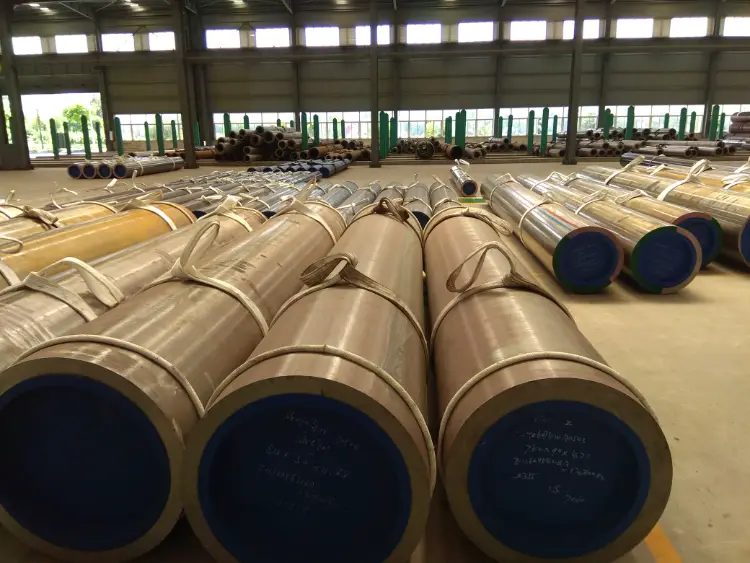
ASTM A139 Grade D LSAW Pipe
ASTM A139 Grade D LSAW Steel Pipe: Full Material Specifications & Alternatives
Explore complete material data for ASTM A139 Grade D steel used in LSAW pipes, including chemical composition restrictions, mechanical properties, bending test requirements, physical constants, international equivalents, similar substitutes, and typical applications.
LSAW (Longitudinal Submerged Arc Welding) from steel plates or coils; subsequent cold expansion, hydrostatic testing, and non-destructive examination are typical. Readily machinable, cuttable, and weldable in fabrication.
- Phone : +8618037372205
- Email : [email protected]
- WhatsApp: Contact via Whtsapp
- WeChat: +8618037372205
ASTM A139 Grade D LSAW Pipe Introduction
ASTM A139 Grade D is an electric-fusion (arc) welded steel pipe grade primarily intended for structural and piling applications. Manufactured by the longitudinal submerged arc welding (LSAW) process, it offers a reliable combination of moderate strength, good weldability, and toughness suitable for welded, bolted, or riveted construction. With a minimum yield strength of 310 MPa (45 ksi) and tensile strength of 415 MPa (60 ksi), it bridges the gap between lower-strength structural grades and higher-strength pipeline steels. The chemistry is not rigidly fixed by the standard, allowing producer flexibility while maintaining consistent mechanical performance under mandatory testing. This material is widely adopted in civil engineering, marine piling, building columns, and industrial structures where cost-effective strength and cylindrical form are essential.
ASTM A139 Grade D LSAW Pipe Chemical Composition
ASTM A139 imposes no fixed chemistry limits for Grade D; the composition is subject to agreement between the manufacturer and purchaser. However, product analysis tolerances are given in the standard, and typical heat analysis of the base metal falls within the ranges below for structural quality steel. These values are typical reference and not mandatory minima or maxima. The composition must ensure weldability and the required mechanical properties.
| Chemical Element | Typical Reference Value | Remarks |
|---|---|---|
| Carbon (C) | ≤0.25% | Typical maximum; actual agreed upon. Controls weldability and strength. |
| Manganese (Mn) | 0.60–1.20% | Provides strength and toughness. Varies with plate thickness. |
| Phosphorus (P) | ≤0.035% | Low phosphorus improves ductility and welding. |
| Sulfur (S) | ≤0.035% | Low sulfur reduces hot cracking risk. |
| Silicon (Si) | 0.15–0.40% | Deoxidizer; aids strength. |
| Other Elements | Balance Fe | Copper, chromium, nickel, molybdenum may be present as residuals or intentionally added with agreement. |
ASTM A139 Grade D LSAW Pipe Thermal and Electrical Physical Properties
These values represent typical physical properties for carbon-manganese structural steels and are not part of ASTM A139's mandatory test schedule. They are provided for engineering calculations such as thermal stress analysis, heat transfer, and electrical resistivity estimates. Actual values may vary slightly depending on exact chemistry and microstructure.
| Property | Typical Reference Value | Unit | Test Condition / Temperature |
|---|---|---|---|
| Density (ρ) | 7850 | kg/m³ | Ambient (20 °C) |
| Elastic Modulus (E) | 200–210 | GPa | Tension, room temperature |
| Shear Modulus (G) | 80 | GPa | Calculated from E and ν, room temperature |
| Poisson's Ratio (ν) | 0.29–0.30 | — | Elastic range, ambient temperature |
| Thermal Expansion Coefficient (α) | 11.7 × 10⁻⁶ | K⁻¹ | Mean between 20 °C and 100 °C |
| Thermal Conductivity (λ) | 50 | W/(m·K) | At 100 °C (approx. for plain carbon steel) |
| Specific Heat Capacity (cp) | 460–500 | J/(kg·K) | Between 20 °C and 100 °C |
| Electrical Resistivity (ρe) | 0.22 × 10⁻⁶ | Ω·m | At 20 °C (microhm-meter) |
ASTM A139 Grade D LSAW Pipe Mechanical Properties
Mechanical properties are mandatory and determined from tensile and bend tests on a test specimen taken from the finished pipe. The values below represent the minimum requirements for ASTM A139 Grade D in its as-welded delivery condition. All tests are performed at room temperature in accordance with ASTM A370. For elongation, different gage lengths and wall thickness thresholds apply.
| Property | Standard Required Value | Unit | Test Condition |
|---|---|---|---|
| Yield Strength (ReH) | ≥310 (45 ksi) | MPa (ksi) | 0.2% offset or 0.5% extension under load, transverse specimen, room temperature |
| Tensile Strength (Rm) | ≥415 (60 ksi) | MPa (ksi) | Ultimate strength, transverse specimen |
| Elongation (A) in 2 in. (50 mm) | ≥30% | % | For wall thickness ≤ 7.94 mm (5/16 in.) |
| Elongation (A) in 2 in. (50 mm) | ≥25% | % | For wall thickness > 7.94 mm (5/16 in.) |
| Bend Test (90°) | No cracks or opening > 3.2 mm (1/8 in.) after bending 90° | — | Bend radius = 1 × wall thickness (for Grade D per typical ASTM A139 requirement); specimen width 38 mm (1.5 in.) |
ASTM A139 Grade D LSAW Pipe Directly Equivalent Material Standards and Substitution Grades
There is no formally designated international equivalent for ASTM A139 Grade D, as the standard covers chemical flexibility. However, the following steel grades, when supplied as welded tube with comparable dimensions and supplementary requirements, can be considered functionally equivalent for structural applications after agreement between purchaser and supplier.
| Country/Region | Standard | Grade | Remarks |
|---|---|---|---|
| USA / Canada | CSA G40.21 / ASTM A500 | Grade C (50W Type) | Yield 345 MPa, requires slightly higher strength; often used interchangeably in structural hollow sections. |
| Europe | EN 10219 | S355J2H | Minimum yield 355 MPa, cold-formed welded structural hollow sections; higher strength requires design adjustment. |
| Japan | JIS G3444 | STK490 | Yield ≥ 315 MPa, tensile ≥ 490 MPa; very close match for structural tubulars. |
| International (Pipeline) | API 5L / ISO 3183 | X42 (L290) | Yield ≥ 290 MPa, tensile ≥ 415 MPa; used for LSAW pipe; slight understrength but balanced by stricter toughness and chemistry. |
ASTM A139 Grade D LSAW Pipe Application Introduction
ASTM A139 Grade D LSAW pipe is designed for moderate-load structural applications where field welding and bolting are required. Its controlled mechanical properties and reliable weld seam integrity make it a preferred choice for permanent construction in both inland and marine environments. Key application areas include:
Product Applications: Large-diameter structural columns, Pile pipes (bearing and friction piles), Steel pipe piles with end plates or shoes, Combination wall piles (connectors welded to pipe), Pile caps and transition pieces, Mono-poles for lighting and antennas, Straight-run water transmission pipes (non-pressurized or low-pressure)
Processed into products: Structural support frames and bracing members, Cantilever sign posts, Bridge pier columns and cross-beams, Cofferdam cells and internal bracing, Dolphin piles and mooring posts, Gate valves and valve chambers (large-bore piping), Industrial machine bases and frames, Exhaust stacks and ventilation shafts
Application industries: Civil and structural engineering (bridges, high-rise columns, stadium frameworks), Marine and offshore engineering (dock piles, dolphins, mooring structures), Port and harbor construction (fender piles, retaining walls), Utility and transmission (lighting poles, HV transmission towers), Highway and railway infrastructure (sign gantries, crash barriers), Water and wastewater (culverts, intake pipes, penstocks)
ASTM A139 Grade D LSAW Pipe Similar / Closely Related Alternative Materials
These grades exhibit mechanical properties and welding characteristics close to ASTM A139 Grade D, and they are often used in similar LSAW or structural tubular applications. When substituted, verification of geometry, delivery condition, and additional tests is recommended.
| Country/Region | Standard | Grade | Remarks |
|---|---|---|---|
| USA | ASTM A252 | Grade 3 | Steel pipe piles; yield 345 MPa (50 ksi), tensile 485 MPa (70 ksi). Higher strength, may require weld procedure requalification. |
| USA | ASTM A53 | Grade B (Type E or S) | Seamless/welded pipe for pressure and structural; yield 240 MPa (35 ksi). Lower strength, but widely available. |
| Europe | EN 10210 | S355J2H | Hot-finished structural hollow sections; equivalent strength range, different manufacturing route (hot-formed) but similar end use. |
| China | GB/T 9711 | L290M (X42M) | Welded steel pipe for pipeline transportation; similar tensile, lower yield (290 MPa). Needs chemical agreement for structural use. |
Notes:
Supplementary requirements: ASTM A139 permits the purchaser to specify numerous supplementary tests applicable to Grade D, such as Charpy V-notch impact testing (S1), drop-weight tear testing (S2), radiographic or ultrasonic examination (S3, S4), and hydrostatic testing (S5). Welding: Grade D steel is readily weldable with low-hydrogen processes; preheat may be necessary for thicker sections (>25 mm) depending on carbon equivalent. LSAW seam: The longitudinal weld is full-penetration submerged-arc, typically made with compatible filler metal ensuring joint efficiency equal to 100% of the base metal. Certification to ASTM A139 requires the pipe to be marked with manufacturer, specification, grade, size, and heat number.
- Share



