
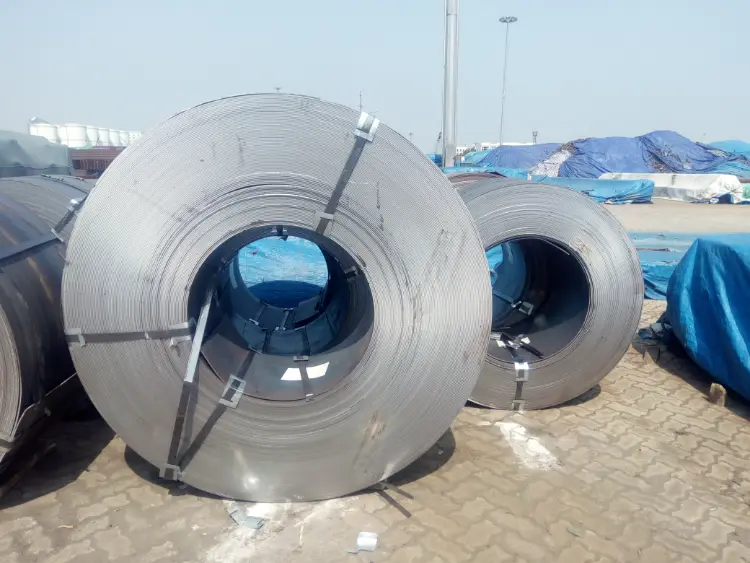
BV FH40 Shipbuilding Steel Coil
BV FH40 Shipbuilding Steel Coil: High Strength Low Temperature Marine Grade
Comprehensive technical data for BV FH40 shipbuilding steel coil, including chemical composition, mechanical properties, thermal and electrical physical properties, international equivalent grades, and application guidelines.
Hot rolling, controlled rolling, thermomechanical controlled processing (TMCP), normalizing
- Phone : +8618037372205
- Email : [email protected]
- WhatsApp: Contact via Whtsapp
- WeChat: +8618037372205
BV FH40 Shipbuilding Steel Coil Introduction
BV FH40 is a high-strength shipbuilding structural steel grade certified by Bureau Veritas (BV) for marine applications demanding excellent toughness at temperatures down to -40°C.
- High yield strength (≥390 MPa) combined with good weldability
- Excellent low-temperature impact toughness (KV -40°C ≥ 41 J longitudinal)
- Superior resistance to brittle fracture under harsh sea conditions
- Controlled rolling or TMCP delivery condition for optimized microstructure
- Strict chemical composition control for consistent quality
BV FH40 Shipbuilding Steel Coil Chemical Composition
Chemical composition according to BV Rules for Grade FH40. The steel is microalloyed with niobium, vanadium and/or titanium to achieve fine grain size and high strength. Maximum limits are specified unless a range is given.
- Low carbon content ensures good weldability
- Aluminum is added as a grain refiner and deoxidizer
- Controlled sulfur and phosphorus enhance toughness
| Element | Standard Value | Remarks |
|---|---|---|
| Carbon (C) | ≤ 0.16 | Ladle analysis |
| Silicon (Si) | 0.10 - 0.50 | Ladle analysis |
| Manganese (Mn) | 0.90 - 1.60 | Ladle analysis |
| Phosphorus (P) | ≤ 0.025 | Ladle analysis |
| Sulfur (S) | ≤ 0.025 | Ladle analysis |
| Chromium (Cr) | ≤ 0.20 | Ladle analysis |
| Nickel (Ni) | ≤ 0.40 | Ladle analysis |
| Molybdenum (Mo) | ≤ 0.08 | Ladle analysis |
| Copper (Cu) | ≤ 0.35 | Ladle analysis |
| Aluminum (Al) Total | ≥ 0.015 | Acid-soluble; for fine grain practice |
| Niobium (Nb) | ≤ 0.05 | Microalloying element |
| Vanadium (V) | ≤ 0.10 | Microalloying element |
| Titanium (Ti) | ≤ 0.02 | Microalloying element |
| Nitrogen (N) | ≤ 0.009 | Ladle analysis |
BV FH40 Shipbuilding Steel Coil Thermal and Electrical Physical Properties
Typical physical properties for FH40 steel at room temperature and elevated temperatures. These values are for reference and may vary slightly depending on exact composition and heat treatment.
- Used for design calculations involving heat transfer and thermal expansion
- Values are representative for low alloy structural steels
| Property | Typical Value | Unit | Test Condition |
|---|---|---|---|
| Density (ρ) | 7.85 | g/cm³ | 20°C |
| Modulus of elasticity (E) | 205 | GPa | 20°C |
| Shear modulus (G) | 79.3 | GPa | 20°C (calculated from E and ν) |
| Poisson's ratio (ν) | 0.3 | - | Ambient |
| Thermal expansion coefficient (α) | 12.0 | 10⁻⁶/K | 20–100°C |
| Thermal conductivity (λ) | 52 | W/(m·K) | 20°C |
| Specific heat capacity | 460 | J/(kg·K) | 20°C |
| Electrical resistivity (ρ_e) | 0.2 | μΩ·m | Ambient |
BV FH40 Shipbuilding Steel Coil Mechanical Properties
Mechanical properties as required by BV Rules for thickness ≤ 50 mm. Tensile testing is performed in the transverse direction unless longitudinal specimens are specifically agreed. Impact test temperature is -40°C. Values represent minimum requirements.
- High yield strength allows weight reduction in hull design
- Guaranteed elongation ensures ductility for forming
- Stringent impact energy ensures safety in cold service
| Property | Required Value | Unit | Test Condition |
|---|---|---|---|
| Upper yield strength (ReH) | ≥ 390 | MPa | Transverse, t ≤ 50 mm |
| Tensile strength (Rm) | 510 - 650 | MPa | Transverse, t ≤ 50 mm |
| Elongation after fracture (A5) | ≥ 20 | % | Gauge length 5.65√So, transverse |
| Impact energy (KV) -40°C, longitudinal | ≥ 41 | J | Charpy V-notch, average of 3 tests |
| Impact energy (KV) -40°C, transverse | ≥ 27 | J | Charpy V-notch, average of 3 tests; if specified |
| Bend test (bend angle 180°) | d = 3a | - | a = specimen thickness; t ≤ 35 mm; no cracks |
BV FH40 Shipbuilding Steel Coil Fully Equivalent Material Standards and Substitute Grades
| Country/Region | Standard | Grade | Remarks |
|---|---|---|---|
| International | IACS (Unified Requirement) | FH40 | All member classification societies |
| USA | ABS Rules | ABS FH40 | American Bureau of Shipping |
| Norway | DNV Rules | DNV FH40 | Det Norske Veritas |
| UK | LR Rules | LR FH40 | Lloyd's Register |
| Japan | NK Rules | NK FH40 | Nippon Kaiji Kyokai |
| South Korea | KR Rules | KR FH40 | Korean Register |
| China | CCS Rules / GB 712 | CCS FH40 / FH40 | China Classification Society |
| Italy | RINA Rules | RINA FH40 | Registro Italiano Navale |
BV FH40 Shipbuilding Steel Coil Application Introduction
BV FH40 steel is designed for high-stress ship and offshore structural components operating in low-temperature environments. Its excellent toughness and strength-to-weight ratio make it suitable for lightweight yet robust designs. Typical applications include:
Product Applications: Container ships and bulk carriers, Oil tankers and LNG carriers, Offshore supply vessels (OSV), Icebreakers and arctic research ships, Jack-up rig legs and spudcans
Processed into products: Hull shell plates (bottom, side, deck), Longitudinal stiffeners and girders, Transverse bulkheads and web frames, Hatch coaming and corner reinforcement, Rudder and stern frame structures
Application industries: Shipbuilding (commercial and naval vessels), Offshore engineering (platforms, jack-ups), Marine equipment manufacturing, Polar class vessel construction
BV FH40 Shipbuilding Steel Coil Similar / Alternative Material Recommendations
| Country/Region | Standard | Grade | Remarks |
|---|---|---|---|
| Europe | EN 10025-4 | S420ML | TMCP structural steel; -50°C impact; yield ≥420 MPa; close but not identical for marine approval |
| Europe | EN 10225 (Offshore) | S420G2+M | Offshore structural steel; -40°C impact; similar strength; may require additional certification |
| Japan | JIS G3106 | SM490YA/B | Welded structural steel; similar strength but impact temperature not guaranteed at -40°C; does not replace FH40 for marine class |
| International | API 2H | Grade 50 | Offshore structural steel; similar yield but property verification needed for shipbuilding classification |
| China | GB 712 | EH40 | Chinese shipbuilding steel; impact at -40°C; yield ≥390 MPa; alternative within China except for BV stamp |
Notes:
Welding: BV FH40 exhibits excellent weldability with low carbon equivalent (CE). Preheating is generally not required for thicknesses below 30 mm; for thicker sections, control of preheat and interpass temperature is recommended. Certification: Material must be tested and certified by Bureau Veritas surveyor. Ultrasonic testing per BV rules may be mandatory for critical applications. Surface condition: Steel is supplied with as-rolled or descaled surface; coil may be oiled for temporary corrosion protection.
- Share



