
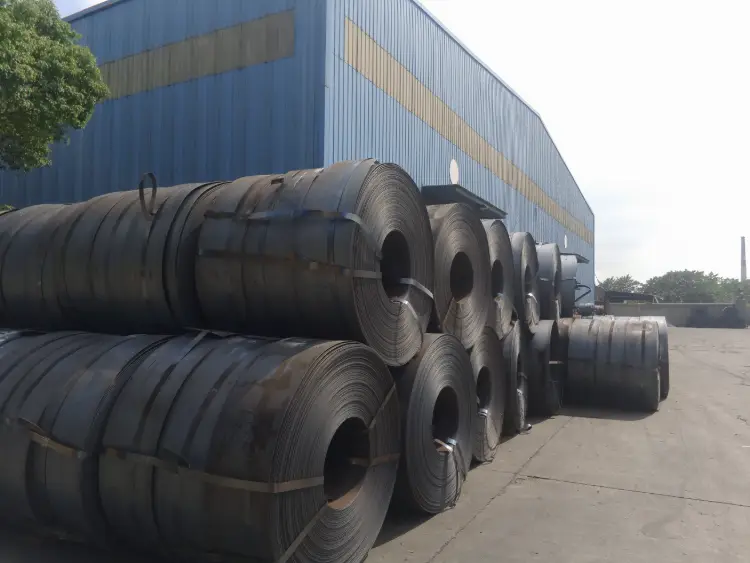
BV F500 Shipbuilding Steel Coil
BV F500 Shipbuilding Steel Coil: High-Strength Hull Structural Plate & Equivalent Grades
Comprehensive material data for BV F500 shipbuilding steel coil: chemical composition, mechanical properties, thermal and electrical physical properties, international equivalents, and application guide for offshore and marine structures.
Hot rolling, controlled rolling, quenching and tempering, welding, bending, cutting, machining
- Phone : +8618037372205
- Email : [email protected]
- WhatsApp: Contact via Whtsapp
- WeChat: +8618037372205
BV F500 Shipbuilding Steel Coil Introduction
BV F500 is a high-strength quenched and tempered structural steel grade certified by Bureau Veritas (BV) for shipbuilding and offshore applications. Designated with a minimum yield strength of 500 MPa, it belongs to the extra-high strength class of hull structural steels according to BV Rules for Steel Ships. The 'F' denotes fine-grain practice and guaranteed impact toughness at -60°C, ensuring reliable performance in Arctic and severe cold environments. This steel is typically supplied as coils, plates, or sections in normalized or quenched and tempered condition. Its high strength-to-weight ratio allows weight reduction in critical ship components while maintaining excellent weldability and formability.
BV F500 Shipbuilding Steel Coil Chemical Composition
The chemical composition of BV F500 steel is not fixed but must comply with the maximum limits specified by BV Rules. Typical ladle analysis ranges are provided below, ensuring adequate hardenability and fine-grain microstructure for strength and toughness.
- Carbon equivalent (CEV) is usually limited to 0.50%–0.55% depending on thickness to guarantee weldability.
- Microalloying elements such as niobium, vanadium, and titanium are added singly or in combination to achieve grain refinement and precipitation strengthening.
| Element | Maximum / Typical Value (%) | Notes |
|---|---|---|
| C | ≤ 0.18 | Higher carbon may impair toughness and weldability |
| Si | ≤ 0.55 | Deoxidation and solid-solution strengthening |
| Mn | ≤ 1.60 | Provides strength and hardenability |
| P | ≤ 0.025 | Phosphorus is a residual element; lower values improve toughness |
| S | ≤ 0.025 | Sulfur limits sulfide inclusions |
| Cr | ≤ 0.50 | Optional; may be present in some heats to enhance hardenability |
| Ni | ≤ 2.0 | Optional; improves toughness at low temperatures |
| Mo | ≤ 0.80 | Optional; may increase hardenability and strength after quenching |
| Cu | ≤ 0.50 | Residual; controlled to avoid hot shortness |
| Nb | ≤ 0.05 | Grain refiner and precipitation strengthener |
| V | ≤ 0.10 | Precipitation strengthening and grain refinement |
| Ti | ≤ 0.05 | Grain size control, deoxidation |
| Al | ≥ 0.015 total | Fine-grain practice (usually total aluminum 0.02–0.05%) |
| N | ≤ 0.012 | Nitrogen control for toughness |
| CEV | ≤ 0.52 (typical) | Based on IIW formula, depends on thickness |
BV F500 Shipbuilding Steel Coil Thermal and Electrical Physical Properties
The following physical properties are representative of quenched and tempered low-alloy steels similar to F500 and are intended for general engineering calculations. They are not mandatory requirements of the BV specification but are derived from published steel data.
- Density and elastic moduli are based on room-temperature measurements.
- Thermal expansion and conductivity vary with temperature; values at elevated temperatures are approximate.
| Property | Typical Value | Unit | Test Condition / Temperature |
|---|---|---|---|
| Density (ρ) | 7.85 | g/cm³ | 20°C |
| Elastic Modulus (E) | 205 | GPa | 20°C |
| Shear Modulus (G) | 80 | GPa | 20°C |
| Poisson's Ratio (ν) | 0.30 | - | 20°C |
| Thermal Expansion (α) | 12.0 × 10⁻⁶ | K⁻¹ | 20–100°C |
| Thermal Expansion (α) | 13.0 × 10⁻⁶ | K⁻¹ | 20–200°C |
| Thermal Expansion (α) | 14.0 × 10⁻⁶ | K⁻¹ | 20–400°C |
| Thermal Conductivity (λ) | 45 | W/(m·K) | 20°C |
| Thermal Conductivity (λ) | 40 | W/(m·K) | 200°C |
| Specific Heat Capacity (c) | 460 | J/(kg·K) | 20°C |
| Electrical Resistivity (ρ_e) | 0.25 × 10⁻⁶ | Ω·m | 20°C |
BV F500 Shipbuilding Steel Coil Mechanical Properties
Mechanical properties apply to quenched and tempered condition with plates up to 100 mm thick. Actual property limits are defined by BV Rules and may vary with product thickness and orientation.
- Tensile testing is performed in accordance with ISO 6892-1, using transverse specimens unless otherwise agreed.
- Impact testing is carried out on Charpy V-notch specimens at -60°C (F-grade), with minimum average absorbed energy values for longitudinal and transverse directions.
- Bend tests require a mandrel diameter of 3× specimen thickness (180° bend) to verify formability.
| Property | Standard Requirement | Unit | Test Condition |
|---|---|---|---|
| Yield Strength (ReH) | ≥ 500 | MPa | Room temperature, thickness ≤ 100 mm, transverse |
| Tensile Strength (Rm) | 610 – 770 | MPa | Room temperature, thickness ≤ 100 mm, transverse |
| Elongation (A) | ≥ 16 | % | Gauge length 5.65√S₀, transverse |
| Bend Test | d = 3a (180°) | - | No cracks; specimen thickness a, bend diameter d |
| Charpy Impact (KV) | ≥ 60 (longitudinal) | J | -60°C, 10×10 mm V-notch, average of 3 |
| Charpy Impact (KV) | ≥ 42 (transverse) | J | -60°C, 10×10 mm V-notch, average of 3 |
BV F500 Shipbuilding Steel Coil Fully Equivalent Standards and Substitutable Grades
| Country / Region | Standard | Grade | Notes |
|---|---|---|---|
| International | BV Rules | F500 | Original BV grade; quenched and tempered, -60°C impact |
| Norway | DNV Rules | NV F500 | Det Norske Veritas equivalent; identical mechanical requirements |
| United Kingdom | LR Rules | FH50 | Lloyd's Register high-strength grade with similar strength and low-temperature toughness |
| Germany/France | EN 10025-6 | S500QL / S500QL1 | European structural steel, QT condition; QL with minimum 50 J at -40°C, QL1 at -60°C |
| USA | ASTM A514 / A517 | Grade Q | High-yield strength quenched and tempered alloy steel plate, 100 ksi (690 MPa) minimum tensile; similar application range |
| International | IACS UR W11 | F500 | Unified Requirement for hull structural steels by International Association of Classification Societies |
BV F500 Shipbuilding Steel Coil Application Introduction
BV F500 steel is designed for the most demanding marine and offshore structural applications where high strength, excellent low-temperature toughness, and good weldability are critical. Its minimum yield of 500 MPa allows significant weight savings compared to conventional 355 or 390 MPa grades, leading to reduced fuel consumption and increased payload in ships. The fine-grain quenched and tempered microstructure provides reliable ductility and resistance to brittle fracture even in Arctic environments.
Product Applications: Hull envelopes and decks of icebreakers and polar supply vessels, Jack-up rig legs and spudcans, FPSO structural modules, Submarine pressure hulls, Crane booms for heavy-lift ships, Offshore wind turbine foundations (transition pieces, monopiles)
Processed into products: Longitudinal stiffeners and bulkhead plating, Shear plates and girder webs in hull girder, Bottom shell plating in high-stress areas, Reinforced frames and brackets, Hydrostructural nodes and complex welded assemblies, Pad-eyes and lifting lugs for large modules, Transition joints between different strength steels
Application industries: Shipbuilding (naval, commercial, and specialized vessels), Offshore oil and gas exploration and production, Marine engineering (ports, breakwaters, floating structures), Polar and ice-class vessel construction, Heavy lifting and transport equipment
BV F500 Shipbuilding Steel Coil Similar / Alternative Material Recommendations
| Country / Region | Standard | Grade | Remarks |
|---|---|---|---|
| Japan | JIS G 3128 | SHY685N | High yield strength steel for welded structures; slightly higher tensile range; suitable for heavy machinery and shipbuilding |
| China | GB/T 712 | FH550 | Chinese shipbuilding steel with minimum yield 550 MPa; often used as an alternative to F500 in Asian yards |
| USA | API 2W / 2Y | Grade 60 / Grade 70 | Offshore structural steel plates; provide comparable toughness at low temperature but based on 60 or 70 ksi yield (414–483 MPa). Not direct substitute but used in offshore |
| Finland/Sweden | SSAB | Strenx 700MC Plus | High-strength cold-forming steel; yield ≥700 MPa; improved weldability; suitable for weight-critical designs where higher strength is acceptable |
| Italy | UNI EN 10025-6 | S500QL1 | Identical to EN grade; often referenced in European shipbuilding as substitute for BV grades |
Notes:
Welding recommendations: F500 steel should be welded with low-hydrogen processes (SMAW, SAW, GMAW) using matching or slightly undermatching filler metals. Preheating may be required depending on thickness and ambient conditions; typical preheat is 100–175°C. Post-weld heat treatment (PWHT) is generally not requested but if needed, stress-relieving should be carried out at temperatures not exceeding the tempering temperature (usually 550–600°C). Corrosion resistance: As a low-alloy carbon steel, F500 does not possess inherent atmospheric corrosion resistance and requires protective coatings or cathodic protection in marine environments. Delivery documentation: BV material certificates with stamp and surveyor's signature are mandatory; test reports include chemical analysis, tensile, impact, and bend tests.
- Share



