
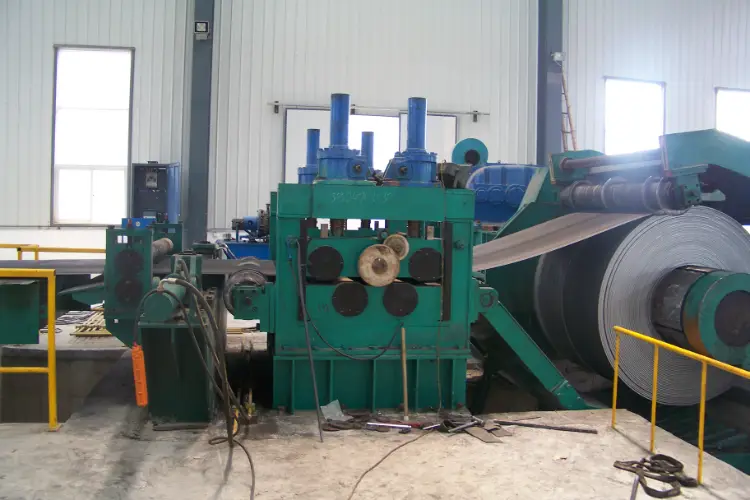
BV A550 Shipbuilding Steel Coil
BV A550 Shipbuilding Steel Coil: Full Data, Equivalents & Marine Applications
Explore detailed specifications of BV A550 high-strength shipbuilding steel coil – chemical composition, mechanical & thermal properties, international equivalents, and application guide per Bureau Veritas rules.
Welding, bending, cutting, forming (suitable for conventional fabrication methods)
- Phone : +8618037372205
- Email : [email protected]
- WhatsApp: Contact via Whtsapp
- WeChat: +8618037372205
BV A550 Shipbuilding Steel Coil Introduction
BV A550 is a high-strength structural steel grade certified by Bureau Veritas for ship and offshore construction. With a minimum yield strength of 550 MPa, it offers excellent weldability, good low-temperature toughness, and reliable performance in harsh marine environments. It is typically supplied as hot-rolled coils or cut-to-length plates in normalized, thermomechanically rolled (TMCP), or quenched-and-tempered condition. The 'A' designation indicates Charpy impact testing at 0 °C, ensuring sufficient ductility for critical structural components. BV A550 complies with BV Rules for the Classification of Steel Ships, Part 2, Chapter 1, and is widely used in hulls, decks, and offshore modules.
BV A550 Shipbuilding Steel Coil Chemical Composition
The chemical composition is controlled to guarantee high strength combined with good weldability and toughness. Maximum limits on carbon, phosphorus, and sulfur are strictly enforced. Microalloying elements such as Nb, V, Ti, and Al are added for grain refinement and precipitation strengthening. The typical heat analysis values are shown below, based on general BV requirements for grade A550. Actual values may be further optimized by the steelmaker, but must remain within the classification limits.
| Element | Specified Value (max. or range) | Remarks |
|---|---|---|
| Carbon (C) | ≤ 0.18 % | Ladle analysis; lower content improves toughness and weldability |
| Silicon (Si) | ≤ 0.50 % | Deoxidizer; higher Si may be allowed for killed steel |
| Manganese (Mn) | 1.00 – 1.60 % | Primary strengthening element |
| Phosphorus (P) | ≤ 0.025 % | Strict limitation to avoid embrittlement |
| Sulfur (S) | ≤ 0.025 % | Controlled for lamellar tearing resistance |
| Copper (Cu) | ≤ 0.35 % | Residual element; may be intentionally added for atmospheric corrosion resistance |
| Chromium (Cr) | ≤ 0.20 % | Residual; enhances hardenability |
| Nickel (Ni) | ≤ 0.40 % | Improves toughness at low temperatures |
| Molybdenum (Mo) | ≤ 0.08 % | Residual; contributes to strength |
| Niobium (Nb) | ≤ 0.05 % | Grain refiner; total Nb+V+Ti ≤ 0.12 % |
| Vanadium (V) | ≤ 0.10 % | Precipitation strengthening |
| Titanium (Ti) | ≤ 0.02 % | Grain refinement and sulfide shape control |
| Aluminium (Al, acid soluble) | ≥ 0.015 % | Minimum for fine grain practice |
| Nitrogen (N) | ≤ 0.009 % | Ideally kept low to avoid strain ageing |
| Total Nb+V+Ti | ≤ 0.12 % | Combined microalloy limit per BV rules |
BV A550 Shipbuilding Steel Coil Physical & Thermal Properties
The following physical and thermal properties are typical for high‑strength shipbuilding steels at room temperature unless otherwise stated. They are not part of the mandatory BV certification testing but are essential for design calculations. Values are derived from widely accepted data for similar 550 MPa yield‑strength structural steels and may vary slightly depending on exact composition and heat treatment.
| Property | Typical Value | Unit | Conditions / Remarks |
|---|---|---|---|
| Density (ρ) | 7850 | kg/m³ | Room temperature |
| Modulus of Elasticity (E) | 210 | GPa | Room temperature |
| Shear Modulus (G) | 81 | GPa | Calculated from E and ν |
| Poisson's Ratio (ν) | 0.3 | – | Elastic range |
| Thermal Expansion Coefficient (α) | 12.0 × 10⁻⁶ | /K | 20–100 °C |
| Thermal Expansion Coefficient (α) | 13.0 × 10⁻⁶ | /K | 20–200 °C |
| Thermal Expansion Coefficient (α) | 13.5 × 10⁻⁶ | /K | 20–300 °C |
| Thermal Conductivity (λ) | 45 | W/(m·K) | At 25 °C; decreases slightly with increasing temperature |
| Specific Heat Capacity | 460 | J/(kg·K) | Approximate at 20 °C |
| Electrical Resistivity (ρ_e) | 0.22 × 10⁻⁶ | Ω·m | At room temperature |
BV A550 Shipbuilding Steel Coil Mechanical Properties
Mechanical testing is performed on specimens taken in the transverse direction unless otherwise specified. Yield and tensile strengths are valid for plate thicknesses up to 100 mm; a slight reduction applies to thicker sections as per BV rules. Charpy V‑notch impact energy is guaranteed at 0 °C for grade A550. Bend test requirement is 180° with no cracks, using the prescribed mandrel diameter. All values represent minimum requirements from BV Rules Part 2, Chapter 1, unless noted as typical.
| Property | Required Value | Unit | Test / Condition |
|---|---|---|---|
| Yield Strength (ReH) | ≥ 550 | MPa | Thickness t ≤ 50 mm, transverse |
| Yield Strength (ReH) | ≥ 530 | MPa | 50 < t ≤ 100 mm, transverse |
| Tensile Strength (Rm) | 670 – 830 | MPa | All thicknesses, transverse |
| Elongation (A) | ≥ 17 | % | Gauge length 5.65√So, transverse |
| Charpy Impact Energy (KV2) | ≥ 31 (average), ≥ 22 (single) | J | 0 °C, V‑notch, transverse |
| Bend Test (180° bending) | No cracks | – | Mandrel diameter = 3t (t ≤ 25 mm); 4t (25<t≤50 mm) |
BV A550 Shipbuilding Steel Coil Exact Matches – Fully Equivalent Classification Society Grades
| Country / Region | Standard / Rule | Grade | Remarks |
|---|---|---|---|
| International | IACS UR W11 (guideline) | AH550 | Common IACS high‑strength ship steel designation |
| United Kingdom | Lloyd's Register Rules | LR A550 | Identical toughness level (A class) |
| Norway | DNV GL Rules | NV A550 | DNV merged with GL; A550 is current |
| USA | ABS Rules | ABS AH550 | 'H' indicates higher strength; toughness level A |
| Germany | Germanischer Lloyd (GL) – now DNV GL | GL A550 | Legacy GL designation |
| China | CCS Rules | CCS A550 | China Classification Society |
| South Korea | KR Rules | KR A550 | Korean Register |
| Japan | ClassNK Rules | NK KA550 | Nippon Kaiji Kyokai |
| Italy | RINA Rules | RINA A550 | Registro Italiano Navale |
| France | Bureau Veritas | BV A550 | Original specification |
BV A550 Shipbuilding Steel Coil Application Introduction
BV A550 is engineered for applications where high strength, weight reduction, and reliable ductility are essential. Its excellent weldability and crack resistance make it a first choice for modern shipbuilding and offshore engineering. The steel can be processed by all common cutting, forming, and welding techniques with appropriate preheating and consumables. When fatigue or fracture‑critical joints are involved, additional post‑weld heat treatment (PWHT) is rarely required if correct procedures are followed.
Product Applications: Container ships and bulk carriers (hull plating, frames), Ice‑class vessels (ice belts and stringers), Offshore construction jack‑ups (legs, spudcans, hull), Semi‑submersible drilling rigs (columns, pontoons), Offshore wind turbine towers and transition pieces
Processed into products: Deck plates and shell plates, Longitudinal stiffeners and transverse webs, Bulkheads and watertight doors, Hatch coamings and crane pedestals, Foundation pads for heavy machinery, Bollards, towing brackets, and lifting lugs
Application industries: Shipbuilding (commercial and naval vessels), Offshore oil & gas (platforms, FPSOs, jackets), Marine engineering (harbour cranes, mooring equipment), Renewable energy (wind turbine foundations, substructures), Heavy lifting and transport (crane barges, heavy‑lift vessels)
BV A550 Shipbuilding Steel Coil Similar / Alternative Materials
| Country / Region | Standard | Grade | Remarks / Analysis |
|---|---|---|---|
| EU | EN 10025‑6 (2019) | S550Q | Quenched and tempered structural steel; minimum yield 550 MPa at t≤50 mm. Lacks specific shipbuilding toughness guarantees (e.g., Z‑quality, low‑temperature Charpy at 0 °C may not be guaranteed). Can be considered if additional impact tests are agreed. |
| EU | EN 10225 (2009) | S550G2+M | Weldable structural steel for fixed offshore structures; similar strength and improved toughness ( -40 °C). Closer to BV F550 than A550; suitable for offshore applications where higher CTOD requirements apply. |
| USA | ASTM A131 / A131M | EH550 | Higher‑strength hull structural steel with toughness for "E" grade (‑40 °C). Slight over‑specification on toughness but otherwise similar strength. AH550 from ASTM A131 would be a closer match for A550. |
| USA | ASTM A572 / A572M | Grade 65 | General structural steel, yield 450 MPa (65 ksi) – significantly lower strength; not a direct substitute but sometimes used in lighter structures where 550 MPa is not essential. |
| International | API 2W | Grade 50 | Steel for offshore tubular platforms; yield 345–414 MPa (50 ksi min). Strength below A550; only suitable for less demanding components. |
Notes:
Additional considerations:
- BV A550 is typically delivered with a BV 3.2 inspection certificate and must be ordered with the required surveyor's stamp.
- The steel is often supplied with enhanced through‑thickness properties (Z‑grade, e.g., Z25, Z35) if specified, to resist lamellar tearing in highly restrained welded joints.
- Weldability is generally good; carbon equivalent (CEV) is usually ≤ 0.43% for this grade. Preheating may be recommended for thick sections (>30 mm) or low ambient temperatures.
- For plates thicker than 100 mm, mechanical properties must be agreed upon individually with the steelmaker and BV.
- When replacing BV A550 with an equivalent grade from another class society, the designer should verify that the material's toughness (Charpy test temperature) matches the design temperature of the structure.
- This data is provided for general information only. For certified values, refer to the original mill test certificate and the latest BV rules.
- Share



