
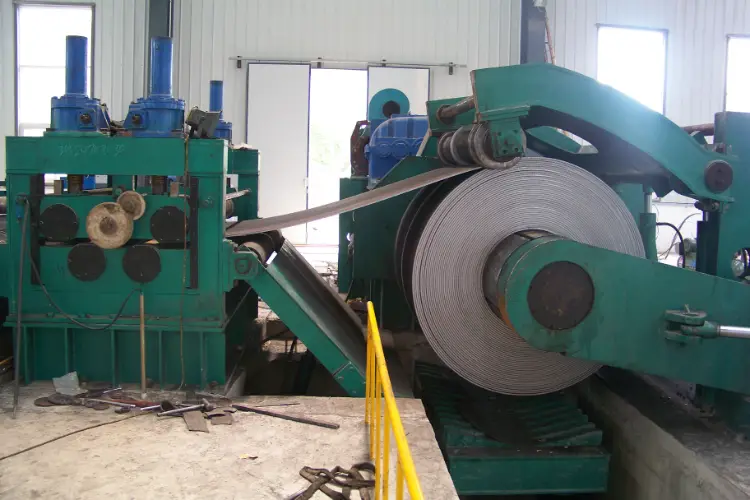
BV D550 Shipbuilding Steel Coil
BV D550 Shipbuilding Steel Coil: Technical Data & Equivalent Grades
Comprehensive material data for BV D550 high-strength shipbuilding steel coil certified by Bureau Veritas. Includes chemical composition, mechanical and physical properties, international equivalents, and application guidance.
Hot rolling, thermomechanical rolling (TMCP), normalizing, quenching and tempering as appropriate
- Phone : +8618037372205
- Email : [email protected]
- WhatsApp: Contact via Whtsapp
- WeChat: +8618037372205
BV D550 Shipbuilding Steel Coil Introduction
BV D550 is a high-strength hull structural steel grade certified by Bureau Veritas (BV) in accordance with the International Association of Classification Societies (IACS) Unified Requirement UR W11. It is designed for critical welded structures in shipbuilding and offshore engineering where high yield strength (minimum 550 MPa) and good low-temperature toughness are required. The 'D' designation indicates that the steel is supplied with guaranteed Charpy V-notch impact properties at -20°C. This grade offers excellent weldability, improved strength-to-weight ratio, and reliable performance in severe marine environments.
- Yield strength: 550 MPa minimum
- Tensile strength: 670-830 MPa
- Excellent notch toughness at -20°C
- Compliant with BV Rules and IACS UR W11
BV D550 Shipbuilding Steel Coil Chemical Composition
The chemical composition conforms to the requirements of IACS UR W11 for DH550 grade. The following limits are typical for thickness ≤ 100 mm. Note: The steel is fully killed and fine-grained, with grain-refining elements such as Al, Nb, and V. Carbon equivalent (CEV) is controlled to ensure weldability.
| Element | Content (%) | Remarks |
|---|---|---|
| C | ≤ 0.18 | Ladle analysis; CEV typically ≤ 0.47-0.49 depending on thickness |
| Si | 0.10 - 0.55 | Killed steel |
| Mn | 0.90 - 1.60 | May be adjusted for strength and thickness |
| P | ≤ 0.025 | Maximum |
| S | ≤ 0.025 | Maximum |
| Al (total) | ≥ 0.015 | Grain refinement |
| Nb | 0.02 - 0.05 | Microalloying for grain refinement and precipitation strengthening |
| V | 0.05 - 0.10 | Optional microalloying element |
| Ti | ≤ 0.02 | Grain refinement (if added) |
| Cr | ≤ 0.20 | Residual element |
| Ni | ≤ 0.40 | Residual element |
| Mo | ≤ 0.08 | Residual element |
| Cu | ≤ 0.35 | Residual element |
| N | ≤ 0.012 | Maximum nitrogen content |
| Others | Trace | As agreed; may contain B (≤0.0005) as optional |
BV D550 Shipbuilding Steel Coil Thermal and Electrical Physical Properties
The following physical properties are typical for high-strength low-alloy structural steels with similar composition, and are provided for design reference only. They are not mandated by the BV specification but are representative for D550 grade. Note: Actual values may vary slightly depending on exact chemistry and processing route.
| Property | Typical Value | Unit | Test Condition / Remarks |
|---|---|---|---|
| Density (ρ) | 7850 | kg/m³ | At 20°C |
| Elastic modulus (E) | 210 | GPa | Room temperature |
| Shear modulus (G) | 80 | GPa | Calculated from E and ν |
| Poisson's ratio (ν) | 0.3 | - | Elastic range |
| Thermal expansion coefficient (α) | 12.0 | 10⁻⁶/K | 20-100°C |
| Thermal expansion coefficient (α) | 13.0 | 10⁻⁶/K | 20-200°C |
| Thermal conductivity (λ) | 45 | W/m·K | At 20°C |
| Specific heat capacity | 460 | J/kg·K | At 20-100°C |
| Electrical resistivity (ρ_e) | 0.20 - 0.25 | µΩ·m | At 20°C |
BV D550 Shipbuilding Steel Coil Mechanical Properties
Mechanical properties are evaluated on standard test pieces taken in the transverse direction unless otherwise specified. The following values are minimum requirements for thickness ≤ 50 mm unless otherwise noted. Note: Tensile strength and yield strength may be reduced for thicker sections; elongation and impact values also vary with thickness and specimen orientation.
| Property | Value | Unit | Test Condition |
|---|---|---|---|
| Yield strength (ReH) | ≥ 550 | MPa | Thickness ≤ 50 mm; for thickness 50-70 mm ≥ 530 MPa |
| Yield strength (ReH) | ≥ 520 | MPa | Thickness 70-100 mm |
| Tensile strength (Rm) | 670 - 830 | MPa | For all thickness ≤ 100 mm |
| Elongation (A5) | ≥ 18 | % | Longitudinal, gauge length 5.65√So |
| Bend test | No cracks | - | Bend angle 180°, mandrel diameter 3a (a = specimen thickness) |
| Charpy V-notch impact (KV2, longitudinal) | ≥ 41 | J | At -20°C, for thickness ≤ 50 mm |
| Charpy V-notch impact (KV2, transverse) | ≥ 27 | J | At -20°C, for thickness ≤ 50 mm (if required) |
BV D550 Shipbuilding Steel Coil Fully Equivalent Materials – Standards and Substitute Grades
| Country/Region | Standard | Grade | Remarks |
|---|---|---|---|
| International | IACS UR W11 | DH550 | Identical requirement under IACS unified rules |
| USA | ABS Rules | ABS DH550 | American Bureau of Shipping equivalent |
| Norway/Germany | DNV Rules | DNV DH550 / VL DH550 | DNV GL (now DNV) equivalent |
| UK | LR Rules | LR DH550 | Lloyd's Register equivalent |
| China | CCS Rules / GB/T 712 | CCS DH550 / DH550 | China Classification Society; also appears in GB/T 712 high-strength hull structural steel |
| South Korea | KR Rules | KR DH550 | Korean Register equivalent |
| Japan | NK Rules | NK DH550 | Nippon Kaiji Kyokai equivalent |
| Italy | RINA Rules | RINA DH550 | Registro Italiano Navale equivalent |
| Russia | RS Rules | RS DH550 | Russian Maritime Register of Shipping equivalent |
BV D550 Shipbuilding Steel Coil Application Introduction
BV D550 steel is specifically developed for demanding shipbuilding and marine constructions where high strength and toughness are essential. Its balanced chemical composition and controlled rolling provide excellent weldability and formability, making it suitable for a wide range of structural components.
- Used primarily in ship hulls, decks, and bottom structures
- Applicable for offshore platform legs, nodes, and modules
- Suitable for heavy machinery supports and cargo handling equipment
- Can be formed, welded, and machined with standard procedures
Product Applications: Ship hulls, bulkheads, and stiffeners, Deck plating and bottom shell plating, Container guides and hatch coamings, Ice-class vessel structures, Jack-up rig legs and spudcans, Offshore platform modules and crane pedestals
Processed into products: Longitudinal stiffeners and transversal frames, Watertight and structural bulkheads, Heavy-duty hatch covers, Ship crane booms and pedestals, Reinforcement plates and brackets, Offshore wind turbine transition pieces (when certified by BV)
Application industries: Shipbuilding and ship repair (commercial and naval vessels), Offshore oil and gas exploration and production, Marine engineering and port equipment, Heavy transport and lifting machinery
BV D550 Shipbuilding Steel Coil Similar/Comparable Materials with Close Properties
| Country/Region | Standard | Grade | Remarks |
|---|---|---|---|
| Europe | EN 10025-6 | S550QL (1.8926) | Quenched and tempered structural steel with minimum 550 MPa yield; good low-temperature toughness (-20°C option); not certified by BV but similar strength and service temperature; requires separate procedure for marine application. |
| Europe | EN 10225 | S550G1+M or S550G2+M | Weldable structural steels for fixed offshore structures; thermomechanical rolled; comparable strength and toughness; may satisfy BV offshore class if qualification agreed. |
| USA | ASTM A514/A514M | Grade E (or Q) | Quenched and tempered alloy steel, 690 MPa tensile; yield ~550 MPa; different chemical composition and specified for structural applications; not automatically accepted for shipbuilding. |
| China | GB/T 1591 | Q550D | High strength low alloy structural steel with min. yield 550 MPa; D-quality for -20°C impact; used in general engineering; may be considered as an alternative with additional marine approvals. |
Notes:
This data is based on IACS UR W11 (Rev.11, 2021) requirements for DH550 and corresponding BV rules. Actual material may be supplied with supplementary requirements such as through-thickness properties (Z-quality), CTOD testing, or specific welding consumable pre-qualification. Always consult the latest BV material certification and project specifications. Physical properties are typical values and should not be used for critical engineering calculations without confirmation from the mill.
- Share



