
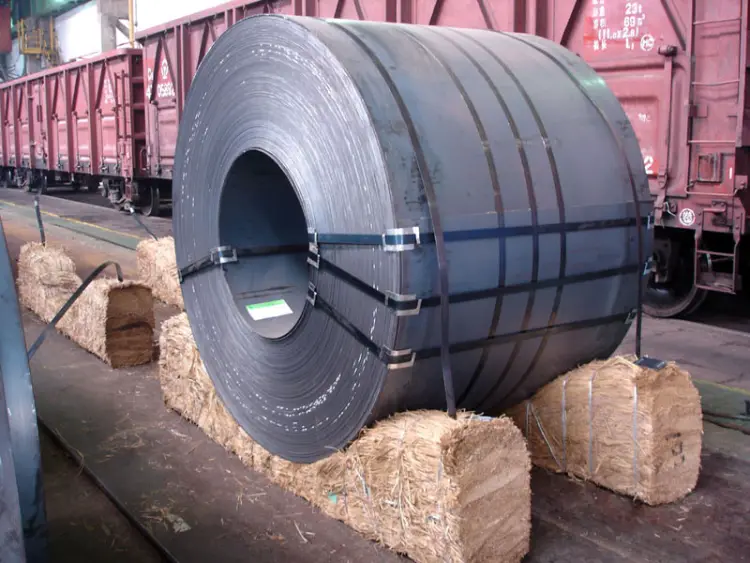
BV E550 Shipbuilding Steel Coil
BV E550 Shipbuilding Steel Coil - High-Strength, Low-Temperature Toughness for Marine Structures
Comprehensive technical data for BV E550 shipbuilding steel coil: chemical composition, mechanical properties, thermal/electrical properties, international equivalents, similar materials, and application guidance.
Hot rolling, thermomechanical rolling, normalizing, welding, cutting, bending, forming
- Phone : +8618037372205
- Email : [email protected]
- WhatsApp: Contact via Whtsapp
- WeChat: +8618037372205
BV E550 Shipbuilding Steel Coil Introduction
BV E550 is a high-strength shipbuilding steel with a minimum yield strength of 550 MPa, certified by Bureau Veritas (BV) under the NR216 rules. It belongs to the E-grade toughness class, which requires impact testing at -40°C, ensuring reliable performance in cold marine environments. The steel is typically supplied as coils or plates and is used for critical structural components in ship hulls, offshore platforms, and other marine constructions. Key attributes include:
- Excellent weldability and formability
- High strength-to-weight ratio for lightweight design
- Guaranteed low-temperature toughness
- Strict purity control for fatigue and corrosion resistance
Delivery condition is usually normalized or thermomechanically rolled, in accordance with BV specifications.
BV E550 Shipbuilding Steel Coil Chemical Composition
The chemical composition of BV E550 is controlled to ensure high strength and excellent weldability. Limits are as specified in BV NR216, Part 2, Chapter 1, for grade E550. The steel is fully killed and fine-grained, with aluminum used for deoxidation. Microalloying elements (Nb, V, Ti) are added singly or in combination to achieve grain refinement and precipitation hardening.
- The values represent ladle analysis maxima unless a range is given.
- Carbon Equivalent (CEV) is often limited to ≤0.45% to ensure weldability.
| Element | Standard Value (max %) | Remarks |
|---|---|---|
| Carbon (C) | 0.20 | Maximum |
| Silicon (Si) | 0.10 – 0.55 | Range |
| Manganese (Mn) | 0.90 – 1.70 | Range |
| Phosphorus (P) | 0.025 | Maximum |
| Sulfur (S) | 0.015 | Maximum |
| Chromium (Cr) | 0.30 | Maximum |
| Nickel (Ni) | 0.40 | Maximum |
| Molybdenum (Mo) | 0.08 | Maximum |
| Copper (Cu) | 0.35 | Maximum |
| Vanadium (V) | 0.10 | Maximum |
| Niobium (Nb) | 0.05 | Maximum |
| Titanium (Ti) | 0.05 | Maximum |
| Aluminum (Al, acid soluble) | ≥ 0.015 | Minimum required for fine grain practice |
| Nitrogen (N) | 0.012 | Maximum |
| Carbon Equivalent (CEV) | Typically ≤0.45 | Based on product thickness and agreement |
BV E550 Shipbuilding Steel Coil Thermal and Electrical Physical Properties
The thermal and electrical properties are representative of low-alloy high-strength steel of this class. Actual values depend on exact chemical composition and heat treatment condition. Data are provided for engineering calculations in ship structure design and fabrication.
- Density is for estimating deadweight and coatings.
- Thermal expansion coefficient is used for distortion analysis in welding.
- Thermal conductivity influences preheating and heat input requirements.
| Property | Typical Value | Unit | Test Condition / Comment |
|---|---|---|---|
| Density (ρ) | 7.85 | g/cm³ | At 20°C |
| Elastic Modulus (E) | 205 | GPa | Room temperature |
| Shear Modulus (G) | 79.3 | GPa | Calculated from E and ν = 0.29 |
| Poisson's Ratio (ν) | 0.29 | — | In elastic range |
| Thermal Expansion Coefficient (α) | 12.5 × 10⁻⁶ | K⁻¹ | 20–100°C |
| Thermal Expansion Coefficient (α) | 13.5 × 10⁻⁶ | K⁻¹ | 20–400°C |
| Thermal Conductivity (λ) | 48 | W/(m·K) | At 20°C |
| Thermal Conductivity (λ) | 42 | W/(m·K) | At 200°C |
| Specific Heat Capacity (cₚ) | 460 | J/(kg·K) | At 20°C |
| Electrical Resistivity (ρₑ) | 0.20 × 10⁻⁶ | Ω·m | At 20°C |
BV E550 Shipbuilding Steel Coil Mechanical Properties
Mechanical properties are determined on test pieces taken from the product in the delivery condition. Testing is performed at room temperature unless otherwise noted. Impact test temperatures and energy values are specific to the E-grade (longitudinal and transverse tests).
- Yield and tensile values apply to product thickness ≤ 50 mm; for greater thickness a slight reduction may be acceptable.
- Elongation is measured on gauge length 5.65√So.
- Bend test diameter as per BV rules.
| Property | Standard Required Value | Unit | Test Condition |
|---|---|---|---|
| Yield Strength (ReH) | ≥ 550 | MPa | Room temperature, transverse test piece, thickness ≤50 mm |
| Tensile Strength (Rm) | 610 – 790 | MPa | Room temperature, transverse test piece |
| Elongation (A5) | ≥ 16 | % | Thickness ≤50 mm; gauge 5.65√So |
| Elongation (A5) | ≥ 15 | % | Thickness 50–100 mm |
| Charpy Impact Energy (KV) | ≥ 34 (longitudinal average) | J | At -40°C, V-notch, specimen size 10x10 mm |
| Charpy Impact Energy (KV) | ≥ 24 (transverse average) | J | At -40°C, V-notch, specimen size 10x10 mm |
| Charpy Impact Energy, single minimum | ≥ 28 (longitudinal), ≥ 20 (transverse) | J | Individual minimum value |
| Bend Test (180°) | No cracking; d = 3a | — | Bend diameter for thickness ≤50 mm |
BV E550 Shipbuilding Steel Coil Fully Equivalent Material Standards and Alternative Designations
| Country / Region | Standard / Rule | Designation / Grade | Remarks |
|---|---|---|---|
| International | American Bureau of Shipping (ABS) | ABS E550 | High-strength hull structural steel, E-grade toughness |
| International | DNV GL | DNV E550 | Same requirements per DNV rules |
| International | Lloyd's Register | LR E550 | Identical mechanical and chemical specifications |
| China | China Classification Society | CCS E550 | Recognised equivalent for shipbuilding |
| International | Korean Register | KR E550 | Equivalent per unified IACS requirements |
| Japan | Nippon Kaiji Kyokai | NK E550 | Equivalent high-strength ship plate |
| Italy | RINA | RINA E550 | Also equivalent under IACS UR W11 |
BV E550 Shipbuilding Steel Coil Application Introduction
BV E550 steel coil is engineered for demanding marine and offshore applications where weight saving and high strength are critical. Its reliable toughness at -40°C makes it suitable for structures operating in cold waters. The steel can be processed by fabricators into a wide range of components using standard shipyard methods including cutting, bending, and welding.
- Prefabricated modules and sub-assemblies
- Repair and conversion of existing vessels
- Arctic-class vessels and ice-strengthened hulls
Product Applications: Coils and strips for cutting into plates and shapes, Heavy plates for hull shell, deck, and bottom structures, Section profiles (angles, channels, bulb flats) by re-rolling or fabrication, Welded beams and stiffeners, Pipe and tubular components for offshore structures
Processed into products: Ship deck plating and stringers, Shell plating for ice belts, Bulkhead and web frame panels, Offshore platform leg and bracing members, Crane booms and lifting arms, Foundation structures for wind turbine towers, Bracket plates and gussets
Application industries: Shipbuilding and ship repair, Offshore oil & gas (platforms, FPSO modules), Offshore wind energy (jackets, transition pieces), Heavy engineering and lifting equipment, Bridge and infrastructure (structural steelwork)
BV E550 Shipbuilding Steel Coil Similar / Alternative Materials with Different Standards
| Country / Region | Standard / Specification | Grade | Remarks on Comparability |
|---|---|---|---|
| Europe | EN 10025-6 | S550Q / S550QL / S550QL1 | Quenched and tempered structural steels; similar strength but different delivery condition (Q&T). S550QL has guaranteed low-temperature impact properties. |
| Europe | EN 10149-2 | S550MC | Thermomechanically rolled high-strength low-alloy strip for cold forming; similar strength level but no mandatory -40°C impact test. |
| USA | ASTM A514 / A514M | Grade H or Grade F | High-yield-strength quenched and tempered alloy steel plate; yield ~690 MPa, higher than E550; requires careful welding. |
| USA | API 2W | Grade 50 (or 50T) | Steel for offshore structures; similar toughness and strength, but certification not necessarily equivalent. |
| USA | ASTM A131 / A131M | EH40 / FH40 | Shipbuilding steel with yield 390 MPa, lower strength, but matching toughness grades (-40°C for EH, -60°C for FH). |
Notes:
- Welding: Low hydrogen processes and appropriate preheating are recommended. For thicknesses above 30 mm, preheat to ~100–150°C to avoid hydrogen cracking. Post-weld heat treatment is generally not required with proper procedure.
- Forming: Cold forming is possible but should be followed by inspection for cracks if the bending radius is less than 3t.
- Corrosion protection: As with all shipbuilding steels, coating or cathodic protection is essential in sea water environments.
- Certification: Material is delivered with BV inspection certificate 3.1 or 3.2 (EN 10204). Mill test reports verify chemical composition, mechanical properties, and impact test results.
- Share



