
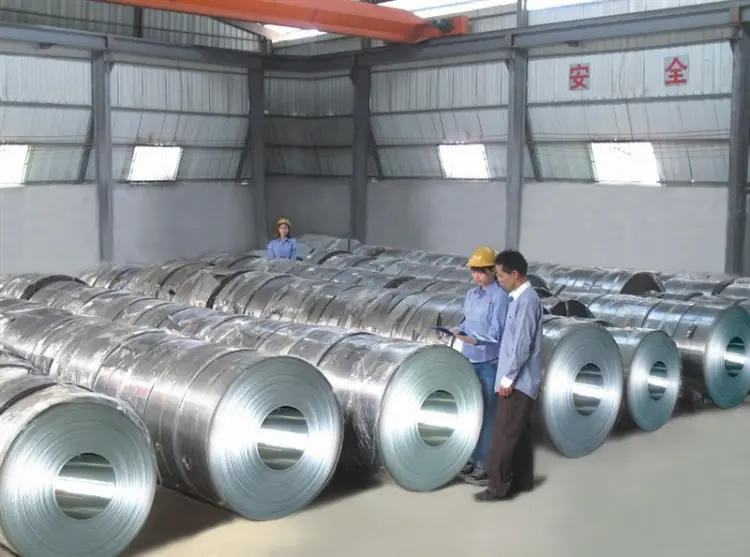
BV F550 Shipbuilding Steel Coil
BV F550 Shipbuilding Steel Coil - High-Strength Quenched & Tempered Marine Steel for Extreme Environments
Complete technical data for BV F550 shipbuilding steel coil (FQ56), covering chemical composition, mechanical properties, thermal physical data, international equivalents, and application guidance for marine and offshore engineering.
Hot rolling, quenching and tempering, normalising (if required), cold forming, welding
- Phone : +8618037372205
- Email : [email protected]
- WhatsApp: Contact via Whtsapp
- WeChat: +8618037372205
BV F550 Shipbuilding Steel Coil Introduction
BV F550 is a quenched and tempered high-strength shipbuilding steel grade defined under the Bureau Veritas Rules for the Classification of Steel Ships. It corresponds to the official designation FQ56, where 'F' indicates impact test temperature of -60°C and 'Q56' denotes a minimum yield strength of 550 MPa. This fine‑grain steel combines excellent strength with good low‑temperature toughness, making it especially suitable for critical structural parts in harsh marine environments. It is typically supplied in coil or plate form after controlled quenching and tempering to meet stringent classification society requirements. Key features:
- Minimum yield strength of 550 MPa, enabling weight reduction without sacrificing structural integrity.
- Guaranteed Charpy V‑notch impact energy at -60°C, ensuring reliable performance in Arctic and deep‑sea applications.
- Alloy balance (Nb, V, Ti) provides grain refinement and precipitation hardening.
- Compliant with international shipbuilding standards, allowing global acceptance.
BV F550 Shipbuilding Steel Coil Chemical Composition
The chemical composition of BV F550 (FQ56) is tightly controlled to achieve the required strength and toughness. Carbon content is limited to ensure good weldability, while micro‑alloying elements such as niobium, vanadium and titanium contribute to grain refinement and precipitation hardening. The following limits are in accordance with BV rules for quenched and tempered high‑strength steels.
| Chemical Element | Standard Value (wt%) | Remarks |
|---|---|---|
| Carbon (C) | ≤ 0.18 | max |
| Manganese (Mn) | 0.90 – 1.60 | range |
| Silicon (Si) | 0.10 – 0.50 | range |
| Phosphorus (P) | ≤ 0.025 | max |
| Sulfur (S) | ≤ 0.025 | max |
| Chromium (Cr) | ≤ 0.20 | max |
| Nickel (Ni) | ≤ 0.40 | max |
| Molybdenum (Mo) | ≤ 0.08 | max |
| Copper (Cu) | ≤ 0.35 | max |
| Aluminium (Al, acid soluble) | ≥ 0.020 | min, for grain size control |
| Niobium (Nb) | 0.02 – 0.05 | range |
| Vanadium (V) | 0.05 – 0.10 | range |
| Titanium (Ti) | ≤ 0.02 | max |
| Nitrogen (N) | ≤ 0.012 | max |
BV F550 Shipbuilding Steel Coil Thermal and Electrical Physical Properties
The physical properties of BV F550 are essentially identical to those of common low‑alloy structural steels. The values below are typical at room temperature unless otherwise noted. They are useful for design calculations involving heat transfer, thermal expansion, and electromagnetic behaviour.
| Property | Typical Value | Unit | Test Condition |
|---|---|---|---|
| Density (ρ) | 7.85 | g/cm³ | 20 °C |
| Elastic Modulus (E) | 205 | GPa | 20 °C, static |
| Shear Modulus (G) | 79 | GPa | 20 °C |
| Poisson's Ratio (ν) | 0.30 | – | 20 °C, elastic range |
| Thermal Expansion Coefficient (α) | 11.5 × 10⁻⁶ | K⁻¹ | 20–100 °C average |
| Thermal Conductivity (λ) | 45 | W/(m·K) | 20 °C |
| Specific Heat Capacity | 460 | J/(kg·K) | 20 °C |
| Electrical Resistivity (ρₑ) | 0.22 × 10⁻⁶ | Ω·m | 20 °C |
BV F550 Shipbuilding Steel Coil Mechanical Properties
The mechanical properties of BV F550 (FQ56) are verified on test specimens taken from the finished product (typically transverse to rolling direction for plates and coils). Values depend on thickness; the table below covers the most common thickness range (≤ 100 mm). Impact tests are carried out at -60°C on Charpy V‑notch specimens, with minimum average values specified by BV rules.
| Property | Standard Requirement | Unit | Test Condition |
|---|---|---|---|
| Yield Strength (ReH) | ≥ 550 | MPa | t ≤ 100 mm, transverse specimen, 0.2% offset |
| Tensile Strength (Rm) | 670 – 830 | MPa | t ≤ 100 mm, transverse specimen |
| Elongation after fracture (A) | ≥ 16 | % | 5.65√So gauge length, transverse, t ≤ 100 mm |
| Impact energy (KV₂) | ≥ 27 (longitudinal) / 20 (transverse) | J | -60 °C, Charpy V‑notch, average of three tests |
| Impact energy (KV₂) | ≥ 27 (longitudinal) / 20 (transverse) | J | For thicker sections (t > 40 mm), values may be agreed |
BV F550 Shipbuilding Steel Coil Fully Equivalent Material Standards and Replaceable Grades
| Country / Region | Standard | Grade | Remarks |
|---|---|---|---|
| International (ABS) | ABS Rules for Steel Vessels | ABS FQ56 | Identical requirements, fully interchangeable |
| Norway (DNV) | DNV Rules for Ships | DNV FQ56 | Identical after approval, same yield/toughness class |
| United Kingdom (LR) | Lloyd's Register Rules | LR FQ56 | Equivalent grade for ship and offshore structures |
| China (CCS) | CCS Rules for Steel Ships | CCS FQ56 | Harmonised with IACS UR W11, fully equivalent |
| Japan (NK) | Nippon Kaiji Kyokai Rules | NK FQ56 | Same requirements for QT high‑strength steel |
| South Korea (KR) | Korean Register Rules | KR FQ56 | Fully equivalent in composition and properties |
| Italy (RINA) | RINA Rules for Ships | RINA FQ56 | Same grade designation, interchangeable |
BV F550 Shipbuilding Steel Coil Application Introduction
BV F550 (FQ56) is intended for welded structures subjected to high stresses and demanding service conditions, especially where reduced weight and excellent low‑temperature toughness are critical. It is widely adopted in the marine and offshore sectors. Typical applications include:
Product Applications: Hull plates (main deck, side shell, bottom plating), Stiffeners and longitudinal frames, Bulkhead panels, Transition pieces for offshore wind monopiles, Pressure hull components for submersibles
Processed into products: Deck plates and stringer plates in large container ships, Ice‑breaker belt regions and bow structures, Column legs and brace members on semi‑submersible platforms, Heavy‑lift crane pedestals and boom sections, Structural nodes and tabular joints in jacket foundations
Application industries: Shipbuilding (commercial and naval vessels), Offshore oil & gas platforms, Offshore wind energy foundations, Heavy engineering for polar and ice‑class ships
BV F550 Shipbuilding Steel Coil Similar / Closely Related Material Recommendations
| Country / Region | Standard | Grade | Remarks |
|---|---|---|---|
| France (BV) | BV Rules | BV FQ51 (F510) | Lower yield strength (≥ 510 MPa), slightly lower tensile range, -60°C toughness; suitable for less demanding components |
| France (BV) | BV Rules | BV FQ63 (F620) | Higher strength (yield ≥ 620 MPa), similar low‑temperature toughness; for further weight reduction |
| USA (ASTM) | ASTM A131/A131M | Grade FH550 (if specified) | TMCP or QT variant under ASTM A131 shipbuilding steel; requires agreement on impact temperature |
| Europe (EN) | EN 10025‑6 | S550QL (1.8926) | Quenched and tempered structural steel with comparable strength, but not classed for marine use; consult classification society |
Notes:
Welding considerations: Preheating may be required depending on thickness and combined hydrogen input. Post‑weld heat treatment is generally not needed, but stress relief may be applied if agreed. All welding consumables must be approved by the classification society. Certification: Products are delivered with BV surveyor's certificate (material certificate 3.1 or 3.2 according to EN 10204). Dimensional tolerances shall conform to the applicable product standard (EN 10029 for plates). For coil products, surface condition and flatness are as agreed between manufacturer and purchaser.
- Share



