
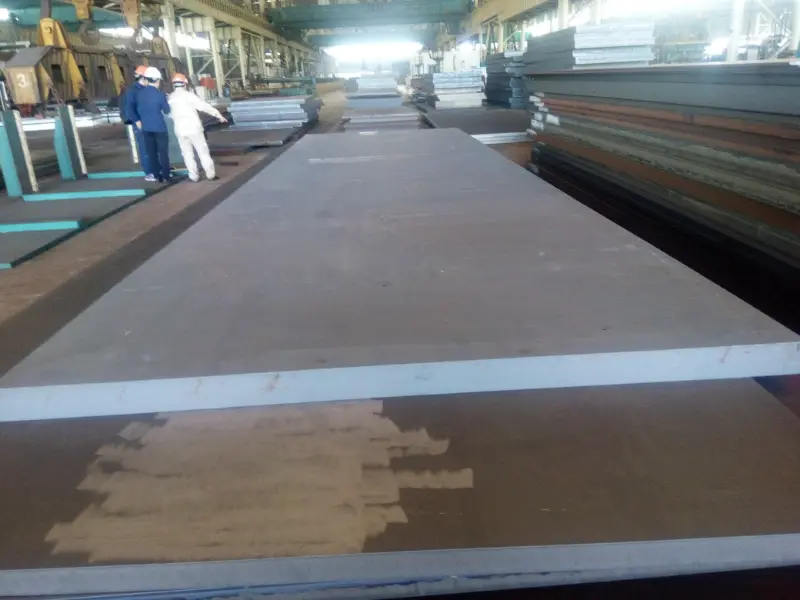
BV E500 High-Strength Shipbuilding Steel
BV E500 High-Strength Shipbuilding Steel: Properties, Equivalents, and Applications
Detailed material data for BV E500 shipbuilding steel coil and plate: chemical composition, tensile and impact properties, physical constants, direct equivalents from ABS, DNV, LR, CCS, and similar grades, plus application guidance for marine and offshore structures.
Cutting (flame, plasma, laser), cold and warm forming, welding (low-hydrogen processes recommended), machining, shot blasting, painting
- Phone : +8618037372205
- Email : [email protected]
- WhatsApp: Contact via Whtsapp
- WeChat: +8618037372205
BV E500 High-Strength Shipbuilding Steel Introduction
BV E500 is a high-strength quenched and tempered (Q&T) or thermo-mechanically controlled processed (TMCP) steel grade certified by Bureau Veritas under the Rules for the Classification of Steel Ships (NR216). It specifies a minimum yield strength of 500 MPa and is engineered for primary structures in shipbuilding and offshore engineering that demand high load-bearing capacity, excellent toughness at low temperatures, and good weldability. The 'E' designation indicates Charpy V-notch impact testing at -40 °C, making the steel suitable for service in cold and Arctic environments. Available as plates, coils, and wide flats up to approximately 50 mm thickness, BV E500 is used in hull girders, decks, bulkheads, and offshore platform modules. It is closely related to grades such as ABS EH51, DNV E500, LR EH51, and CCS EH51 within the IACS framework, facilitating global procurement and classification.
- Minimum yield strength: 500 MPa
- Excellent low-temperature toughness: impact test at -40 °C
- Delivery condition: Q&T or TMCP
- Thickness range: typically 8–50 mm for plates/coils
BV E500 High-Strength Shipbuilding Steel Chemical Composition
The chemical composition conforms to Bureau Veritas NR216 rules for grade E500. Maximum and range values are given; all elements are in weight percent. Fine grain practices (Al, Nb, V, Ti) and a controlled carbon equivalent (CEV) ensure high strength with good weldability.Note: Actual production values are tailored by the steelmaker within the specified limits to achieve the required properties.
| Element | Specified Limits (Max or Range) | Remarks |
|---|---|---|
| C | ≤ 0.18 | Carbon |
| Si | ≤ 0.55 | Silicon |
| Mn | 0.90 – 1.70 | Manganese |
| P | ≤ 0.025 | Phosphorus |
| S | ≤ 0.020 | Sulfur |
| Al (total) | ≥ 0.020 | Total aluminium, for fine grain practice |
| Nb | ≤ 0.05 | Niobium |
| V | ≤ 0.10 | Vanadium |
| Ti | ≤ 0.05 | Titanium |
| Cu | ≤ 0.50 | Copper |
| Cr | ≤ 0.25 | Chromium |
| Ni | ≤ 1.00 | Nickel |
| Mo | ≤ 0.50 | Molybdenum |
| N | ≤ 0.012 | Nitrogen |
| CEV* | ≤ 0.43 (t ≤ 50 mm) | Carbon Equivalent = C + Mn/6 + (Cr+Mo+V)/5 + (Ni+Cu)/15 |
BV E500 High-Strength Shipbuilding Steel Physical Properties
The following physical constants are typical for high-strength quenched and tempered steels with similar composition. They are not mandatory specification requirements but are suitable for design calculations and simulations. Actual values may vary slightly with processing history.
| Property | Typical Value | Unit | Test Condition / Remarks |
|---|---|---|---|
| Density (ρ) | 7850 | kg/m³ | At 20 °C |
| Modulus of elasticity (E) | 205 | GPa | At 20 °C |
| Shear modulus (G) | 80 | GPa | Calculated from E and ν |
| Poisson's ratio (ν) | 0.3 | Within elastic range | |
| Thermal expansion coefficient (α) | 11.7 | ×10⁻⁶ /K | From 20 to 100 °C |
| Thermal conductivity (λ) | 51.9 | W/(m·K) | At 20 °C |
| Specific heat capacity (cₚ) | 460 | J/(kg·K) | At 20 °C |
| Electrical resistivity (ρ_e) | 0.23 | μΩ·m | At 20 °C |
BV E500 High-Strength Shipbuilding Steel Mechanical Properties
Mechanical properties are verified on transverse test specimens unless otherwise stated. Tensile testing is performed at room temperature; Charpy V-notch impact tests are carried out at -40 °C for grade E. Bend tests demonstrate formability.Note: Properties for products thicker than 50 mm may be separately agreed.
| Property | Specified Requirement | Unit | Test Condition / Remarks |
|---|---|---|---|
| Yield strength (ReH) | ≥ 500 | MPa | Transverse specimens, thickness ≤ 50 mm |
| Tensile strength (Rm) | 610 – 770 | MPa | Transverse specimens |
| Elongation after fracture (A5) | ≥ 16 | % | Gauge length 5.65√So, transverse, t ≤ 50 mm |
| Bend test (180°) | Mandrel diameter d = 3a (t ≤ 25 mm); d = 4a (t > 25 mm) | No cracks permitted | |
| Charpy impact energy (KV) at -40 °C, longitudinal | ≥ 42 | J | Average of 3 specimens, minimum single 30 J |
| Charpy impact energy (KV) at -40 °C, transverse | ≥ 27 | J | Average of 3 specimens, minimum single 20 J |
BV E500 High-Strength Shipbuilding Steel Directly Equivalent Grades from Other Classification Societies
| Country/Region | Standard / Specification | Grade / Designation | Remarks |
|---|---|---|---|
| USA | ABS Rules for Building and Classing Marine Vessels | ABS EH51 | Extra-high strength hull steel, yield 500 MPa, -40 °C impact |
| Norway | DNV Rules for Ships | DNV E500 | Identical minimum requirements to BV E500 |
| UK | Lloyd's Register Rules for the Manufacture, Testing and Certification of Materials | LR EH51 | Shipbuilding steel with 500 MPa yield, -40 °C Charpy |
| China | China Classification Society (CCS) Rules | CCS EH51 | Equivalent to BV E500 per IACS unified requirements |
| Italy | RINA Rules for the Classification of Ships | RINA E500 | Direct equivalent, same strength and impact temperature |
| Japan | ClassNK Rules for the Survey and Construction of Steel Ships | NK KE51 | Nippon Kaiji Kyokai; grade K corresponds to E (-40 °C) |
| South Korea | Korean Register of Shipping Rules | KR REH51 | Korean Register equivalent of EH51 for marine structures |
BV E500 High-Strength Shipbuilding Steel Application Introduction
BV E500 is engineered for safety-critical structural applications where high strength, toughness, and weldability are essential. It enables weight reduction without compromising structural integrity. Primary application fields:
Product Applications: Ship hull plates (bottom, side, deck, and bulkhead plating), Longitudinals, stiffeners, and web frames, Deck girders and crane pedestals, Offshore module structural beams and columns, Piles and sheet piles for marine construction, Structures for subsea templates and manifolds
Processed into products: Hull girder flange and web plates, Bracket plates and tripping brackets, Reinforced doubler plates in high-stress zones, Lifting pad eyes and padeyes, Bearing supports for heavy rotating equipment, Fatigue-critical connections and transition pieces
Application industries: Shipbuilding (naval vessels, container ships, icebreakers, cruise liners), Offshore oil & gas (jackets, topsides, FPSO modules, riser supports), Renewable energy (offshore wind turbine foundations, transition pieces, boat landings), Marine civil engineering (locks, gates, dry docks, quay walls), Heavy lifting and transport (crane booms, heavy-lift vessel skids), Bridge construction (offshore and movable bridges requiring classification)
BV E500 High-Strength Shipbuilding Steel Similar / Alternative Materials with Comparable Performance
| Country/Region | Standard / Specification | Grade / Designation | Remarks |
|---|---|---|---|
| Europe | EN 10225:2009 | S500G2+M / S500G2+QT | Weldable structural steels for fixed offshore structures; yield 500 MPa, -40 °C impact option; requires project-specific approval |
| USA | ASTM A514 / A517 | Grade Q (Quenched and Tempered) | Yield strength 690 MPa (>500) – may need design review; Charpy at -40 °C available; not a direct ship class steel without approval |
| Europe | EN 10025-6:2019 | S500Q / S500QL1 | Structural steels with improved atmospheric corrosion resistance; comparable strength; not covered by ship rules unless specially approved |
| China | GB/T 712-2011 | EH500 | Chinese shipbuilding steel, equivalent to CCS EH51; similar chemical and mechanical profile |
Notes:
Certification: All BV E500 plates/coils must be inspected and stamped by a Bureau Veritas surveyor. Material certificates (3.1 or 3.2 according to EN 10204) are mandatory.
Welding: Low-hydrogen processes (SMAW, SAW, GMAW, FCAW) are strongly recommended. Preheat and interpass temperatures shall be controlled based on thickness and ambient conditions; typically 100–150 °C preheat for t ≤ 50 mm.
Post-weld heat treatment (PWHT): Usually not required for thicknesses up to 50 mm in non-severe applications; may be specified for highly restrained joints or when required by the design code.
Non-destructive testing: Ultrasonic testing (UT) in accordance with BV rules may be required for primary structure components. Magnetic particle or dye penetrant inspection is applied for weld surface checks.
- Share



