
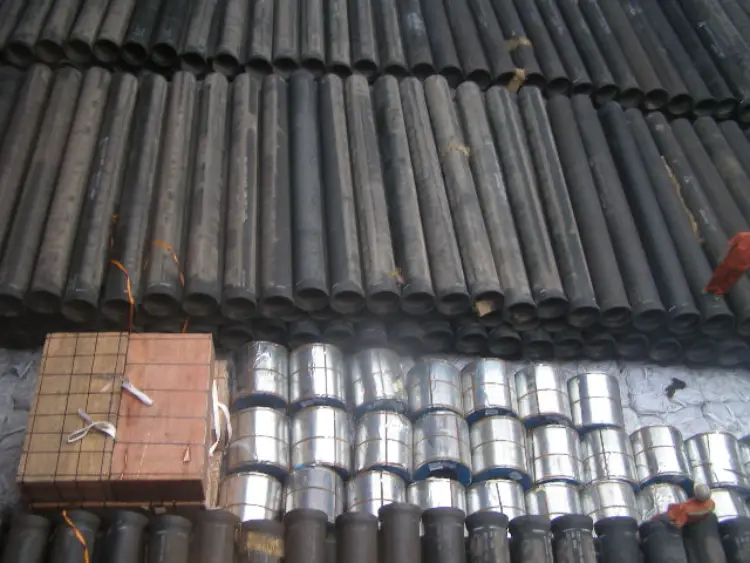
BV D500 High Strength Shipbuilding Steel Coil
BV D500 High Strength Shipbuilding Steel Coil - Properties & Equivalents
Comprehensive material data for BV D500 shipbuilding steel coil: chemical composition, mechanical and physical properties, international equivalents, and application guide.
Welding, bending, cold forming, cutting, and machining; suitable for thermomechanical controlled processing (TMCP) or normalized rolling.
- Phone : +8618037372205
- Email : [email protected]
- WhatsApp: Contact via Whtsapp
- WeChat: +8618037372205
BV D500 High Strength Shipbuilding Steel Coil Introduction
BV D500 is a high-strength shipbuilding steel grade specified in the Bureau Veritas (BV) Rules for the Classification of Steel Ships. This thermomechanically rolled or normalized steel has a minimum specified yield strength of 500 MPa, ensuring excellent structural performance in demanding marine environments. The steel is typically supplied in coil form, featuring good weldability, toughness at low temperatures (impact tested at -20°C for D-grade), and reliable mechanical properties. It is widely used for constructing hull structures, decks, and other critical components where weight savings and high strength are required. BV D500 complies with IACS unified requirements for high-strength hull structural steels, ensuring global acceptance and consistent quality.
BV D500 High Strength Shipbuilding Steel Coil Chemical Composition
The chemical composition of BV D500 shipbuilding steel conforms to BV Rules, ensuring a fine balance of strength, toughness, and weldability. The table below lists the maximum and/or minimum values, with grain-refining elements added as required. Carbon equivalent (CEV) requirements may apply to ensure good weldability.
| Element | Standard Value | Notes |
|---|---|---|
| C (Carbon) | ≤ 0.20 | Max. |
| Mn (Manganese) | ≤ 1.70 | Max. |
| Si (Silicon) | ≤ 0.55 | Max. |
| P (Phosphorus) | ≤ 0.035 | Max. |
| S (Sulfur) | ≤ 0.035 | Max. |
| Al (total) (Aluminum) | ≥ 0.015 | Min. for fine grain practice |
| Nb (Niobium) | ≤ 0.05 | If added, max. per BV rules |
| V (Vanadium) | ≤ 0.12 | If added, max. per BV rules |
| Ti (Titanium) | ≤ 0.02 | If added, max. per BV rules |
| Cu (Copper) | ≤ 0.35 | May be present as residual; impact on properties considered |
| Cr (Chromium) | ≤ 0.20 | Residual element |
| Ni (Nickel) | ≤ 0.40 | Residual element |
| Mo (Molybdenum) | ≤ 0.08 | Residual element |
| Ceq (Carbon Equivalent) | Typically ≤ 0.45 | Based on formula in applicable standard |
BV D500 High Strength Shipbuilding Steel Coil Thermal and Electrical Physical Properties
The following physical properties are typical for low-alloy structural steels of similar composition and are provided for design calculations. They are not mandatory specification values but serve as engineering references. Values may vary with temperature and composition.
| Property | Typical Value | Unit | Test Condition / Note |
|---|---|---|---|
| Density (ρ) | 7850 | kg/m³ | At 20°C |
| Elastic Modulus (E) | 205 – 210 | GPa | At 20°C |
| Shear Modulus (G) | about 80 | GPa | Calculated (E/(2(1+ν))) |
| Poisson's Ratio (ν) | 0.3 | - | At 20°C |
| Thermal Expansion Coefficient (α) | 11.5 – 12.5 × 10⁻⁶ | 1/K | At 20–100°C; typical value 12 × 10⁻⁶ /K |
| Thermal Conductivity (λ) | 45 – 50 | W/(m·K) | At 20°C |
| Specific Heat Capacity (cp) | 460 – 480 | J/(kg·K) | At 20°C |
| Electrical Resistivity (ρe) | 0.20 – 0.25 × 10⁻⁶ | Ω·m | At 20°C |
BV D500 High Strength Shipbuilding Steel Coil Mechanical Properties
Mechanical properties are determined in accordance with BV Rules for thicknesses ≤50 mm (tensile test specimen transverse or longitudinal as specified). Impact test values are for D-grade (test temperature -20°C). Actual properties may vary depending on thickness and specific production route.
| Property | Standard Required Value | Unit | Test Condition |
|---|---|---|---|
| Yield Strength (ReH) | ≥ 500 | MPa | Transverse, t ≤ 50 mm |
| Tensile Strength (Rm) | 610 – 770 | MPa | Transverse, t ≤ 50 mm |
| Elongation (A) | ≥ 15 | % | Gauge length L₀=5.65√S₀ (or 50 mm), transverse |
| Bend Test (Mandrel Diameter) | No cracks, mandrel diameter = 3a | - | 180° bend, t ≤ 50 mm, a = specimen thickness |
| Impact Energy (KV₂) | ≥ 41 (average of 3 tests), one individual ≥ 28 | J | Longitudinal, at -20°C |
| Impact Energy (KV₂) | ≥ 27 (average of 3 tests), one individual ≥ 19 | J | Transverse, at -20°C (if specified) |
BV D500 High Strength Shipbuilding Steel Coil Completely Equivalent Material Standards and Substitutable Grades
| Country/Region | Standard | Grade | Notes |
|---|---|---|---|
| International (IACS) | IACS UR W31 | DH500 / EH500 | Equivalent in yield strength and impact class |
| International (DNV) | DNV Rules | D500 | Direct equivalent in BV rules; same strength and toughness |
| International (LR) | Lloyd's Register Rules | DH500 / EH500 | DH500 for -20°C impact, fully equivalent |
| USA | ABS Rules | DH500 / EH500 | American Bureau of Shipping equivalent |
| China | CCS Rules | DH500 / EH500 | China Classification Society equivalent |
| Japan | NK Rules | KD500 | Nippon Kaiji Kyokai equivalent |
| Korea | KR Rules | RD500 | Korean Register equivalent |
| Italy | RINA Rules | D500 | RINA equivalent grade |
| Russia | RS Rules | D500 / E500 | Russian Maritime Register of Shipping equivalent |
BV D500 High Strength Shipbuilding Steel Coil Application Introduction
BV D500 steel coil is used extensively in modern shipbuilding due to its excellent combination of high strength, good toughness, and weldability. Its reduced weight potential compared to lower strength grades allows for more efficient hull designs or increased cargo capacity. The following lists typical applications and suitable product forms.
Product Applications: Hull plates and coils for shipbuilding, Deck sections and stiffened panels, Bottom shell and bilge strake, Longitudinal and transverse frames, Watertight bulkheads and superstructure components, Offshore platform deck plates and legs
Processed into products: Main deck plating, Side shell plating, Bottom plate (keel plating), Stiffeners (bulb flats, angles), Bulkhead panels, Web frames and brackets, Hatch coamings and covers, Offshore template structural parts
Application industries: Commercial shipbuilding (container ships, bulk carriers, tankers), Naval shipbuilding, Offshore oil & gas structures (fixed platforms, FPSOs), Marine engineering (harbor cranes, lock gates), Pressure vessel construction for marine service
BV D500 High Strength Shipbuilding Steel Coil Similar or Near-Equivalent Alternative Materials
| Country/Region | Standard | Grade | Notes |
|---|---|---|---|
| Europe | EN 10025-6 | S500Q / S500QL | Quenched and tempered structural steel, 500 MPa yield, similar strength but different delivery condition |
| Europe | EN 10025-4 | S500M / S500ML | Thermomechanical rolled structural steel, 500 MPa yield, close to shipbuilding requirements |
| International | API Spec 2W | Grade 50 (optional 500 MPa class) | Steel for offshore structures, may be used as substitute if impact properties are adjusted |
| USA | ASTM A514 / A517 | Grade B / H / F | High-strength quenched and tempered plate, ~690 MPa tensile, but 500 MPa class not directly present; for higher strength substitution |
| USA | ASTM A572 | Grade 60 / 65 | Lower yield strength (415/450 MPa), not direct substitute but often considered for lighter duty marine structures |
Notes:
Special requirements:
- Carbon equivalent (CEV) and weldability may be agreed upon at the time of order; typical CEV ≤0.45% for this grade.
- Thickness and product form range: coil thickness normally up to 25 mm, but heavier plates up to 50 mm are covered under the same grade.
- Bend test: no cracks are permitted for a 180° bend with mandrel diameter 3 times specimen thickness.
- Ultrasonic testing (UT) may be required per BV rules or customer specification.
- Surface condition can be supplied as-rolled, descaled, or primed with shop primer for temporary corrosion protection.
- HVAC materials may require through-thickness properties (Z-quality) according to BV Rules, available upon request.
- Share



