
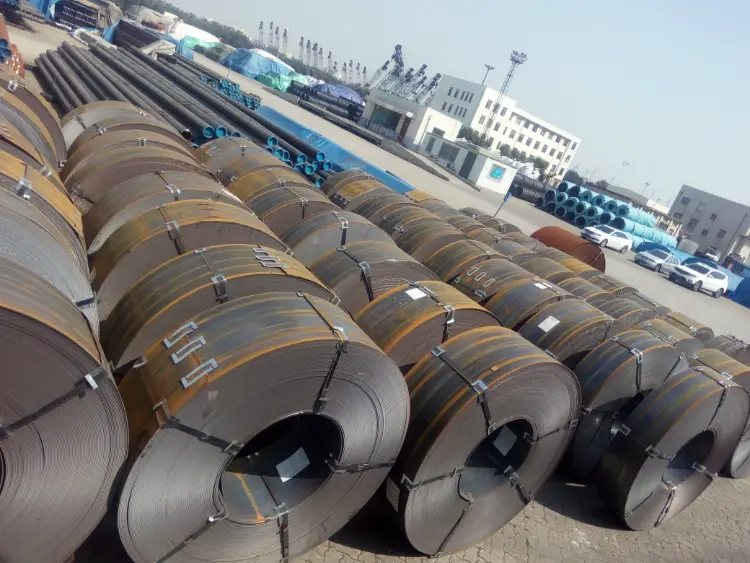
BV EH36 Shipbuilding Steel Coil
BV EH36 Shipbuilding Steel Coil - High Strength Hull Structural Steel
Comprehensive analysis of BV EH36 shipbuilding steel coil, including chemical composition, mechanical properties, physical properties, equivalent grades, applications.
Welding, cutting, bending, forming, punching, machining (with suitable practices for high-strength steel)
- Phone : +8618037372205
- Email : [email protected]
- WhatsApp: Contact via Whtsapp
- WeChat: +8618037372205
BV EH36 Shipbuilding Steel Coil Introduction
BV EH36 is a high-strength hull structural steel certified by Bureau Veritas (BV) under its Rules for Materials and Welding. It corresponds to the EH36 grade defined by IACS UR W11, designed for critical ship and offshore structures requiring excellent toughness at low temperatures (-40°C). This steel exhibits a minimum yield strength of 355 MPa, good weldability, and high resistance to brittle fracture. Typical delivery condition is normalized or thermo-mechanically controlled processed (TMCP). The coil form facilitates manufacturing of plates and sections for shipbuilding.
BV EH36 Shipbuilding Steel Coil Chemical Composition
The chemical composition of BV EH36 shipbuilding steel must meet the requirements of IACS UR W11. Values below are ladle analysis limits. Refining elements such as Nb, V, Ti may be added singly or in combination. Carbon equivalent (CEV) is controlled to ensure weldability. Note: Actual values may vary within the specified range.
| Element | Standard Value (%) | Remarks |
|---|---|---|
| Carbon (C) | ≤0.18 | |
| Manganese (Mn) | 0.90 – 1.60 | |
| Silicon (Si) | ≤0.50 | |
| Phosphorus (P) | ≤0.035 | |
| Sulfur (S) | ≤0.035 | |
| Aluminum (Al), acid soluble | ≥0.015 | If used as grain-refining element |
| Niobium (Nb) | ≤0.05 | If added |
| Vanadium (V) | ≤0.10 | If added |
| Titanium (Ti) | ≤0.02 | If added |
| Copper (Cu) | ≤0.35 | Residual content |
| Chromium (Cr) | ≤0.20 | Residual content |
| Nickel (Ni) | ≤0.40 | Residual content |
| Molybdenum (Mo) | ≤0.08 | Residual content |
| Nitrogen (N) | ≤0.012 | If not fixed by Al |
| Others (total) | ≤0.10 | Total residual elements |
BV EH36 Shipbuilding Steel Coil Thermal and Electrical Physical Properties
The following physical properties are indicative for normalized EH36 high-strength steel at room temperature unless specified otherwise. These values are based on general data for similar carbon-manganese structural steels.
| Property | Typical Value | Unit | Test Condition |
|---|---|---|---|
| Density (ρ) | 7.85 | g/cm³ | 20°C |
| Young's Modulus (E) | 205 | GPa | 20°C |
| Shear Modulus (G) | 79 | GPa | 20°C (calculated) |
| Poisson's Ratio (ν) | 0.3 | 20°C | |
| Thermal Expansion Coefficient (α) | 11.7 × 10⁻⁶ | /K | 20–100°C |
| Thermal Conductivity (λ) | 51 | W/(m·K) | 20°C |
| Specific Heat Capacity (c) | 460 | J/(kg·K) | 20°C |
| Electrical Resistivity (ρe) | 0.16 × 10⁻⁶ | Ω·m | 20°C |
BV EH36 Shipbuilding Steel Coil Mechanical Properties
Mechanical properties are verified on test specimens taken from the product in delivery condition. Tensile testing is performed transversely, and impact tests are carried out on Charpy V-notch specimens. The minimum requirements are valid for thicknesses ≤ 50 mm; for thicker plates, adjusted values may apply per BV Rules.
| Property | Standard Requirement | Unit | Test Condition |
|---|---|---|---|
| Yield Strength (ReH) | ≥355 | MPa | Transverse, thickness ≤ 50 mm |
| Tensile Strength (Rm) | 490 – 620 | MPa | Transverse, thickness ≤ 50 mm |
| Elongation (A) | ≥21 | % | Gauge length 5.65√S0, transverse |
| Impact Energy (KV) at -40°C | ≥34 (longitudinal) / ≥24 (transverse) | J | Charpy V-notch, average of 3 specimens, thickness ≤ 50 mm |
| Impact Energy (KV) at -40°C, thickness >50 mm up to 70 mm | ≥27 (longitudinal) / ≥20 (transverse) | J | Charpy V-notch, average of 3 specimens |
| Bending Test (mandrel diameter) | 3t (t ≤ 25 mm), 4t (t = 25-50 mm) | 180° bend, no cracks |
BV EH36 Shipbuilding Steel Coil Identical / Substitute Standards and Grades
| Country/Region | Standard | Grade | Remarks |
|---|---|---|---|
| France / International | BV Rules Part 2, Ch.1 | EH36 | Original classification society grade |
| USA | ABS Rules | EH36 | American Bureau of Shipping |
| USA | ASTM A131 / A131M | EH36 | US standard for shipbuilding steel, directly equivalent |
| Norway/Germany | DNV GL Rules | EH36 | DNV and GL merged; EH36 is same |
| UK | LR Rules | EH36 | Lloyd's Register |
| South Korea | KR Rules | EH36 | Korean Register |
| Italy | RINA Rules | EH36 | Registro Italiano Navale |
| China | CCS Rules | EH36 | China Classification Society |
| Japan | NK Rules | EH36 | Nippon Kaiji Kyokai |
| International | IACS UR W11 | EH36 | International Association of Classification Societies unified requirement |
BV EH36 Shipbuilding Steel Coil Application Introduction
BV EH36 steel coil is primarily used for marine and offshore applications where high strength combined with excellent low-temperature toughness is essential. Its coil form allows efficient roll-forming into stiffeners, profiles, and plates. Typical thicknesses range from 1.5 mm to 20 mm for coil-produced plate.
Product Applications: Ship hull plates and stiffeners, Offshore platform decks and substructures, Ice-strengthened vessel components, Pressure hulls for submersibles (if certified), Cut-to-length sheets for fabricators
Processed into products: Stiffeners (angles, bulb flats, channels), Longitudinal girders, Transverse frames, Watertight bulkheads, Weldments requiring high strength and fatigue resistance
Application industries: Shipbuilding (hulls of tankers, bulk carriers, container ships, FPSOs, ferries, ice-going vessels), Offshore engineering (jacket legs, deck structures, helidecks), Polar equipment (structures operating in Arctic conditions), Heavy machinery (crane booms, structural frames in cold regions), Bridge and civil engineering (where similar properties are accepted)
BV EH36 Shipbuilding Steel Coil Similar / Near-Equivalent Materials
| Country/Region | Standard | Grade | Remarks |
|---|---|---|---|
| All IACS members | IACS UR W11 | AH36, DH36, FH36 | Lower/missing low-temperature impact requirements (AH36 at 0°C, DH36 at -20°C, FH36 at -60°C); EH36 sits in the middle |
| All IACS members | IACS UR W11 | EH40 | Higher strength grade (yield ≥390 MPa), similar toughness (-40°C) |
| Europe | EN 10225 | S355G10+M | Weldable structural steels for fixed offshore structures, similar strength and toughness |
| ISO | ISO 4950-2 | S355 | High yield strength flat steel products (quenched and tempered), some overlap in mechanical properties, not ship-specific |
Notes:
Welding notes: BV EH36 steel can be welded by all common methods (SMAW, SAW, GMAW, FCAW). Preheating is generally not required for thicknesses below 30 mm but shall follow approved welding procedure specifications. Low-hydrogen consumables are recommended to avoid hydrogen-induced cracking. Post-weld heat treatment is rarely needed due to the low carbon equivalent. CEV control: Typically CEV ≤0.38% for TMCP and ≤0.43% for normalized condition. Certification: Products must be accompanied by BV certificates with heat analysis, tensile, and impact test results.
- Share



