
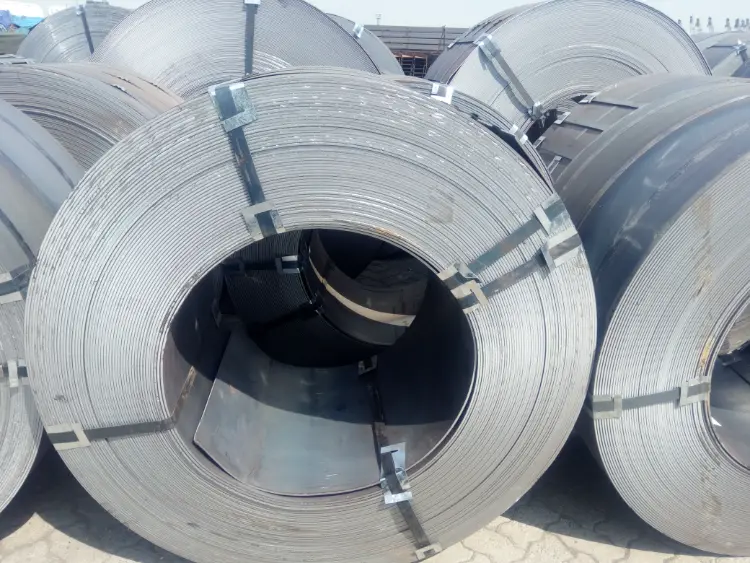
BV DH36 Shipbuilding Steel Coil
BV DH36 Shipbuilding Steel Coil - High-Strength Low-Temperature Marine Plate
Detailed material data for BV DH36 shipbuilding steel coil: chemical composition, mechanical properties, thermal and electrical physical properties, equivalent grades, similar materials, and application guidance for offshore and marine engineering.
Hot rolling, normalizing, controlled rolling (TMCP), welding, cold forming (limited)
- Phone : +8618037372205
- Email : [email protected]
- WhatsApp: Contact via Whtsapp
- WeChat: +8618037372205
BV DH36 Shipbuilding Steel Coil Introduction
BV DH36 is a high-strength hull structural steel grade certified by Bureau Veritas (BV) under the IACS (International Association of Classification Societies) unified requirements. It is designed for shipbuilding and offshore structures where high strength, good weldability, and excellent low-temperature toughness are required. The grade 'DH36' indicates a minimum yield strength of 355 MPa and impact testing at -20°C. Typical delivery condition is normalized or thermo-mechanically controlled processed (TMCP). This steel is widely used in the construction of ship hulls, decks, bulkheads, and offshore platforms, offering a reliable combination of mechanical properties and corrosion resistance in marine environments. Plate and coil forms are available in various thicknesses up to 100 mm.
BV DH36 Shipbuilding Steel Coil Chemical Composition
Chemical composition as per BV Rules, Chapter 1, Table 2.2.1 for DH36 grade. The steel is fully killed and fine grain treated. Aluminum, niobium, vanadium, and titanium may be added singly or in combination to achieve the required strength and toughness. Carbon equivalent (CEV) is typically controlled to ensure weldability.
| Chemical Element | Standard Value | Remarks |
|---|---|---|
| Carbon (C) | ≤ 0.18% | Ladle analysis |
| Manganese (Mn) | 0.90 – 1.60% | |
| Silicon (Si) | ≤ 0.50% | |
| Phosphorus (P) | ≤ 0.035% | |
| Sulfur (S) | ≤ 0.035% | |
| Aluminum (Al) (acid soluble) | ≥ 0.015% | Minimum for fine grain practice |
| Niobium (Nb) | ≤ 0.05% | Optional grain refiner |
| Vanadium (V) | ≤ 0.10% | Optional grain refiner |
| Titanium (Ti) | ≤ 0.02% | Optional grain refiner |
| Copper (Cu) | ≤ 0.35% | If specified |
| Chromium (Cr) | ≤ 0.20% | |
| Nickel (Ni) | ≤ 0.40% | |
| Molybdenum (Mo) | ≤ 0.08% | |
| Nitrogen (N) | ≤ 0.009% | If element binding nitrogen is not present |
BV DH36 Shipbuilding Steel Coil Thermal and Electrical Physical Properties
Typical physical properties for DH36 grade carbon-manganese steel. Values are not part of the BV specification but are commonly accepted for similar structural steels. Density, elastic modulus, thermal conductivity and electrical resistivity are essential for design and welding process calculations.
| Property | Typical Value | Unit | Test Condition |
|---|---|---|---|
| Density (ρ) | 7.85 | g/cm³ | Room temperature |
| Elastic modulus (E) | 205 | GPa | Room temperature |
| Shear modulus (G) | 80 | GPa | Calculated from E and ν |
| Poisson's ratio (ν) | 0.3 | — | Room temperature |
| Thermal expansion coefficient (α) | 11.7 × 10⁻⁶ | K⁻¹ | 20 – 100°C |
| Thermal expansion coefficient (α) | 12.5 × 10⁻⁶ | K⁻¹ | 20 – 300°C |
| Thermal conductivity (λ) | 48 | W/(m·K) | Room temperature |
| Specific heat capacity (c) | 480 | J/(kg·K) | Room temperature |
| Electrical resistivity (ρ_e) | 0.20 × 10⁻⁶ | Ω·m | Room temperature |
BV DH36 Shipbuilding Steel Coil Mechanical Properties
Tensile and impact properties according to BV Rules, Tables 2.2.2 and 2.2.3 for DH36 steel. Values apply to thickness ≤ 100 mm. Impact test temperature is -20°C with minimum average absorbed energy of 34 J for longitudinal specimens. Bend test: 180° over a former of 3t (t = thickness) without cracking.
| Property | Standard Requirement | Unit | Test Condition |
|---|---|---|---|
| Yield Strength (ReH) | ≥ 355 | MPa | min, thickness ≤ 100 mm |
| Tensile Strength (Rm) | 490 – 620 | MPa | thickness ≤ 100 mm |
| Elongation after fracture (A) | ≥ 22 | % | gauge length 5.65√S₀, thickness ≤ 50 mm |
| Elongation after fracture (A) | ≥ 22 | % | thickness > 50 mm; or as agreed |
| Charpy V-notch impact energy (KV) | ≥ 34 (longitudinal) | J | -20°C, average of three specimens |
| Charpy V-notch impact energy (KV) | ≥ 24 (transverse) | J | -20°C, average of three specimens |
| Bend test (bend diameter) | No cracks | 180° bend, former diameter = 3 × thickness |
BV DH36 Shipbuilding Steel Coil Fully Equivalent Standard Grades and Substitutable Designations
| Country / Region | Standard | Designation | Remarks |
|---|---|---|---|
| International (IACS) | IACS UR W11 | DH36 | Basis for all classification societies |
| USA | ABS Rules | ABS DH36 | American Bureau of Shipping |
| UK | LR Rules | LR DH36 | Lloyd's Register |
| Norway/Germany | DNV Rules | DNV DH36 | DNV GL (now DNV) |
| China | CCS Rules | CCS DH36 | China Classification Society |
| Japan | NK Rules | NK DH36 | ClassNK |
| Korea | KR Rules | KR DH36 | Korean Register |
| Italy | RINA Rules | RINA DH36 | Registro Italiano Navale |
| Russia | RS Rules | RS DH36 | Russian Maritime Register |
| India | IRS Rules | IRS DH36 | Indian Register of Shipping |
BV DH36 Shipbuilding Steel Coil Application Introduction
BV DH36 steel is ideal for critical marine and offshore applications where a combination of high strength, toughness at sub-zero temperatures, and excellent weldability is required. The steel is produced by a fully killed and fine-grain practice, often with microalloying elements for improved strength. It can be delivered in coil form for efficient processing into rolled sections, pipes, or cut plates. Common uses include:
Product Applications: Ship hulls (shell plating, decks, bottom plating), Longitudinal and transverse bulkheads, Stiffeners and stringers, Offshore platform decks and legs, Caissons and mooring equipment, Dredger buckets and cutter heads (wear-resistant variants)
Processed into products: Deck plates and floor plates, Hull side frames and web frames, Bracket plates, Keel plates, Bilge keels, Superstructure components, Padeyes and lifting lugs, Crane pedestals (offshore), Transition pieces (wind turbine monopiles)
Application industries: Shipbuilding (commercial and naval vessels), Offshore oil & gas platforms, Renewable energy (offshore wind turbine foundations), Port and harbor construction, Bridge engineering (special approval)
BV DH36 Shipbuilding Steel Coil Similar / Comparable Steel Grades
| Country / Region | Standard | Designation | Remarks |
|---|---|---|---|
| EU | EN 10025-4 | S355ML | TMCP structural steel, -50°C impact, similar mechanical properties but not classed for marine; require BV approval for marine use |
| USA | ASTM A131/A131M | DH36 | Standard specification for structural steel for ships, same grade but different certifying body |
| China | GB/T 712 | DH36 | Chinese standard for shipbuilding steel, same design philosophy |
| Russia | GOST R 52927 | D36 | Russian equivalent, similar strength and toughness at -20°C |
| Japan | JIS G 3106 | SM490B | Welded structural steel, yield 325 MPa, -20°C toughness, may substitute after re-certification |
Notes:
Weldability: Welding must follow approved procedures according to BV Rules; preheating may be required for thicker sections. Corrosion protection: Standard marine coatings are necessary. Certification: Material must be stamped with BV mark and heat number. Thickness tolerance: As per BV Rule Part 2 or as agreed. Supplementary testing: Ultrasonic examination, lamellar tearing resistance (Z-quality) can be specified.
- Share



