
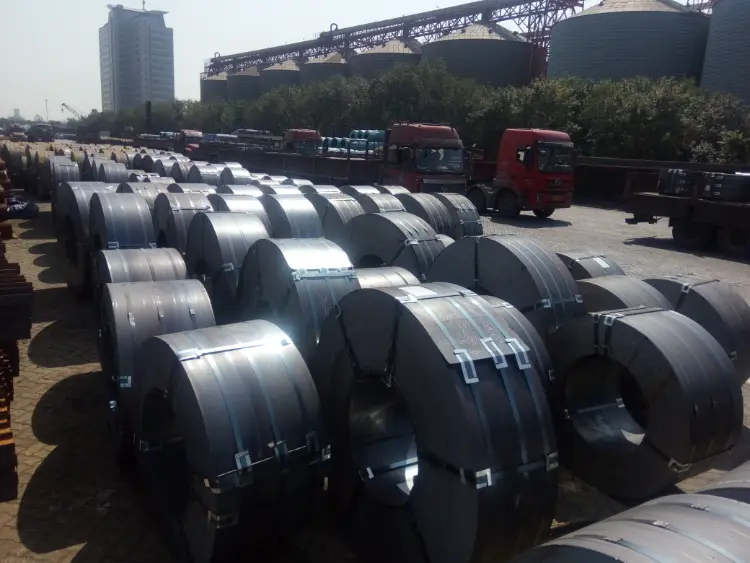
BV AH36 Shipbuilding Steel Coil
BV AH36 Shipbuilding Steel Coil - High-Strength Hull Structural Plate for Marine Applications
Comprehensive material data for BV AH36 shipbuilding steel coil: chemical composition, mechanical properties, thermal and electrical physical properties, international equivalents, and application guidelines.
Hot rolling, thermomechanical rolling, normalizing, cutting, forming, welding, bending
- Phone : +8618037372205
- Email : [email protected]
- WhatsApp: Contact via Whtsapp
- WeChat: +8618037372205
BV AH36 Shipbuilding Steel Coil Introduction
BV AH36 is a high-strength hull structural steel grade certified by Bureau Veritas (BV) in accordance with the BV Rules for the Classification of Steel Ships. As a member of the AH36 series under IACS UR W11, this steel is widely used in ship and offshore platform construction, offering a minimum yield strength of 355 MPa and excellent weldability at low temperatures.
Key characteristics:
- Controlled chemical composition with micro-alloying (Nb, V, Ti) for grain refinement and strength
- Guaranteed impact toughness at 0 °C (A-grade) delivering ≥34 J longitudinal (24 J transverse) for standard thicknesses
- Good balance of strength, ductility, and formability, enabling cold bending and welding without preheat
- Supplied as hot-rolled coil, later cut and processed into plates, profiles, or structural components
- Compliant with IACS unified requirements and equivalent to ABS AH36, DNV AH36, LR AH36, CCS AH36, etc.
This grade is typically delivered in normalized or thermomechanically rolled (M) condition, ensuring uniform mechanical properties and fine-grain microstructure. Its low carbon equivalent (CEV ≤0.38) minimizes weld cracking risk, making it suitable for heavy fabrication in shipyards.
BV AH36 Shipbuilding Steel Coil Chemical Composition
The following chemical limits are defined in the BV Rules, Chapter 1, Section 3 for grade AH36. Maxima are given unless a range is indicated. Aluminum is required for fully killed steel; micro-alloying elements (Nb, V, Ti) may be added individually or in combination, with a combined limit of Nb+V+Ti ≤0.12 %. The carbon equivalent CEV = C + Mn/6 + (Cr+Mo+V)/5 + (Ni+Cu)/15 is controlled, typically ≤0.38 % to ensure good weldability.
| Element | Standard Value (%, max unless range) | Remarks |
|---|---|---|
| Carbon (C) | ≤0.18 | Ladle analysis; product analysis may slightly differ |
| Silicon (Si) | ≤0.50 | For killed steel; typical 0.10–0.50 |
| Manganese (Mn) | 0.90–1.60 | Dependent on thickness and manufacturing process |
| Phosphorus (P) | ≤0.035 | Stricter limits for some applications |
| Sulfur (S) | ≤0.035 | Low S improves ductility and impact |
| Aluminium (Al) acid soluble | ≥0.015 | Required for fully killed fine grain practice |
| Niobium (Nb) | ≤0.05 | Grain refiner; total Nb+V+Ti ≤0.12 |
| Vanadium (V) | ≤0.10 | Precipitation strengthening |
| Titanium (Ti) | ≤0.02 | Grain refinement; total with Nb+V ≤0.12 |
| Chromium (Cr) | ≤0.20 | Residual element; may be intentionally added up to 0.25 in some cases |
| Nickel (Ni) | ≤0.40 | Residual limit |
| Molybdenum (Mo) | ≤0.08 | Residual limit |
| Copper (Cu) | ≤0.35 | For corrosion resistance; higher with agreement |
| Nitrogen (N) | ≤0.009 (if not nitrogen-fixing elements) | May be higher if sufficient Al/Nb/V present |
| Carbon Equivalent (CEV) | Typically ≤0.38 (as per agreement) | Ensures weldability; value depends on thickness |
BV AH36 Shipbuilding Steel Coil Thermal and Electrical Physical Properties
Physical properties are representative for low-carbon, micro-alloyed steel at ambient temperature unless otherwise noted. Values may vary slightly depending on exact chemical composition and heat treatment. The coefficient of thermal expansion increases with temperature; thermal conductivity decreases with rising temperature. Electrical resistivity is given for direct current at 20 °C.
| Property | Typical Value | Unit | Test Condition |
|---|---|---|---|
| Density (ρ) | 7.85 | g/cm³ | 20 °C |
| Elastic Modulus (E) | 210 | GPa | 20 °C, static |
| Shear Modulus (G) | 81 | GPa | 20 °C, calculated |
| Poisson's Ratio (ν) | 0.30 | – | 20 °C, typical |
| Thermal Expansion (α) | 11.7 | 10⁻⁶ /K | 20 – 100 °C |
| Thermal Expansion (α) | 12.5 | 10⁻⁶ /K | 20 – 200 °C |
| Thermal Expansion (α) | 13.2 | 10⁻⁶ /K | 20 – 300 °C |
| Thermal Conductivity (λ) | 50 | W/(m·K) | 20 °C |
| Specific Heat Capacity (c) | 460 | J/(kg·K) | 20 °C |
| Electrical Resistivity (ρₑ) | 0.19 – 0.25 | µΩ·m | 20 °C, DC |
BV AH36 Shipbuilding Steel Coil Mechanical Properties
The mechanical properties are valid for longitudinal test pieces (transverse values may differ). Impact test is at 0 °C since grade designation 'A'. Yield strength remains 355 MPa minimum for all shipbuilding thicknesses (≤100 mm). Tensile strength range is 490–620 MPa. Elongation and impact requirements vary with thickness. Bend test (180°) uses different mandrel diameters according to thickness.
| Property | Standard Required Value | Unit | Test Condition / Thickness |
|---|---|---|---|
| Yield Strength (ReH) | ≥355 | MPa | t ≤50 mm |
| Yield Strength (ReH) | ≥355 | MPa | 50 < t ≤70 mm |
| Yield Strength (ReH) | ≥355 | MPa | 70 < t ≤100 mm |
| Tensile Strength (Rm) | 490 – 620 | MPa | All thicknesses |
| Elongation (A) | ≥22 | % | t ≤50 mm; gauge length 5.65√S₀ |
| Elongation (A) | ≥21 | % | 50 < t ≤70 mm |
| Elongation (A) | ≥20 | % | 70 < t ≤100 mm |
| Impact Energy (KV, longitudinal) | ≥34 | J | t ≤50 mm; 0 °C, V-notch |
| Impact Energy (KV, transverse) | ≥24 | J | t ≤50 mm; 0 °C, V-notch |
| Impact Energy (KV, longitudinal) | ≥41 | J | 50 < t ≤70 mm; 0 °C |
| Impact Energy (KV, transverse) | ≥27 | J | 50 < t ≤70 mm; 0 °C |
| Impact Energy (KV, longitudinal) | ≥50 | J | 70 < t ≤100 mm; 0 °C |
| Impact Energy (KV, transverse) | ≥34 | J | 70 < t ≤100 mm; 0 °C |
| Bend Test (180°), mandrel dia = 3a | No cracks | - | t ≤25 mm |
| Bend Test (180°), mandrel dia = 4a | No cracks | - | 25 < t ≤50 mm |
BV AH36 Shipbuilding Steel Coil Completely Equivalent Material Standards and Substitutable Grades
| Country / Region | Standard | Grade | Remarks |
|---|---|---|---|
| International (IACS) | IACS UR W11 | AH36 | International Association of Classification Societies unified requirement; identical properties |
| USA | ABS Rules (American Bureau of Shipping) | AH36 | Same grade with equivalent mechanical and chemical limits |
| Norway / Germany | DNV Rules (Det Norske Veritas) | AH36 | Now DNV GL; grade recognized as equivalent |
| UK | LR Rules (Lloyd's Register) | AH36 | LR grade AH36 matches BV AH36 |
| China | CCS Rules (China Classification Society) | AH36 | CCS AH36 fully equivalent |
| Japan | NK Rules (ClassNK) | AH36 | Nippon Kaiji Kyokai – interchangeable |
| South Korea | KR Rules (Korean Register) | AH36 | KR AH36 same specification |
| Italy | RINA Rules (Registro Italiano Navale) | AH36 | Grade accepted as equivalent |
| Russia | RS Rules (Russian Maritime Register) | AH36 | RS grade AH36 corresponds to BV AH36 |
BV AH36 Shipbuilding Steel Coil Application Introduction
BV AH36 steel coil is engineered for demanding marine environments where high strength, weldability, and toughness at 0 °C are essential. Its typical use involves cutting, forming, and welding into large structural assemblies. The material is suitable for cold forming and moderate bending without preheating when following recommended practices. Below are typical application areas.
Product Applications: Ship hull plates (shell, bottom, deck), Coil-fed cut-to-length sheets for stiffeners, Longitudinal and transverse bulkheads, Web frames and brackets, Pipes and hollow sections for marine structures, Offshore module structural members
Processed into products: Deck plates and deck stringers, Bottom plating and bilge keels, Side shell frames and girders, Watertight and oiltight bulkheads, Foundations for main engines and generators, Hatch coamings and crane pedestal plates, Stiffening profiles (angle, bulb flat, tee) cut from coil, Offshore platform legs and bracing elements
Application industries: Shipbuilding and ship repair, Offshore oil & gas platforms, Marine equipment manufacturing, Port and harbour construction, Barge and floating structure fabrication, Renewable energy (offshore wind turbine foundations)
BV AH36 Shipbuilding Steel Coil Similar/Alternative Materials with Comparable Performance
| Country / Region | Standard | Grade | Remarks |
|---|---|---|---|
| EU | EN 10025-4 | S355G7+N / S355G7+M | Structural steel for offshore structures; yield 355 MPa, impact at -20°C (better), requires additional testing for marine use |
| USA | ASTM A131 / A131M | AH36 | Structural steel for ships; identical nominal mechanical properties, but minor chemical differences may exist |
| Japan | JIS G 3106 | SM490A / SM490B | Welded structural steel; yield ~325-365 MPa, impact at 0°C for B, not all ship class requirements included |
| China | GB 712 | AH36 | Similar marine steel; Chinese shipbuilding standard, equivalent to IACS AH36 |
| International | BV Rules | DH36 | Higher toughness version (impact at -20°C) with same strength; can substitute where improved low-temperature performance is required |
| International | BV Rules | AH32 | Lower strength (315 MPa yield); alternative for less stressed parts |
Notes:
Testing and Certification: BV AH36 is always supplied with a BV surveyor's endorsement or a certified test report (EN 10204 type 3.1 or 3.2). Strict control of CEV and impact properties is mandatory. Welding: Preheating is generally not required for thicknesses up to 30 mm, but low hydrogen procedures are recommended. Corrosion resistance: Standard atmospheric corrosion applies; protective coatings are necessary for sea water exposure. Availability: Coil form allows efficient laser or plasma cutting and roll-forming into various marine structural profiles.
- Share



