
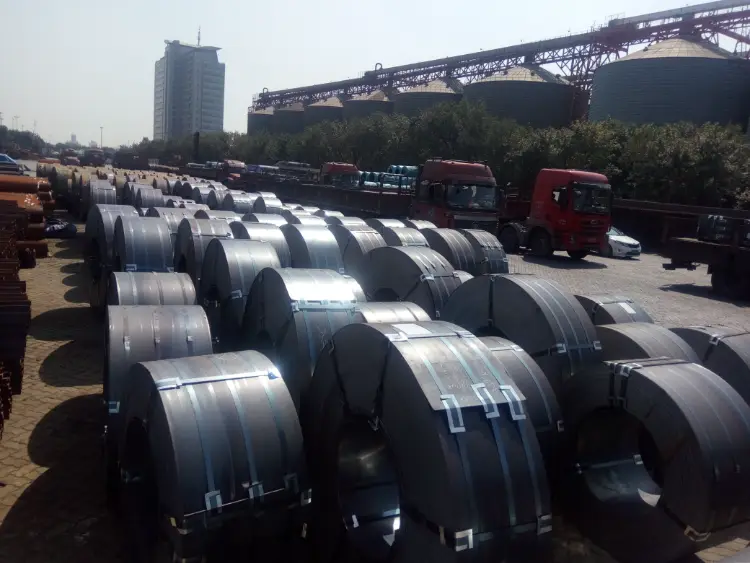
BV FH32 Shipbuilding Steel Coil
BV FH32 Shipbuilding Steel Coil: High-Strength Hull Structural Steel for Arctic and LNG Vessels
Comprehensive technical data for BV FH32 shipbuilding steel coil, including chemical composition, mechanical properties, physical properties, equivalent grades, and application guidelines for marine and offshore engineering.
Thermomechanical rolling (TMCP), normalized rolling, controlled rolling; weldable with standard shipbuilding procedures
- Phone : +8618037372205
- Email : [email protected]
- WhatsApp: Contact via Whtsapp
- WeChat: +8618037372205
BV FH32 Shipbuilding Steel Coil Introduction
BV FH32 is a high-strength hull structural steel grade certified by Bureau Veritas (BV) for shipbuilding and offshore applications, conforming to the IACS UR W11 unified requirements for normal and high-strength hull steels. The designation 'FH32' indicates fine-grain fully killed steel with a minimum specified yield strength of 315 MPa (32 kgf/mm²) and guaranteed impact toughness at -60 °C (F class). This thermomechanically rolled or normalized steel exhibits excellent low-temperature notch toughness, reliable weldability, and good strength-to-weight ratio. It is primarily supplied in plates, coils, and sections, and is widely used in critical structures of vessels operating in cold climates and ice zones, such as LNG carriers, icebreakers, and Arctic offshore platforms. The material fulfills stringent collision resistance and fatigue requirements mandated by classification societies.
BV FH32 Shipbuilding Steel Coil Chemical Composition
The chemical composition of BV FH32 is strictly regulated by IACS UR W11 and BV Rules to ensure consistent weldability, toughness, and strength. Microalloying elements such as niobium, vanadium, and titanium are used for grain refinement and precipitation strengthening. Sulfur and phosphorus contents are minimized to enhance ductility and resistance to cracking. A minimum acid-soluble aluminum content ensures full deoxidation and fine-grain structure.
| Element | Specified Value (%) | Remarks |
|---|---|---|
| Carbon (C) | ≤0.18 | Ladle analysis |
| Manganese (Mn) | 0.90 – 1.60 | For thicknesses >50 mm, higher Mn may be required for strength |
| Silicon (Si) | ≤0.50 | Promotes deoxidation |
| Phosphorus (P) | ≤0.025 | Maximizes toughness and reduces temper embrittlement |
| Sulfur (S) | ≤0.025 | Stringent control for improved through-thickness properties |
| Aluminum (Al, acid sol.) | ≥0.015 | Minimum for fine-grain practice |
| Niobium (Nb) | ≤0.05 | Grain refiner and precipitation hardener |
| Vanadium (V) | ≤0.10 | Optional microalloy; sum Nb+V+Ti may be limited |
| Titanium (Ti) | ≤0.02 | Optional; used for nitrogen fixation |
| Copper (Cu) | ≤0.35 | Residual; may be higher for weathering resistance with approval |
| Chromium (Cr) | ≤0.20 | Residual |
| Nickel (Ni) | ≤0.40 | Residual; may be intentionally added for low-temperature toughness |
| Molybdenum (Mo) | ≤0.08 | Residual |
| Nitrogen (N) | ≤0.009 | Applicable when insufficient Al or other nitrogen binders present |
BV FH32 Shipbuilding Steel Coil Thermal and Electrical Physical Properties
The following physical properties represent typical values for low-alloy structural steels like BV FH32. These data are derived from general engineering references and may slightly vary depending on exact chemical composition and heat treatment condition. They are essential for design calculations involving thermal loads, heat transfer, and structural dynamics.
| Property | Typical Value | Unit | Test Condition / Remarks |
|---|---|---|---|
| Density (ρ) | ~7.85 | g/cm³ | At room temperature |
| Modulus of elasticity (E) | ~210 | GPa | Tension, at 20°C |
| Shear modulus (G) | ~80 | GPa | Calculated from E and ν |
| Poisson's ratio (ν) | ~0.3 | – | Within elastic range |
| Coefficient of thermal expansion (α) | ~12.0 × 10⁻⁶ | /K | Linear expansion, range 20–100°C |
| Coefficient of thermal expansion (α) | ~13.0 × 10⁻⁶ | /K | Range 20–300°C |
| Thermal conductivity (λ) | ~50 | W/(m·K) | At 20°C |
| Thermal conductivity (λ) | ~45 | W/(m·K) | At 300°C |
| Specific heat capacity (c) | ~460 | J/(kg·K) | At 20°C |
| Specific heat capacity (c) | ~510 | J/(kg·K) | At 300°C |
| Electrical resistivity (ρₑ) | ~0.15 × 10⁻⁶ | Ω·m | At 20°C; approx. 15 μΩ·cm |
BV FH32 Shipbuilding Steel Coil Mechanical Properties
Mechanical properties are determined on test pieces taken from the finished product in the delivery condition. BV FH32 exhibits high yield and tensile strengths combined with outstanding Charpy-V notch impact energy at -60 °C, ensuring safe performance in arctic environments. Elongation and bend test requirements guarantee good formability. Values for thicknesses >50 mm are subject to separate specifications per BV rules.
| Property | Required Value | Unit | Test Condition / Remarks |
|---|---|---|---|
| Yield strength (minimum) | ≥315 | MPa | Transverse or longitudinal; applies to all thicknesses ≤100 mm |
| Tensile strength | 440 – 570 | MPa | For thicknesses ≤100 mm |
| Elongation after fracture (A, min.) | ≥22 | % | Gauge length 5.65√S₀ (5d); transverse test piece |
| Elongation after fracture (A, min.) | ≥24 | % | Longitudinal test piece (optional) |
| Charpy-V impact energy (KV₂) at -60°C (min.) | ≥31 | J | Longitudinal; average of three specimens; single min. 22 J |
| Charpy-V impact energy (KV₂) at -60°C (min.) | ≥24 | J | Transverse; average of three specimens; single min. 17 J |
| Bend test (thickness ≤50 mm) | No cracks or defects | – | Bend angle 180°; former diameter = 3a (a = specimen thickness) |
| Bend test (thickness 50–100 mm) | No cracks or defects | – | Bend angle 180°; former diameter = 4a |
BV FH32 Shipbuilding Steel Coil Completely Equivalent Material Standards and Substitute Grades
The following classification society and international standards define grades that are technically equivalent to BV FH32, offering identical minimum yield strength (315 MPa) and Charpy V-notch impact toughness at -60°C. These materials can be directly substituted for one another subject to the acceptance of the relevant classification society.
| Country/Region | Standard | Grade | Remarks |
|---|---|---|---|
| USA / International | ABS Rules | FH32 | American Bureau of Shipping; identical requirements |
| Norway / International | DNV Rules | FH32 | Det Norske Veritas; F32 Arctic designation |
| UK / International | Lloyd's Register Rules | FH32 | LR designation for low-temperature hull steel |
| China / International | CCS Rules | FH32 | China Classification Society; identical to IACS UR W11 |
| Japan / International | ClassNK Rules | FH32 | Nippon Kaiji Kyokai |
| South Korea / International | KR Rules | FH32 | Korean Register |
| Italy / International | RINA Rules | FH32 | Registro Italiano Navale |
| International | ISO 630-3:2012 | E315GC or E315GD | Fine-grain weldable structural steel with impact test at -60°C; technical delivery conditions differ slightly |
BV FH32 Shipbuilding Steel Coil Application Introduction
BV FH32 steel combines high strength and excellent low-temperature toughness, making it a material of choice for marine structures exposed to severe cold. Its fine-grain microstructure and low impurity levels ensure reliable welding performance and resistance to brittle fracture. Major application areas include:
Product Applications: Hull plates and stiffener profiles in ice-class vessels (Ice Class PC1–PC7), Deck structures and cargo tank boundaries for LNG, LPG, and LEG carriers, Floating production storage and offloading (FPSO) hull modules, Jack-up rig legs and spudcans, Polar icebreaker stem and stern frames, Drillship and semi-submersible platform columns and pontoons
Processed into products: Outer shell plating in ice belt regions, Transverse and longitudinal bulkheads, Web frames and stringers, Bottom and side longitudinals, Keel, stem, and rudder horn castings (weldable matching compositions), Helideck support structures, Offshore crane pedestals and heavy-load grillages
Application industries: Commercial shipbuilding, Naval marine engineering, Offshore oil & gas, Arctic and polar infrastructure, Renewable energy (offshore wind foundations)
BV FH32 Shipbuilding Steel Coil Similar and Comparable Substitute Material Recommendations
The grades listed below offer comparable strength and toughness characteristics but may differ in guaranteed minimum impact temperature, alloying philosophy, or delivery condition. They can be considered as possible alternatives for BV FH32 after careful engineering review, especially when -60°C impact testing is not mandatory.
| Country/Region | Standard | Grade | Remarks |
|---|---|---|---|
| Europe | EN 10025-4:2004 | S355ML (1.8834) | Thermomechanical rolled; minimum yield 355 MPa; impact test at -50°C (KV ≥27 J). Higher strength but lower design temperature capability than FH32. |
| Europe | EN 10025-4:2004 | S420ML (1.8836) | Thermomechanical rolled; minimum yield 420 MPa; impact test at -50°C. Higher strength alternative for weight reduction, but requires joint approval. |
| Japan | JIS G 3106:2015 | SM490YB | Rolled steel for welded structure; minimum yield 365 MPa, impact -10°C. Suitable only for moderate climate applications. |
| USA | ASTM A131 / A131M | EH36 | Higher strength (min. 355 MPa) with impact test at -40°C. Often used in offshore structures; requires verification for -60°C service. |
| Russia | GOST 5521-93 | E32 | Marine hull steel with minimum yield 315 MPa; impact test temperature specified separately. Match with F-class ordered if required. |
Notes:
All data are compiled from BV Rules for the Classification of Steel Ships (latest edition) and IACS UR W11 (Rev.8 2019). The maximum thickness for guaranteed FH32 properties is typically 100 mm; for thicker products, supplementary requirements may apply. Weldability is excellent with standard shipbuilding consumables, but preheating may be necessary for thicknesses over 50 mm. For critical applications, through-thickness property testing (Z-quality) can be specified following BV acceptance criteria. The steel can be supplied with additional certifications for low temperature service (e.g., DNV 'E' or 'F' designation) as per project requirements.
- Share



