
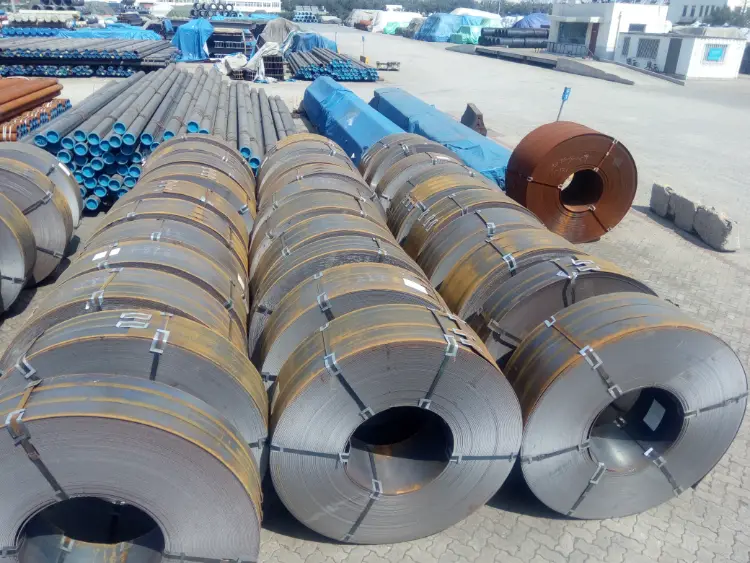
BV FH36 Shipbuilding Steel Coil
BV FH36 Shipbuilding Steel Coil: High-Strength Low-Temperature Toughness for Arctic-Grade Marine Structures
Comprehensive datasheet for BV FH36 shipbuilding steel coil including chemical composition, mechanical properties at -60°C, thermal physics, and full international equivalent grades from ABS, DNV, LR, and other major classification societies.
Welding, bending, cold forming, machining, flame cutting, controlled rolling, normalizing rolling, thermo-mechanical controlled processing (TMCP) optional
- Phone : +8618037372205
- Email : [email protected]
- WhatsApp: Contact via Whtsapp
- WeChat: +8618037372205
BV FH36 Shipbuilding Steel Coil Introduction
BV FH36 is a high-strength, low-temperature fine-grain structural steel grade certified by Bureau Veritas for shipbuilding and offshore applications. As per BV Rules Part B, it offers a minimum yield strength of 355 MPa and excellent notch toughness down to -60°C, making it ideal for hulls, decks, and critical structural components in ice-going vessels and Arctic offshore platforms.
Key characteristics:
- Controlled rolling or normalized-rolled delivery condition for uniform fine grain structure
- Low carbon equivalent for superior weldability without preheating
- Guaranteed Charpy V-notch impact energy of 34 J at -60°C (longitudinal and transverse)
- Full compliance with IACS UR W11 and EN 10025-4 S355ML equivalent
- Available as coil, plate, and cut-to-length sheet with traceable mill certificates
BV FH36 Shipbuilding Steel Coil Chemical Composition
The ladle analysis of BV FH36 complies with the requirements of BV Rules Part B, Chapter 1, Table 1.2 for FH36 steel. The values shown below are maximum or range limits, and the steel is fully killed with fine grain practice. Nb, V, Ti may be used singly or in combination for grain refinement. If the carbon equivalent (CEV) based on product analysis exceeds 0.43%, supplementary welding tests may be required.
Key elements:
- Low carbon for weldability and toughness
- Manganese content 0.90–1.60% for strength and deoxidation
- Micro-alloying with Nb, V, Ti ensures fine grain and precipitation hardening
- Strict control of phosphorus and sulfur for high clean steel
| Element | Specified Value | Remarks |
|---|---|---|
| Carbon (C) | ≤ 0.18% | Heat analysis; product analysis ≤ 0.20% |
| Silicon (Si) | ≤ 0.50% | Fully killed; sufficient for deoxidation |
| Manganese (Mn) | 0.90–1.60% | If CEV allows, up to 1.65% for thickness > 40 mm |
| Phosphorus (P) | ≤ 0.030% | Low P ensures resistance to temper embrittlement |
| Sulfur (S) | ≤ 0.030% | Low S improves through-thickness properties |
| Aluminum (Al), total | ≥ 0.015% acid soluble | Fine grain practice; Al/N ratio > 2:1 |
| Niobium (Nb) | 0.02–0.05% | Single or combined with V, Ti; sum Nb+V+Ti ≤ 0.12% |
| Vanadium (V) | 0.05–0.10% | Optional; see combined limits |
| Titanium (Ti) | 0.007–0.05% | If Ti used, N typically fixed as TiN |
| Nitrogen (N) | ≤ 0.012% | Lower for improved toughness; if >0.012%, binding elements required |
| Carbon Equivalent (CEV) | ≤ 0.42% (typically ≤ 0.40%) | Based on product analysis: CEV = C + Mn/6 + (Cr+Mo+V)/5 + (Ni+Cu)/15 |
BV FH36 Shipbuilding Steel Coil Thermal and Electrical Physical Properties
Physical properties are not mandatory per BV rules but are provided as typical reference values for design calculations. These values are based on structural steel with similar composition and are valid for temperatures from 20°C to 400°C. Actual values may vary slightly depending on exact composition and manufacturing route.
Usage notes:
- Density is used for weight estimation and deadweight calculations.
- Thermal expansion affects welding distortion and fit-up clearance.
- Thermal conductivity influences heat flow during welding and fire safety design.
- Electrical resistivity is relevant for non-destructive testing (eddy current) and earth bonding.
| Property | Typical Value | Unit | Test Condition |
|---|---|---|---|
| Density (ρ) | 7850 | kg/m³ | At 20°C |
| Modulus of Elasticity (E) | 210 | GPa | At 20°C; static tensile modulus |
| Shear Modulus (G) | 81 | GPa | At 20°C; calculated G = E/[2(1+ν)] |
| Poisson's Ratio (ν) | 0.3 | — | Within elastic range |
| Thermal Expansion Coefficient (α) | 11.7 × 10⁻⁶ | K⁻¹ | Mean value between 20°C and 100°C |
| Thermal Expansion Coefficient (α) | 12.5 × 10⁻⁶ | K⁻¹ | Mean value between 20°C and 300°C |
| Thermal Expansion Coefficient (α) | 13.5 × 10⁻⁶ | K⁻¹ | Mean value between 20°C and 500°C |
| Thermal Conductivity (λ) | 52 | W/(m·K) | At 20°C |
| Thermal Conductivity (λ) | 47 | W/(m·K) | At 200°C |
| Thermal Conductivity (λ) | 40 | W/(m·K) | At 400°C |
| Specific Heat Capacity (cp) | 475 | J/(kg·K) | At 20°C |
| Specific Heat Capacity (cp) | 515 | J/(kg·K) | At 200°C |
| Specific Heat Capacity (cp) | 580 | J/(kg·K) | At 400°C |
| Electrical Resistivity (ρe) | 0.19 | µΩ·m | At 20°C |
BV FH36 Shipbuilding Steel Coil Mechanical Properties
Mechanical testing is performed in accordance with BV Rules Part B. Tests include tensile testing at room temperature and Charpy V-notch impact testing at -60°C. Properties are valid for thicknesses up to 50 mm unless otherwise specified. For thicker sections, modified requirements may apply. All values are minimum unless a range is given.
Important notes:
- Impact energy values are the average of three specimens; one individual value may be below the average but not less than 70% of the specified average.
- Bend test (if required) uses a mandrel diameter of 2t (t = thickness) for 180° bending.
- Mechanical properties may be verified on normalized-rolled or TM rolled condition as per delivery state.
| Property | Specified Requirement | Unit | Test Condition |
|---|---|---|---|
| Yield Strength (ReH) | ≥ 355 | MPa | Ambient temperature, transverse or longitudinal for flat products |
| Tensile Strength (Rm) | 490–630 | MPa | Ambient temperature |
| Elongation (A) | ≥ 21 | % | Gauge length 5.65√So (e.g., 200 mm for 12.5 mm thick) |
| Charpy impact energy (KV) | ≥ 34 (average) | J | -60°C, longitudinal direction, V-notch |
| Charpy impact energy (KV) | ≥ 24 (individual min.) | J | -60°C, longitudinal direction, V-notch |
| Charpy impact energy (KV) | ≥ 34 (average) | J | -60°C, transverse direction (if specified in order) |
| Charpy impact energy (KV) | ≥ 24 (individual min.) | J | -60°C, transverse direction |
| Through-thickness reduction of area (Z) | ≥ 15 (Z15), 25 (Z25), 35 (Z35) | % | If ordered as Z-grade per BV Pt B, Ch 1, Sec 2 |
BV FH36 Shipbuilding Steel Coil Full Equivalent Material Standards and Substitutable Grades
| Country/Region | Standard | Grade | Remarks |
|---|---|---|---|
| International (IACS) | IACS UR W11 | FH36 | Baseline requirement; all class societies adopt this. |
| France/International | BV Rules Part B | FH36 | Original grade under discussion. |
| USA/International | ABS Rules | FH36 | Identical chemical and mechanical requirements. |
| Norway/International | DNV Rules (now DNV-GL) | FH36 | Often marked as NV FH36; equivalent in all respects. |
| UK/International | LR Rules | FH36 | Lloyd's Register FH36. |
| Germany/International | DNV GL (merged) | FH36 | GL FH36 equivalent; uses GL 2009 or DNVGL rules. |
| China | CCS Rules | FH36 | China Classification Society, widely used in domestic shipbuilding. |
| Japan | NK Rules | FH36 | Nippon Kaiji Kyokai. |
| South Korea | KR Rules | FH36 | Korean Register. |
| Italy | RINA Rules | FH36 | Registro Italiano Navale. |
| Russia | RS Rules | FH36 | Russian Maritime Register of Shipping. |
| Europe (EN) | EN 10025-4:2019 | S355ML | Structural steel with specified low-temperature impact at -50°C; FH36 matches S355ML but verified at -60°C; often accepted. |
| USA (ASTM) | ASTM A131/A131M | FH36 | Standard specification for structural steel for ships, Grade FH36. |
BV FH36 Shipbuilding Steel Coil Application Introduction
BV FH36 steel coil is engineered for the most demanding marine environments requiring high strength and exceptional low-temperature toughness. Its delivery as coils enables efficient automated cutting and forming for large-volume ship and offshore module production. Below are typical applications across industries, products, and specific components.
Product Applications: Hull plates and stiffeners for ice-class vessels, Deck and bottom longitudinal stiffeners, Bulkheads and watertight doors, Offshore platform topside modules and helidecks, Monopile and transition piece steel for offshore wind turbines, Cryogenic storage tank shells (if double-certified)
Processed into products: Shell plating for ice belt (ice-strengthened region), Web frames and floor plates, Bracket plates and brackets, Hatch coaming and coaming stays, Crane pedestal rings and slew bearings, Pipe support saddles and deck pads, Cutouts and reinforcements for mooring fairleads
Application industries: Shipbuilding (commercial and naval vessels ), Offshore oil & gas (FPSO, platforms, subsea structures), Offshore wind energy (monopiles, transition pieces, jacket foundations), Polar engineering (icebreakers, Arctic LNG carriers), Heavy equipment and crane manufacturing (marine cranes, A-frames), Bridge and infrastructure (cold climate bridges, floating bridges)
BV FH36 Shipbuilding Steel Coil Closely Related Alternative Grades
| Country/Region | Standard | Grade | Remarks |
|---|---|---|---|
| Europe | EN 10025-4 | S460ML | Higher strength (460 MPa yield) but similar toughness at -50°C; may replace FH36 if weight reduction is critical, subject to design approval. |
| Europe | EN 10025-3 | S355NL | Normalized fine-grain steel with -50°C impact; can be used in less severe low-temperature marine environments. |
| USA | ASTM A131/A131M | EH36 | Same strength as FH36 but toughness guaranteed only down to -40°C; suitable where -60°C is not required. |
| USA | ASTM A537 Class 1 | A537 Cl1 | Pressure vessel steel with -60°C toughness; plate form only, may be considered for non-classed marine structures. |
| Japan | JIS G 3106 | SM490YB | Equivalent to EH36; use as FH36 substitute only if impact test at -60°C is specially agreed. |
| China | GB/T 712 | FH36 | Chinese national shipbuilding steel standard; equivalent to CCS FH36, interchangeable with BV FH36. |
Notes:
Additional information:
All FH36 coil products from BV-approved mills are subject to mandatory non-destructive testing (ultrasonic) per BV Class requirements when used in critical areas. The coil may be supplied with edge mill or trimmed edge. If intended for welded fabrications subject to PWHT, the CEQ should be controlled to <0.45% to avoid reheat cracking. For Z-grade (through-thickness property) orders, the chemical composition may be adjusted, especially sulfur content, and the test specimen orientation must be agreed upon. Contact the manufacturer for the latest product-specific data sheet and typical multi-certification (e.g., BV+DNV+ABS) availability.
- Share



