
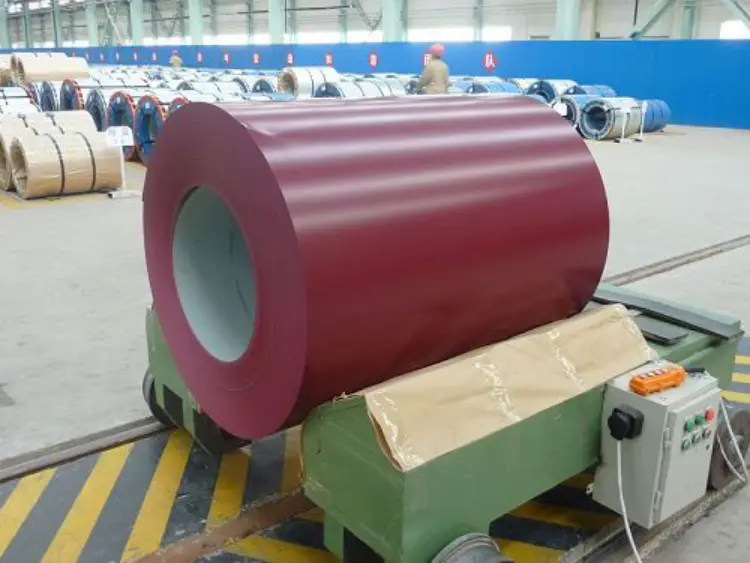
BV E620 Shipbuilding Steel Coil
BV E620 Shipbuilding Steel Coil: High Strength Quenched & Tempered Steel for Marine Applications
BV E620 is a high-strength quenched and tempered structural steel for shipbuilding, certified by Bureau Veritas with minimum yield strength of 620 MPa and excellent low-temperature toughness at -40°C.
Hot rolling followed by quenching and tempering, cutting, forming, welding, shot blasting
- Phone : +8618037372205
- Email : [email protected]
- WhatsApp: Contact via Whtsapp
- WeChat: +8618037372205
BV E620 Shipbuilding Steel Coil Introduction
BV E620 is a high-strength shipbuilding steel grade classified under Bureau Veritas (BV) Rules for Steel Ships. It is a quenched and tempered (Q&T) fine-grain structural steel with a minimum yield strength of 620 MPa, providing an optimal combination of strength, toughness, and weldability for critical marine and offshore structures. Key characteristics include:
- High yield strength up to 620 MPa for significant weight savings
- Low-temperature impact toughness down to -40°C (E-grade)
- Excellent weldability with proper procedures
- Compliance with BV material requirements and classification rules
This steel is mainly used in heavy-duty hull construction, offshore platforms, and lifting equipment where high structural integrity is mandatory.
BV E620 Shipbuilding Steel Coil Chemical Composition
The chemical composition conforms to BV Rules Part D, Chapter 2 for E620 grade. Fine-grain practice is mandatory using aluminium, niobium, vanadium or titanium. Limits ensure good hardenability for quenching, and low impurity levels (P, S) guarantee high ductility and toughness.
Typical ladle analysis (maximum values unless range given):
| Element | Standard Requirement (%) | Remarks |
|---|---|---|
| Carbon (C) | 0.20 max | Varies slightly with thickness |
| Silicon (Si) | 0.10 – 0.55 | Grain refinement, deoxidation |
| Manganese (Mn) | 0.90 – 1.70 | Hardenability and strength |
| Phosphorus (P) | 0.025 max | Strict control for toughness |
| Sulfur (S) | 0.025 max | Strict control for toughness |
| Chromium (Cr) | 1.50 max | Corrosion resistance and strength |
| Nickel (Ni) | 2.00 max | Low-temperature toughness |
| Molybdenum (Mo) | 0.70 max | Hardenability |
| Copper (Cu) | 0.35 max | Optional, corrosion resistance |
| Vanadium (V) | 0.08 max | Microalloying, grain refinement |
| Titanium (Ti) | 0.05 max | Microalloying, grain refinement |
| Niobium (Nb) | 0.05 max | Microalloying, grain refinement |
| Nitrogen (N) | 0.012 max | Limit for toughness |
| Aluminium (Al, total) | 0.015 min | Fine grain practice |
| Boron (B) | 0.005 max (if added) | Optional for enhanced hardenability |
BV E620 Shipbuilding Steel Coil Thermal & Electrical Physical Properties
Physical properties are typical for quenched and tempered high-strength low-alloy steel with a density similar to standard structural steels. Values are derived from comparable grades such as S690Q. They may vary slightly depending on exact chemical composition and heat treatment condition.
| Property | Typical Value | Unit | Test Conditions / Remarks |
|---|---|---|---|
| Density (ρ) | 7.85 | g/cm³ | At 20 °C |
| Elastic modulus (E) | 205 | GPa | At 20 °C, dynamic |
| Shear modulus (G) | 80 | GPa | Calculated |
| Poisson's ratio (ν) | 0.30 | — | Standard |
| Thermal expansion coeff. (α) | 11.7 | 10⁻⁶/K | Between 20 °C and 100 °C |
| Thermal expansion coeff. (α) | 12.6 | 10⁻⁶/K | Between 20 °C and 200 °C |
| Thermal expansion coeff. (α) | 13.2 | 10⁻⁶/K | Between 20 °C and 300 °C |
| Thermal conductivity (λ) | 25 – 30 | W/(m·K) | At 100 °C, typical range |
| Specific heat capacity (cp) | 460 | J/(kg·K) | At 20 °C |
| Electrical resistivity (ρe) | ~0.25 | μΩ·m | At 20 °C |
BV E620 Shipbuilding Steel Coil Mechanical Properties
Mechanical properties are determined on test pieces taken from the mid-thickness of the product, in transverse direction. Specimens are machined and tested according to BV Rules. The values below apply to material in quenched and tempered condition unless otherwise stated. Impact test at -40 °C is mandatory for E-grade.
| Property | Typical Requirement | Unit | Test Conditions / Remarks |
|---|---|---|---|
| Yield strength (ReH) | 620 min | MPa | Thickness ≤ 50 mm |
| Yield strength (ReH) | 580 min | MPa | 50 mm < thickness ≤ 70 mm |
| Yield strength (ReH) | 540 min | MPa | 70 mm < thickness ≤ 100 mm |
| Tensile strength (Rm) | 720 – 890 | MPa | Thickness ≤ 50 mm |
| Tensile strength (Rm) | 700 – 870 | MPa | 50 mm < thickness ≤ 70 mm |
| Tensile strength (Rm) | 680 – 840 | MPa | 70 mm < thickness ≤ 100 mm |
| Elongation (A) | 15 min | % | Transverse, gauge length 5.65√S₀ (typical for plate) |
| Bend test | No cracks | – | 180° bend; d=3t for t≤16 mm, d=4t for t>16 mm |
| Impact energy (KV, -40°C) | 50 min | J | Longitudinal direction (E-grade) |
| Impact energy (KV, -40°C) | 34 min | J | Transverse direction (E-grade) |
BV E620 Shipbuilding Steel Coil Fully Equivalent Standards & Substitute Grades
| Country/Region | Standard | Grade | Remarks |
|---|---|---|---|
| International | BV Rules | E620 | Original designation |
| USA / International | ABS Rules | E620 | American Bureau of Shipping – exactly equivalent |
| Norway / International | DNV Rules | E620 | Det Norske Veritas – exactly equivalent |
| UK / International | LR Rules | E620 | Lloyd's Register – exactly equivalent |
| China / International | CCS Rules | E620 | China Classification Society – exactly equivalent |
| Japan / International | NK Rules | E620 | Nippon Kaiji Kyokai – exactly equivalent |
| Italy / International | RINA Rules | E620 | Registro Italiano Navale – exactly equivalent |
| South Korea / International | KR Rules | E620 | Korean Register – exactly equivalent |
| European / International | EN 10225 | S620Q (1.8985) | Weldable structural steels for fixed offshore structures – same yield class |
BV E620 Shipbuilding Steel Coil Application Introduction
BV E620 steel is engineered for heavy-duty marine and offshore applications where high strength, low-temperature toughness, and reliability are critical. Its high yield strength permits thinner sections and weight savings without compromising structural safety. The material is delivered under BV survey to guarantee conformance to classification rules.
Key application sectors and products:
Product Applications: Merchant and naval vessel hulls, Jack-up rig legs and spudcans, Floating production storage and offloading (FPSO) modules, Crane boom and lattice boom sections, Submarine pressure hulls (subject to additional requirements)
Processed into products: Main deck plates, sheer strake, Bottom shell plates and bilge keel, Longitudinal and transverse bulkheads, Offshore crane pedestals and slewing rings, Tubular nodes for jacket structures (K-joints, Y-joints), Heavy lift spreader bars and shackle plates
Application industries: Shipbuilding and marine engineering, Offshore oil & gas platforms (jackets, decks), Renewable energy foundations (offshore wind), Heavy lifting and transport equipment, Bridge structures in marine environment
BV E620 Shipbuilding Steel Coil Similar or Closely Matching Substitute Alloys
| Country/Region | Standard | Grade | Remarks |
|---|---|---|---|
| EU | EN 10025-6 | S690Q (1.8931)/S690QL (1.8928) | Higher yield strength (690 MPa), similar chemistry and application; may be used with adjusted thickness |
| USA | ASTM A514 / A517 | Gr. E | 690 MPa QT steel for pressure vessels and structural; similar toughness but requires evaluation for marine service |
| USA | ASTM A709 | HPS 100W grade (690) | High-performance structural steel for bridges; weldable and tough, similar strength level |
| Japan | JIS G 3128 | SHY 685/ SHY 685N | High yield strength steel for welded structures; nominally 685 MPa yield but close in mechanical properties |
Notes:
Additional requirements:
- Material must be ordered with BV survey and marking; certificates according to EN 10204 3.1 or 3.2 are mandatory.
- Welding procedures must be qualified in accordance with BV Rules and typically require preheating and controlled interpass temperature. Low-hydrogen processes are recommended.
- Post-weld heat treatment (PWHT) is generally not required for thicknesses up to 50 mm, but may be needed for thicker sections or highly constrained joints.
- Steel is sensitive to hydrogen embrittlement; proper storage and handling to avoid moisture pickup is essential.
- Surface condition after shot blasting is usually Sa 2½ per ISO 8501-1.
- These values are for reference only; the exact specifications in the BV Rules at the time of order govern.
- Share



