
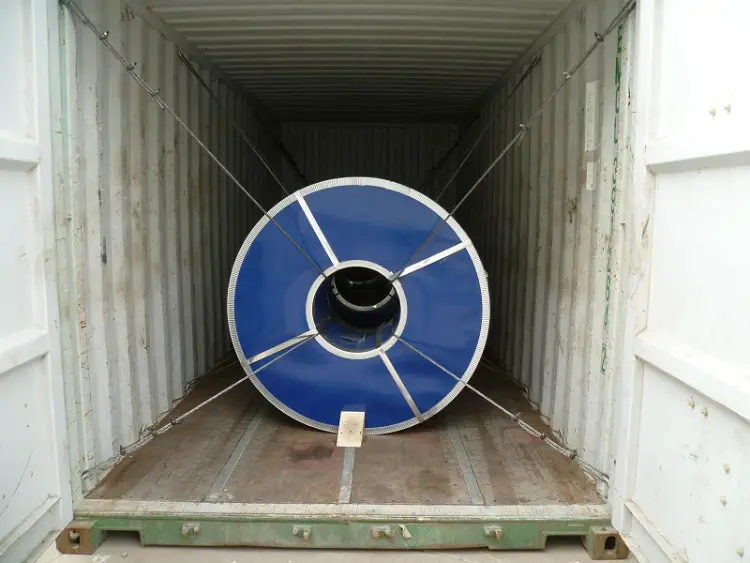
BV D620 Shipbuilding Steel Coil
BV D620 Shipbuilding Steel Coil - High-Strength Hull Structural Steel for Marine Applications
BV D620 is a high-strength hull structural steel regulated by Bureau Veritas Classification Society, with a minimum yield strength of 620 MPa. Supplied as coil or plate, it is designed for critical parts of ships and offshore structures, offering excellent weldability, notch toughness, and formability.
Thermomechanical controlled rolling (TMCP), normalizing rolling, or quenching and tempering (QT)
- Phone : +8618037372205
- Email : [email protected]
- WhatsApp: Contact via Whtsapp
- WeChat: +8618037372205
BV D620 Shipbuilding Steel Coil Introduction
BV D620 is a thermomechanically rolled (TMCP) or quenched and tempered high-strength shipbuilding steel grade specified by Bureau Veritas (BV) Rules for Materials and Welding. It belongs to the 620 MPa yield strength class of hull structural steels, characterized by:
- Minimum yield strength of 620 MPa at ambient temperature
- Guaranteed Charpy impact toughness at -20°C (designated 'D' quality)
- Stringent chemical composition limits to ensure weldability and corrosion resistance
- Suitability for cold forming and heavy plate welding
- Available in coil and plate form, typical delivery condition is TMCP or QT
This steel is mainly used in the construction of large vessels, container ships, and ice-class ships where weight reduction and high structural integrity are crucial.
BV D620 Shipbuilding Steel Coil Chemical Composition
The table provides the maximum permissible limits for ladle analysis according to BV Rules. Microalloying elements such as Nb, V, Ti, and Al are commonly added to achieve the required strength and toughness. All values are in weight percent, and the steel is fully killed with fine grain practice.
| Element | Typical/Standard Requirement (%) | Remarks |
|---|---|---|
| C | ≤ 0.20 | Maximum content |
| Si | 0.10 – 0.55 | Silicon range |
| Mn | 0.90 – 1.70 | Manganese range, may be adjusted depending on thickness and strength requirement |
| P | ≤ 0.030 | Phosphorus maximum |
| S | ≤ 0.030 | Sulfur maximum |
| N | ≤ 0.012 | Nitrogen maximum |
| Al (total) | ≥ 0.015 | Aluminum used for deoxidation and grain refinement; acid-soluble Al minimum |
| Nb | 0.02 – 0.05 | Niobium microalloying, typical range |
| V | 0.05 – 0.10 | Vanadium microalloying, typical range |
| Ti | ≤ 0.05 | Titanium addition, limited to avoid reheat cracking |
| Cr | ≤ 0.25 | Residual element, not intentionally added |
| Ni | ≤ 0.40 | Residual element, not intentionally added |
| Mo | ≤ 0.08 | Residual element, not intentionally added |
| Cu | ≤ 0.35 | Residual element, not intentionally added |
| CEV | Typically ≤ 0.50 – 0.52 | Carbon equivalent value calculated by formula; often guaranteed to ensure weldability |
BV D620 Shipbuilding Steel Coil Thermal and Electrical Physical Properties
The physical properties listed below are typical for this class of low-alloy high-strength shipbuilding steel and may vary slightly with heat treatment and exact chemical composition. They are provided for engineering design purposes and are not part of the classification society's mandatory requirements.
| Property | Typical Value | Unit | Condition / Remarks |
|---|---|---|---|
| Density (ρ) | 7.85 | g/cm³ | At 20°C |
| Elastic modulus (E) | 205 – 210 | GPa | At room temperature |
| Shear modulus (G) | 79 – 81 | GPa | Calculated from E and ν |
| Poisson's ratio (ν) | 0.29 – 0.30 | – | Elastic range |
| Thermal expansion coefficient (α) | 11.5 × 10⁻⁶ | K⁻¹ | 20 – 100°C |
| Thermal expansion coefficient (α) | 12.4 × 10⁻⁶ | K⁻¹ | 20 – 200°C |
| Thermal expansion coefficient (α) | 13.2 × 10⁻⁶ | K⁻¹ | 20 – 400°C |
| Thermal conductivity (λ) | 42 – 46 | W/(m·K) | At 20°C |
| Thermal conductivity (λ) | 40 – 43 | W/(m·K) | At 200°C |
| Specific heat capacity (c) | 460 – 480 | J/(kg·K) | At 20°C |
| Electrical resistivity (ρₑ) | 0.20 – 0.25 | µΩ·m | At room temperature |
BV D620 Shipbuilding Steel Coil Mechanical Properties
Mechanical properties are tested in accordance with BV Rules. Unless stated otherwise, values refer to longitudinal test pieces. The tensile and impact properties are valid for plate thickness up to 100 mm. Impact energy is an average of three tests, with single value not less than 70% of the average.
| Property | Required Value | Unit | Test Condition |
|---|---|---|---|
| Yield strength (ReH) | ≥ 620 | MPa | Transverse or longitudinal, at room temperature; for thickness ≤ 100 mm |
| Tensile strength (Rm) | 700 – 890 | MPa | Typical range depending on thickness |
| Elongation after fracture (A) | ≥ 15 | % | Gauge length 5.65√S₀, for thickness ≤ 50 mm |
| Elongation after fracture (A) | ≥ 14 | % | Gauge length 5.65√S₀, for thickness 50–100 mm |
| Charpy V-notch impact energy (KV₂) | ≥ 31 (longitudinal) | J | At -20°C, D-quality: average of 3 specimens |
| Charpy V-notch impact energy (KV₂) | ≥ 24 (transverse) | J | At -20°C, when transverse tests are required |
| Bend test (180° | d = 3a (for thickness ≤ 25 mm) | – | Bend diameter; no cracks on tension side |
| Bend test (180° | d = 4a (for thickness > 25 mm) | – | Bend diameter; no cracks on tension side |
BV D620 Shipbuilding Steel Coil Fully Equivalent Material Standards and Substitutable Grades
| Country / Region | Classification Society / Standard | Grade Designation | Remarks |
|---|---|---|---|
| International (IACS) | IACS UR W11 | GH620 (DH quality) | Universal requirement for high-strength hull structural steel, yield 620 MPa, impact at -20°C |
| Norway / Germany | DNV | NV D620 | Same technical requirements as BV D620 |
| USA | ABS | AB/DH620 | Equivalent DH620 grade under ABS Rules |
| United Kingdom | Lloyd's Register (LR) | DH620 | LR Rules, yield 620 MPa, test -20°C |
| China | CCS | D620 | China Classification Society, identical to IACS requirements |
| Japan | Nippon Kaiji Kyokai (ClassNK) | KD620 | NK Rules, equivalent toughness and strength class |
| Russia | Russian Maritime Register (RMRS) | D620 | RMRS high-strength shipbuilding steel, same YS 620 MPa |
| Korea | Korean Register (KR) | KD620 | KR Rules, equivalent to BV D620 |
| Italy | RINA | D620 | RINA Rules, equivalent designations |
BV D620 Shipbuilding Steel Coil Application Introduction
BV D620 steel is designed for load-bearing structural components in marine environments where high strength-to-weight ratio, weldability, and low-temperature toughness are essential. It is widely used in shipbuilding and offshore engineering. Proper welding consumables and procedures (e.g., low hydrogen welding, preheating as per rules) should be followed to maintain toughness in the heat-affected zone. The material can be cold formed to certain radii and is suitable for automated panel line processing.
Product Applications: Hull shell plates and longitudinal stiffeners, Deck plates and hatch coamings of large container vessels, Bulkhead and tank structures in crude oil tankers, Ice belt and icebreaker hulls, Offshore module structural frames, Crane pedestal and leg components of liftboats
Processed into products: Keel plates and bottom longitudinals, Sheer strakes, Transverse web frames and girders, Stringers and brackets, Watertight doors and trunk systems, Structural node parts in jack-up rigs
Application industries: Shipbuilding and ship repair, Offshore oil and gas platforms (FPSO, jack-ups), Heavy machinery for marine environments, Bridge construction (marine sections), Wind turbine offshore substructures
BV D620 Shipbuilding Steel Coil Similar / Comparable Materials for Reference
| Country / Region | Standard | Grade | Remarks |
|---|---|---|---|
| Europe | EN 10025-6 | S620Q | Quenched and tempered structural steel, yield 620 MPa, but different notch toughness specification (J0/J2/K2 instead of D class). Suitable for non-marine structures. |
| USA | ASTM A517 / A517M | Grade Q | High-strength quenched and tempered alloy steel plate, yield approx. 620 MPa, but intended for pressure vessels and non-marine applications. |
| USA | ASTM A514 / A514M | Grade Q | High-yield-strength quenched and tempered alloy steel plate for structural uses, similar strength, but impact test at different temperatures. |
| International | ISO 4950-3 | S620QR | High yield strength flat steel products in the quenched and tempered condition (QR quality), equivalent to EN S620Q, comparable strength. |
Notes:
For thicknesses above 50 mm, special qualification tests may be required by the classification society. Coil material must be flattened and resquared before use; residual stress level and flatness should be agreed upon at the time of order. Preheating for welding is generally not required for thicknesses below 30 mm when using low hydrogen processes, but should follow approved welding procedure specifications. The carbon equivalent (CEV) is normally limited to 0.52% to avoid cold cracking. Delivery conditions can be tailored: for example, 'D620' with 'D' quality implies good through-thickness properties and resistance to lamellar tearing when specified.
- Share



