
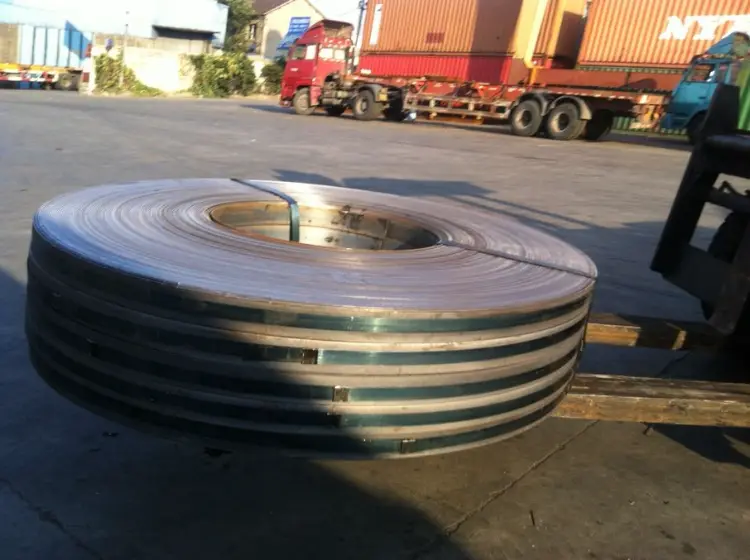
BV FH620 Shipbuilding Steel Coil
BV FH620 Shipbuilding Steel Coil - High-Strength Quenched & Tempered Grade for Marine Structures
Complete material data for BV FH620 shipbuilding steel coil: chemical composition, mechanical properties, thermal and electrical physical properties, international equivalents, similar materials, and application guidance, all according to Bureau Veritas rules and IACS UR W11.
Hot rolling, quenching and tempering
- Phone : +8618037372205
- Email : [email protected]
- WhatsApp: Contact via Whtsapp
- WeChat: +8618037372205
BV FH620 Shipbuilding Steel Coil Introduction
BV FH620 is an extra-high-strength quenched and tempered steel grade defined by Bureau Veritas (BV) for shipbuilding and offshore structures. It offers a minimum yield strength of 620 MPa in delivery condition, combined with excellent toughness at -60 °C (grade F). The steel is microalloyed to achieve fine grain structure and superior weldability, making it suitable for critical hull members, heavy-lift crane booms, and leg components of jack-up rigs. It is typically supplied as coil or plate in thicknesses up to 100 mm, and complies with IACS UR W11 harmonised requirements. The steel exhibits good formability and can be welded with proper preheat and consumables, enabling efficient fabrication of large, highly stressed structures.
BV FH620 Shipbuilding Steel Coil Chemical composition
The chemical composition conforms to BV Rules and IACS UR W11 for extra-high-strength hull structural steel grade FH620. Limits are specified as maximum values unless a range is given. Elements such as Nb, V, Ti may be added singly or in combination, with the sum Nb+V+Ti ≤ 0.12%. Fine grain practice is mandatory. The carbon equivalent CE = C + Mn/6 + (Cr+Mo+V)/5 + (Ni+Cu)/15 ≤ 0.52% for thicknesses ≤ 50 mm, and ≤ 0.54% for thicknesses > 50 to 100 mm.
| Chemical element | Standard value (max % unless range) | Remarks |
|---|---|---|
| C (Carbon) | 0.20 | For thickness ≤ 50 mm; further restricted for thicker products |
| Si (Silicon) | 0.55 | |
| Mn (Manganese) | 1.70 | |
| P (Phosphorus) | 0.025 | |
| S (Sulphur) | 0.025 | |
| Al (Aluminium, total) | ≥ 0.020 (range) | Acid-soluble Al ≥ 0.015% if total not reported |
| Nb (Niobium) | 0.05 | Single or combined with V, Ti |
| V (Vanadium) | 0.10 | Single or combined with Nb, Ti |
| Ti (Titanium) | 0.02 | Single or combined with Nb, V |
| Cr (Chromium) | 0.25 | |
| Ni (Nickel) | 0.80 | |
| Mo (Molybdenum) | 0.50 | |
| Cu (Copper) | 0.35 | |
| N (Nitrogen) | 0.012 | For aluminium-treated steels |
| CE (Carbon Equivalent) | 0.52 (t ≤ 50 mm); 0.54 (50 < t ≤ 100 mm) | Mandatory control for weldability |
BV FH620 Shipbuilding Steel Coil Thermal and electrical physical properties
The following physical properties are typical for quenched and tempered low-alloy structural steels of this type. They are not mandatory requirements by BV but are representative for engineering calculations. Actual values may vary slightly depending on exact composition, heat treatment condition, and temperature. The data are given for room temperature unless otherwise specified.
| Property | Typical value | Unit | Test condition / remarks |
|---|---|---|---|
| Density (ρ) | 7850 | kg/m³ | At 20 °C |
| Elastic modulus (E) | 210 | GPa | At 20 °C, static |
| Shear modulus (G) | 80 | GPa | At 20 °C, calculated |
| Poisson's ratio (ν) | 0.3 | – | Elastic range |
| Thermal expansion coefficient (α) | 12.0 × 10⁻⁶ | K⁻¹ | Between 20 °C and 100 °C |
| Thermal expansion coefficient (α) | 13.0 × 10⁻⁶ | K⁻¹ | Between 20 °C and 200 °C |
| Thermal conductivity (λ) | 45 | W/(m·K) | At 20 °C |
| Specific heat capacity (cp) | 460 | J/(kg·K) | At 20 °C |
| Electrical resistivity (ρe) | 0.25 × 10⁻⁶ | Ω·m | At 20 °C |
BV FH620 Shipbuilding Steel Coil Mechanical properties
Mechanical properties are determined on standard test pieces in accordance with BV Rules and IACS UR W11. Yield strength and tensile strength are specified for different thickness ranges. Elongation is measured on a gauge length of 5.65√So (A5). Impact testing is performed on Charpy V-notch specimens at -60 °C (grade F). Bend tests are carried out through 180° over a mandrel of specified diameter. All values are minimum requirements unless a range is given.
| Property | Required value | Unit | Test condition |
|---|---|---|---|
| Yield strength (ReH) | 620 | MPa | Thickness ≤ 50 mm; transverse |
| Yield strength (ReH) | 570 | MPa | 50 < t ≤ 70 mm; transverse |
| Yield strength (ReH) | 550 | MPa | 70 < t ≤ 100 mm; transverse |
| Tensile strength (Rm) | 720 – 930 | MPa | Thickness ≤ 70 mm; transverse |
| Tensile strength (Rm) | 700 – 930 | MPa | 70 < t ≤ 100 mm; transverse |
| Elongation (A5) | 14 | % | Gauge length 5.65√So; min. value |
| Charpy impact (KV) – longitudinal | 46 | J | At -60 °C; thickness ≤ 50 mm |
| Charpy impact (KV) – transverse | 31 | J | At -60 °C; thickness ≤ 50 mm |
| Charpy impact (KV) – longitudinal | 39 | J | At -60 °C; 50 < t ≤ 70 mm |
| Charpy impact (KV) – transverse | 27 | J | At -60 °C; 50 < t ≤ 70 mm |
| Charpy impact (KV) – longitudinal | 35 | J | At -60 °C; 70 < t ≤ 100 mm |
| Charpy impact (KV) – transverse | 24 | J | At -60 °C; 70 < t ≤ 100 mm |
| Bend test (180°) | Mandrel diameter = 3t (t = specimen thickness) | – | Applicable for tensile strength range 720–930 MPa; no cracks |
BV FH620 Shipbuilding Steel Coil Exact equivalent standards and replaceable grades
| Country/Region | Standard | Grade | Remarks |
|---|---|---|---|
| International (IACS) | UR W11 | FH620 | Harmonised rule; basis for all class societies |
| USA / ABS | ABS Rules | FH620 | Identical in scope |
| Norway / DNV | DNV Rules | FH620 | Identical and interchangeable |
| UK / LR | LR Rules | FH620 | Identical and interchangeable |
| South Korea / KR | KR Rules | FH620 | Identical and interchangeable |
| China / CCS | CCS Rules | FH620 | Identical and interchangeable |
| Japan / NK | NK Rules | FH620 | Identical and interchangeable |
BV FH620 Shipbuilding Steel Coil Application Introduction
BV FH620 steel is engineered for heavy-duty marine and offshore applications where a combination of ultra-high strength, excellent low‑temperature toughness, and good weldability is required. It is primarily used in ship hulls, offshore platform structural members, and heavy machinery. The steel can be delivered as coil or plate, and can be cut, formed, and welded with standard industrial practices (preheating and low-hydrogen procedures recommended). Typical products and components include:
Product Applications: Ship hull plates and stiffeners, Deck and bottom longitudinals, Structural profiles for ice-class vessels, Jack-up rig legs and spudcans, Crane pedestals and heavy-lift booms, Transition pieces for offshore wind turbines
Processed into products: Main deck and shell plates, Bilge strake and sheer strake, Frames and web frames, Bulkhead plating, Leg chords and rack plates, Heavy-duty slew rings and bearings housings, Welded box girders and beams
Application industries: Shipbuilding and marine engineering, Offshore oil & gas exploration and production, Heavy-lift and transport equipment, Bridge and civil construction (subject to approval), Pressure vessel and storage tank manufacturing (with class approval)
BV FH620 Shipbuilding Steel Coil Similar / alternative material recommendations
| Country/Region | Standard | Grade | Remarks |
|---|---|---|---|
| Europe | EN 10025-6 (2004) + A1 (2011) | S620Q (1.8909) | Quenched and tempered structural steel; similar yield/tensile but different impact temperature classes (Q = -20 °C; QL = -40 °C; QL1 = -60 °C). Not automatically accepted for shipbuilding unless approved by the class society. |
| USA | ASTM A514 / A514M | Grade S / Type S | High-strength quenched and tempered plate; typical ReH ≥ 620 MPa, Rm 690–895 MPa; impact properties not directly equivalent to FH620. Requires additional verification for marine use. |
| USA | ASTM A709 / A709M | Grade HPS 100W (690 MPa) | High-performance structural steel; similar tensile range but different toughness and weathering characteristics. Not a direct substitute for FH620. |
| World | ISO 4995 / 4996 | HR620 | Hot-rolled structural steel with min. yield 620 MPa; limited availability and less stringent toughness requirements compared to shipbuilding steel. |
Notes:
BV FH620 is supplied in the quenched and tempered condition. Welding must be performed with low-hydrogen processes and suitable consumables; preheating and interpass temperature control are necessary depending on thickness. The steel may be stress‑relieved after forming, but the temperature must not exceed the tempering temperature to avoid loss of strength. Before use in critical applications, the purchaser should consult the material certificate and BV rules for detailed requirements on NDT, surface condition, and marking. The chemical composition tables above reflect ladle analysis; product analysis tolerances are defined in the standard. For thicknesses greater than 100 mm, special procedures and class approval are required.
- Share



