
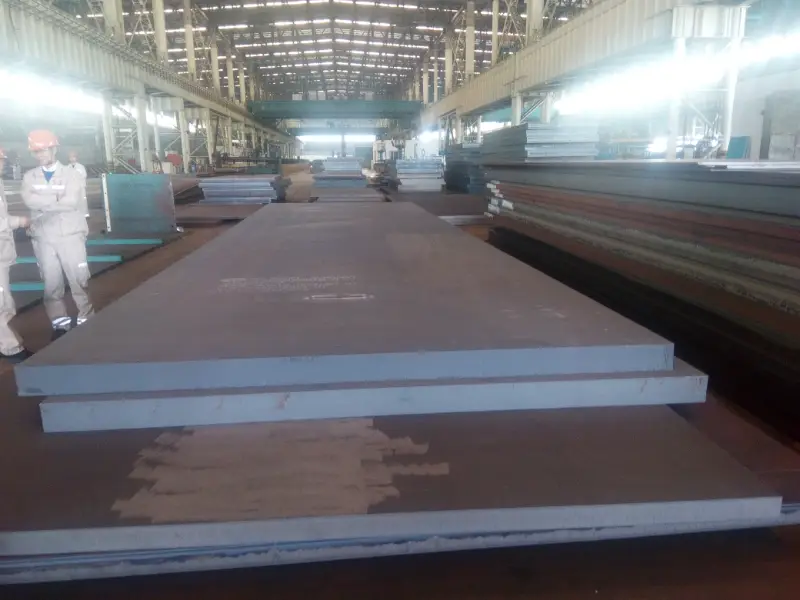
BV D460 Shipbuilding Steel
BV D460 Shipbuilding Steel: High Strength, Low Temperature Toughness for Marine Engineering
Detailed material data for BV D460 high strength shipbuilding steel certified by Bureau Veritas, including chemical composition, mechanical and physical properties, international equivalents, and application guidance.
Hot rolling, normalizing, quenching and tempering, thermo-mechanical controlled processing (TMCP); suitable for welding, cutting, cold forming, and machining
- Phone : +8618037372205
- Email : [email protected]
- WhatsApp: Contact via Whtsapp
- WeChat: +8618037372205
BV D460 Shipbuilding Steel Introduction
BV D460 is a high-strength shipbuilding steel certified by Bureau Veritas (BV) in accordance with the BV Rules for the Classification of Steel Ships. It belongs to the category of high-strength quenched and tempered or thermo-mechanically rolled structural steels with a minimum specified yield strength of 460 MPa. The letter D indicates that the steel can be used at a design temperature of -20 °C, ensuring excellent low-temperature toughness. BV D460 steel is characterized by:
- High strength-to-weight ratio, enabling lighter ship structures.
- Good weldability when proper procedures are followed.
- Reliable impact toughness down to -20°C.
- Excellent formability for ship hulls and offshore components.
Typical applications include hull plates, deck panels, and structural members for shipbuilding and offshore engineering. The steel is usually delivered in normalized, quenched and tempered, or thermo-mechanical rolled condition depending on thickness and manufacturer.
BV D460 Shipbuilding Steel Chemical Composition
The chemical composition is specified by BV Rules Pt.2, Ch.1 for high strength steel grade D460. Values are based on ladle analysis and may be subject to supplementary requirements. Carbon equivalent (CEV) is usually limited to ensure weldability.
- For thickness ≤ 50 mm, CEV ≤ 0.43% typically, depending on delivery condition.
- Microalloying elements like Nb, V, Ti are added to refine grain and enhance strength and toughness.
| Element | Specified Value (wt%) | Remarks |
|---|---|---|
| Carbon (C) | ≤ 0.20 | Lower for thicker sections; typical 0.08–0.16 |
| Silicon (Si) | ≤ 0.55 | Deoxidation element; typical 0.20–0.50 |
| Manganese (Mn) | 0.90–1.70 | Main strengthening element; adjusted for thickness |
| Phosphorus (P) | ≤ 0.035 | Max. 0.035% |
| Sulfur (S) | ≤ 0.035 | Max. 0.035% |
| Aluminum (Al, acid soluble) | ≥ 0.015 | Fine grain practice; typically 0.020–0.050 |
| Niobium (Nb) | ≤ 0.05 | Microalloy; grain refinement |
| Vanadium (V) | ≤ 0.10 | Microalloy; precipitation strengthening |
| Titanium (Ti) | ≤ 0.02 | Microalloy; grain refinement |
| Nb + V + Ti | ≤ 0.12 | Sum of microalloying elements |
| Nitrogen (N) | ≤ 0.012 | If not aluminium-killed; else not specified |
| Nickel (Ni) | ≤ 0.70 (optional) | May be added for toughness |
| Chromium (Cr) | ≤ 0.25 (typical) | Residual element |
| Molybdenum (Mo) | ≤ 0.35 (optional) | For higher strength variants |
| Copper (Cu) | ≤ 0.30 (typical) | Residual element |
BV D460 Shipbuilding Steel Thermal and Electrical Physical Properties
Physical properties are typical values for low-alloy structural steels at room temperature unless otherwise noted. They are not part of the mandatory specification but are useful for design and processing.
- Density is assumed as standard for carbon steel.
- Thermal conductivity and specific heat influence weld thermal cycles.
| Property | Typical Value | Unit | Condition / Temperature |
|---|---|---|---|
| Density (ρ) | 7.85 | g/cm³ | Room temperature |
| Modulus of Elasticity (E) | 205 | GPa | Room temperature, static |
| Shear Modulus (G) | approx. 80 | GPa | Calculated from E and ν |
| Poisson's Ratio (ν) | 0.3 | – | Room temperature |
| Thermal Expansion Coefficient (α) | 11.5 | 10⁻⁶/K | 20–100°C |
| Thermal Expansion Coefficient (α) | 12.5 | 10⁻⁶/K | 20–200°C |
| Thermal Expansion Coefficient (α) | 13.5 | 10⁻⁶/K | 20–400°C |
| Thermal Conductivity (λ) | 42–50 | W/(m·K) | At 100°C |
| Specific Heat Capacity (cp) | 460 | J/(kg·K) | 20–100°C approx. |
| Electrical Resistivity (ρ_e) | 0.20 – 0.25 | 10⁻⁶ Ω·m | At 20°C |
BV D460 Shipbuilding Steel Mechanical Properties
Mechanical properties are according to BV Rules for tensile and impact tests at -20°C. Values depend on product thickness. Transverse properties may be specified. Bending test is performed to check formability.
- Yield strength is defined as upper yield strength (ReH) for steels exhibiting yield point, or 0.2% proof stress (Rp0.2) otherwise.
- Impact tests use Charpy V-notch specimens, usually longitudinal direction.
| Property | Specified Value | Unit | Test Condition / Remarks |
|---|---|---|---|
| Yield Strength (ReH) | ≥ 460 | MPa | Thickness ≤ 50 mm |
| Yield Strength (ReH) | ≥ 440 | MPa | Thickness 50 < t ≤ 70 mm |
| Yield Strength (ReH) | ≥ 420 | MPa | Thickness 70 < t ≤ 100 mm |
| Tensile Strength (Rm) | 570 – 720 | MPa | All thicknesses up to 100 mm |
| Elongation (A) | ≥ 17 | % | Gauge length 5.65√S₀ (proportional specimen), thickness ≤ 50 mm |
| Elongation (A) | ≥ 17 | % | Thickness 50 < t ≤ 100 mm |
| Impact Energy (KV) at -20°C, longitudinal | ≥ 31 | J | Average of three specimens; min. single 21 J |
| Impact Energy (KV) at -20°C, transverse | ≥ 22 | J | When specified; min. single 15 J |
| Bend Test (bending angle 180°) | No cracks or ruptures | Mandrel diameter: 3t (t ≤ 50 mm); 4t (t > 50 mm); t = specimen thickness |
BV D460 Shipbuilding Steel Fully Equivalent Material Standards and Replaceable Grades
| Country / Region | Standard / Approval | Grade | Remarks |
|---|---|---|---|
| International | American Bureau of Shipping (ABS) | ABS DH460 | Equivalent high strength grade for -20°C use |
| International | DNV (Det Norske Veritas) | DNV D460 | Same strength and toughness designation |
| International | Lloyd's Register (LR) | LR DH460 | Fully comparable; must be LR certified |
| International | China Classification Society (CCS) | CCS D460 | Equivalent according to CCS Rules |
| International | Nippon Kaiji Kyokai (ClassNK) | NK KD460 | Similar grade; K indicates low temperature |
| International | Korean Register (KR) | KR D460 | Equivalent high strength steel |
| International | RINA (Registro Italiano Navale) | RINA D460 | Equivalent in RINA Rules |
| International | Russian Maritime Register of Shipping (RS) | RS D460 | If certified to RS |
BV D460 Shipbuilding Steel Application Introduction
BV D460 steel is widely used in marine and offshore structures where high strength and reliable low-temperature performance are required. Its good weldability and toughness make it suitable for critical components. Below are typical industries, products, and specific components.
Product Applications: Hull plates and stiffeners, Deck plates and bulkheads, Longitudinal and transverse frames, Web frames and stringers, Offshore platform structural members (legs, braces, columns), Ice-class vessel reinforcements, Heavy-lift crane booms (marine)
Processed into products: Ship hull shell plating (side, bottom, bilge), Strength deck plating, Transverse web frames and girders, Bottom longitudinals and stringers, Bulkhead plating, Bracket plates and beam knees, Offshore module support beams, Wind turbine foundation transition pieces (marine), Caisson and dolphin structural elements
Application industries: Shipbuilding and ship repair industry, Offshore oil and gas platform construction, Marine engineering and port equipment, Heavy machinery for marine environments, Bridge and infrastructure construction (with classification society approval), Pressure vessels and storage tanks (subject to additional requirements)
BV D460 Shipbuilding Steel Similar or Substitute Materials
| Country / Region | Standard | Grade | Remarks |
|---|---|---|---|
| Europe | EN 10025-6 | S460ML | Thermo-mechanically rolled, min. 460 MPa yield, -50°C toughness; may substitute if approved |
| Europe | EN 10025-6 | S460QL | Quenched and tempered, min. 460 MPa, -40°C; higher alloy content |
| USA | ASTM A131 / A131M | EH46 (hypothetical) | ASTM A131 does not have a direct 460 MPa grade; EH40 max. 390 MPa; not directly comparable |
| USA | ASTM A572 / A572M | Grade 65 | Min. yield 450 MPa, not exactly matching; supplementary requirements needed for marine service |
| Japan | JIS G 3106 | SM570 | Min. yield 460–530 MPa, but not specifically for shipbuilding; may need additional certification |
| China | GB/T 712 | DH460 | Chinese standard for shipbuilding steel, similar to D460 |
Notes:
Certification: Delivery of BV D460 steel includes a BV material certificate with heat number traceability. Welding: Preheating and interpass temperature control are required based on thickness and hydrogen level; post-weld heat treatment may not be mandatory but can be applied. Testing: Mechanical tests per cast and per 40 tons or per rolled product; supplementary Z-grade through-thickness tensile testing may be specified using Z25 or Z35 according to BV Rules. Thickness Tolerance: According to relevant EN 10029 or BV standards. Surface Condition: Float finished, free from harmful defects.
- Share



