
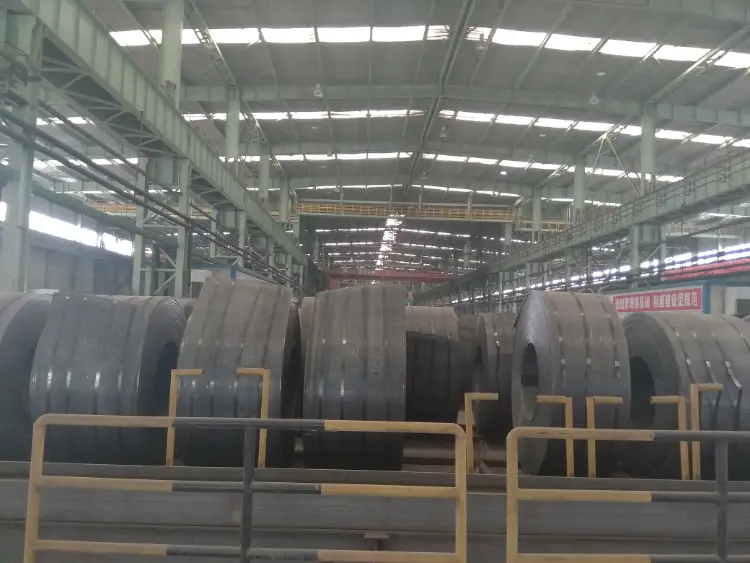
BV A460 Shipbuilding Steel Coil
BV A460 Shipbuilding Steel Coil: High-Strength Marine Structural Material for Shipbuilding and Offshore Engineering
Comprehensive technical data for BV A460 shipbuilding steel coil according to Bureau Veritas Rules, including chemical composition, mechanical properties, physical characteristics, equivalent grades, and application guidance.
Thermo-Mechanical Control Process (TMCP), Normalizing, Welding, Forming, Cutting, Bending
- Phone : +8618037372205
- Email : [email protected]
- WhatsApp: Contact via Whtsapp
- WeChat: +8618037372205
BV A460 Shipbuilding Steel Coil Introduction
BV A460 is a high-strength structural steel specifically designed for shipbuilding and offshore applications, certified by Bureau Veritas (BV). It belongs to the category of thermo-mechanically controlled processed (TMCP) or normalized high-tensile steel plates and coils with a minimum specified yield strength of 460 MPa. The steel offers an excellent combination of high strength, good weldability, and adequate toughness, making it suitable for critical structural components in harsh marine environments. Manufactured under strict process control, BV A460 ensures reliable mechanical properties, consistent chemistry, and compliance with the stringent requirements of BV Rules for the Classification of Steel Ships. Its balanced composition allows reduced plate thickness and structural weight without compromising safety or service performance.
BV A460 Shipbuilding Steel Coil Chemical Composition
The chemical composition of BV A460 is controlled to ensure high strength, excellent weldability, and sufficient toughness. All values are maximum unless a range is specified. The actual mill analysis may be tighter, especially for carbon equivalent (CEV) to guarantee weldability. Residual elements are kept low to avoid embrittlement.
Source: Based on typical requirements of BV Rules and IACS UR W11 for Grade A460 mild/high-strength hull structural steel (A grade).
| Element | Standard Value (max, wt.%) | Remarks |
|---|---|---|
| Carbon (C) | 0.18 | Ladle analysis; CEV typically ≤0.41–0.43 depending on thickness |
| Silicon (Si) | 0.10–0.55 | Deoxidation element |
| Manganese (Mn) | 0.90–1.60 | Increases strength and hardenability |
| Phosphorus (P) | 0.025 | Residual element; kept low for toughness |
| Sulfur (S) | 0.025 | Residual element; kept low for cleanliness |
| Chromium (Cr) | 0.25 | Residual limit |
| Nickel (Ni) | 0.40 | Residual limit |
| Molybdenum (Mo) | 0.08 | Residual limit |
| Copper (Cu) | 0.35 | Residual limit; beneficial for corrosion resistance |
| Aluminium (Al, total) | ≥0.015 | Grain refining; soluble Al typically ≥0.015% |
| Niobium (Nb) | 0.02–0.05 | Microalloying for grain refinement and precipitation strengthening |
| Vanadium (V) | 0.05–0.10 | Microalloying; typically ≤0.10% |
| Titanium (Ti) | 0.02 | Grain refining; max 0.02% |
| Nitrogen (N) | 0.012 | Kept low; may be bound by Ti/Al |
BV A460 Shipbuilding Steel Coil Thermal and Electrical Physical Properties
Physical properties are typical for high-strength low-alloy shipbuilding steel at room temperature unless stated otherwise. Values are provided for design guidance and are not specification requirements. They may vary slightly with exact chemical composition and processing.
| Property | Typical Value | Unit | Test Condition |
|---|---|---|---|
| Density (ρ) | 7.85 | g/cm³ | At 20°C |
| Modulus of Elasticity (E) | 206 | GPa | At 20°C; tensile modulus |
| Shear Modulus (G) | 79.3 | GPa | At 20°C; calculated from E and ν |
| Poisson's Ratio (ν) | 0.3 | - | At 20°C; elastic range |
| Mean Coefficient of Thermal Expansion (α) | 11.5 | 10⁻⁶/K | Between 20°C and 100°C |
| Thermal Conductivity (λ) | 46 | W/(m·K) | At 20°C |
| Specific Heat Capacity (cp) | 470 | J/(kg·K) | At 20°C |
| Electrical Resistivity (ρe) | 0.22 – 0.25 | 10⁻⁶ Ω·m | At 20°C, depending on alloying content |
BV A460 Shipbuilding Steel Coil Mechanical Properties
Mechanical properties are determined on tensile and impact test pieces taken transverse to the rolling direction (unless longitudinal specified for impact). Values meet the BV Rules for Grade A460. Impact test temperature is 0°C for grade A. For thicker products or alternative grades (D460, E460), lower temperatures or higher toughness apply. Bend test requires no cracking after 180° bending over a former diameter equal to 3 times the specimen thickness.
| Property | Specified Value | Unit | Test Condition |
|---|---|---|---|
| Yield Strength (ReH, minimum) | 460 | MPa | Room temperature; applies to thickness ≤50 mm. For 50 < t ≤ 70 mm: ≥440 MPa; 70 < t ≤ 100 mm: ≥400 MPa |
| Tensile Strength (Rm) | 570 – 720 | MPa | Room temperature; transverse test piece |
| Elongation after fracture (A5, minimum) | 17 | % | Gauge length L0 = 5.65√S0; transverse test piece |
| Bend Test (180° bend) | No cracks | - | Bend former diameter: 3 × specimen thickness (t) for t ≤ 35 mm; for t > 35 mm, diameter may be increased by agreement |
| Impact Energy (KV, min., longitudinal) | 27 (average of 3 tests) | J | At 0°C (Grade A); Individual value min. 20 J |
BV A460 Shipbuilding Steel Coil Completely Equivalent Grades: Standards and Substitute Designations
The following grades are recognized as metallurgically and mechanically equivalent to BV A460 under the IACS UR W11 (Unified Requirements for High Strength Hull Structural Steel) or respective society rules. They share the same minimum yield strength (460 MPa) and similar impact grade A (0°C).
| Country / Society | Standard / Rule | Grade | Remarks |
|---|---|---|---|
| International (IACS) | UR W11 | AH46 | A-grade, 460 MPa yield; basis for many society grades |
| Lloyd's Register (LR) | LR Rules | LR AH46 | Identical mechanical requirements and chemistry limits |
| DNV (Det Norske Veritas) | DNV Rules | VL A460 | Formerly NV A460; harmonized with IACS |
| American Bureau of Shipping (ABS) | ABS Rules | ABS AH46 | Direct equivalent |
| China Classification Society (CCS) | CCS Rules | CCS AH46 | Direct equivalent |
| Nippon Kaiji Kyokai (ClassNK) | NK Rules | NK KA46 | Same strength and impact properties |
| Registro Italiano Navale (RINA) | RINA Rules | RINA AH46 | Equivalent |
| Russian Maritime Register (RS) | RMRS Rules | RS A460 | Equivalent |
BV A460 Shipbuilding Steel Coil Application Introduction
BV A460 is intended for welded structural applications in shipbuilding and offshore engineering where high strength-to-weight ratio, good formability, and reliable toughness are required. Its balanced chemistry and fine-grained microstructure make it suitable for heavy load-bearing members, fatigue-sensitive details, and welded fabrications in ambient and moderately cold service conditions. The material can be formed, machined, and welded using standard procedures, with careful attention to preheating and post-weld heat treatment if required by design codes.
Product Applications: Main deck plates and stiffeners, Bottom shell plating, Side shell and longitudinal framing, Watertight and oiltight bulkheads, Hatch coamings and covers, Offshore topside modules and deck beams, Wind turbine monopile transition pieces, Crane pedestals and heavy-duty brackets
Processed into products: Stiffened panels and grillages, Web frames and girders, Bracket toes and knuckle plates, Longitudinal stiffeners and transverse webs, Box girders for crane beams, Tubular joints and cast nodes (if forged/welded), Fatigue-critical connections (with proper detail design), Cut-outs, collars, and reinforcements
Application industries: Commercial Shipbuilding (bulk carriers, tankers, container vessels), Naval Shipbuilding (frigates, auxiliary vessels), Offshore Oil & Gas (jack-up legs, topside structures, helidecks), Renewable Energy (offshore wind turbine foundations, transition pieces), Port & Harbor Infrastructure (caisson walls, lock gates), Heavy Lifting & Crane Construction (pedestal bases, booms)
BV A460 Shipbuilding Steel Coil Similar/Alternative Material Recommendations
Materials with comparable strength may differ in impact toughness temperature rating, delivery condition, or chemical composition. These can be considered for substitution where impact requirements are at least as stringent or where a different standard is requested.
| Country / Standard | Standard | Grade | Remarks |
|---|---|---|---|
| European (EN) | EN 10025-6 | S460M / S460ML | Thermomechanical rolled; ML has stricter limits on C and lower CEV. Impact temperatures down to -50°C possible; verify minimum Charpy requirements |
| European (EN) | EN 10025-6 | S460Q / S460QL | Quenched and tempered; typically provided with higher toughness at lower temperatures |
| European (EN) | EN 10025-3 | S460N / S460NL | Normalized/normalized rolled; NL with specified low-temperature toughness |
| ASTM | ASTM A131 / A131M | EH46 | Higher toughness: impact tested at -40°C; often usable as substitute when strict low-temperature toughness is required |
| BV | BV Rules | BV D460 | D-grade (impact -20°C); improved toughness over A460 |
| BV | BV Rules | BV E460 | E-grade (impact -40°C); superior low-temperature performance |
Notes:
Welding: BV A460 can be welded by all conventional arc welding processes (SMAW, SAW, GMAW, FCAW) using low-hydrogen consumables of matching strength. Preheat and interpass temperatures should be controlled according to thickness and CEV to avoid cold cracking. Post-weld heat treatment (PWHT) is not normally required, but if stress relief is performed, it should be below the tempering temperature of the TMCP condition.
Forming: Cold forming limits must respect minimum bending radii; hot forming is possible but may alter mechanical properties, requiring verification after re-heat treatment.
Certification: All plates/coils are supplied with BV inspection certificate 3.1 or 3.2 per EN 10204, showing results of tensile, impact, bend, and chemical analysis tests. Additional testing (e.g., ultrasonic, Z-grade through-thickness) may be ordered separately.
- Share



