
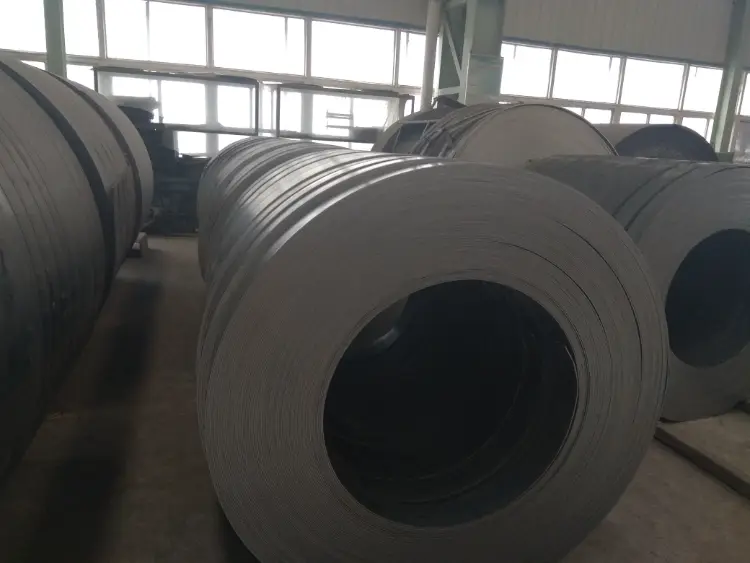
BV F420 Shipbuilding Steel Coil
BV F420 Shipbuilding Steel Coil - High-Strength Arctic-Grade Marine Plate for Extreme Offshore Environments
Explore BV F420 shipbuilding steel coil data: chemical composition, mechanical properties, thermal and electrical physical properties, equivalent grades, and application guide.
Thermo-mechanical controlled processing (TMCP), normalizing rolling, or quenching and tempering depending on thickness. Suitable for hot forming, cold forming (with caution), and welding with preheating recommendations.
- Phone : +8618037372205
- Email : [email protected]
- WhatsApp: Contact via Whtsapp
- WeChat: +8618037372205
BV F420 Shipbuilding Steel Coil Introduction
BV F420 is a high-strength shipbuilding steel grade certified by Bureau Veritas (BV) for marine and offshore applications. It belongs to the F-grade toughness category, guaranteeing minimum impact energy at -60 °C, making it suitable for Arctic and very-low-temperature environments.
- Minimum yield strength of 420 MPa in delivery condition (typically thermo-mechanically controlled processed, TMCP).
- Excellent weldability with low carbon equivalent and fine grain practice.
- High resistance to brittle fracture and lamellar tearing, ideal for critical structural components.
- Supplied as coils and plates for hull structures, decks, and offshore platforms.
It complies with BV Rules for the Classification of Ships, Part 2, Chapter 1, and aligns with IACS UR W11 requirements.
BV F420 Shipbuilding Steel Coil Chemical Composition
The chemical composition complies with BV Rules for grade F420. Microalloying elements such as niobium, vanadium, titanium, and aluminium are added for grain refinement and precipitation strengthening.
- Low carbon content ensures good weldability and toughness.
- Strict limits on phosphorus and sulphur enhance resistance to brittle fracture.
- Carbon equivalent (CEV) typically ≤ 0.45 for plates up to 50 mm thickness.
Notes: Residual elements Cr, Ni, Cu, Mo are typically limited (Cr+Ni+Cu+Mo ≤ 0.80 unless agreed). Nitrogen is controlled (usually ≤ 0.012).
| Element | Specified Value (max, unless range) | Remarks |
|---|---|---|
| Carbon (C) | 0.18 | Ladle analysis; max 0.20 for product analysis |
| Silicon (Si) | 0.10 – 0.55 | Typical range |
| Manganese (Mn) | 1.00 – 1.60 | Higher Mn for strength |
| Phosphorus (P) | 0.025 | Max, for enhanced toughness |
| Sulphur (S) | 0.025 | Max, controls inclusions |
| Aluminium (Al) | 0.020 min (acid soluble) | Grain refinement |
| Niobium (Nb) | 0.02 – 0.05 | Microalloying, optional |
| Vanadium (V) | 0.05 – 0.10 | Optional, for strength |
| Titanium (Ti) | 0.005 – 0.020 | Optional, grain refinement |
| Nitrogen (N) | 0.012 | Max, unless nitrogen-binding elements sufficient |
| Copper (Cu) | ≤ 0.35 | Residual; can be specified higher for corrosion resistance |
| Chromium (Cr) | ≤ 0.20 | Residual |
| Nickel (Ni) | ≤ 0.40 | Residual |
| Molybdenum (Mo) | ≤ 0.08 | Residual |
BV F420 Shipbuilding Steel Coil Thermal and Electrical Physical Properties
Physical properties are typical for low-alloy structural steels and not mandatory per BV Rules. They are provided for design calculations at room temperature unless stated.
- Density is standard for steel.
- Elastic modulus and shear modulus are nearly constant up to ~200 °C.
- Thermal expansion coefficient is given for the range 0-100 °C; it increases at higher temperatures.
- Resistivity is an approximate value and may vary with composition.
Values are suitable for finite element modelling and heat transfer analysis.
| Property | Typical Value | Unit | Test Condition |
|---|---|---|---|
| Density (ρ) | 7.85 | g/cm³ | Room temperature |
| Elastic Modulus (E) | 205 – 210 | GPa | Room temperature |
| Shear Modulus (G) | 80 – 85 | GPa | Room temperature |
| Poisson's Ratio (ν) | 0.29 – 0.30 | — | Room temperature |
| Thermal Expansion Coefficient (α) | 11.5 – 12.3 | 10⁻⁶/K | 0 – 100 °C |
| Thermal Conductivity (λ) | 42 – 48 | W/(m·K) | Room temperature |
| Specific Heat Capacity | 0.46 – 0.49 | J/(g·K) | Room temperature |
| Electrical Resistivity (ρ_e) | 0.18 – 0.25 | µΩ·m | Room temperature |
BV F420 Shipbuilding Steel Coil Mechanical Properties
Values are based on BV Rules for plates and wide flats in TMCP or normalised condition, thickness ≤ 100 mm (unless stated).
- Minimum yield strength and tensile strength are guaranteed at room temperature.
- Elongation is measured on a gauge length of 5.65√S₀ (ISO 6892-1).
- Impact test for F-grade is performed at -60 °C, minimum absorbed energy 27 J for longitudinal specimens and 20 J for transverse (standard BV).
- Bend test: 180° around a former of diameter 3t (t = thickness) for t ≤ 25 mm; 4t for 25 < t ≤ 40 mm.
Actual values from typical production may exceed these minima substantially.
| Property | Specified Value | Unit | Test Condition |
|---|---|---|---|
| Yield Strength (ReH) | 420 min | MPa | t ≤ 100 mm; transverse direction |
| Tensile Strength (Rm) | 530 – 680 | MPa | t ≤ 100 mm; transverse direction |
| Elongation (A) | 18 min | % | Gauge length 5.65√S₀; transverse, t ≤ 100 mm |
| Impact Energy (KV) | 27 min (longitudinal) | J | -60 °C, standard Charpy-V specimen |
| Impact Energy (KV) | 20 min (transverse) | J | -60 °C, standard Charpy-V specimen |
| Bend Test (180°) | No cracks | — | Former diameter 3t for t ≤ 25 mm; 4t for 25 < t ≤ 40 mm |
BV F420 Shipbuilding Steel Coil Completely Equivalent Material Standards and Alternative Grades
Since BV F420 is a classification society grade, direct equivalents are found in other IACS member rules. Each society has an identical grade structure: the letter indicates toughness class (F = -60°C) and the number the minimum yield strength (420 MPa). These grades are mutually accepted for certification transfer.
| Country / Region | Standard (Classification Society) | Grade | Remarks |
|---|---|---|---|
| International | Lloyd's Register (LR) | LR F420 | Identical toughness and strength; chemical limits may differ slightly |
| Norway | DNV (Det Norske Veritas) | DNV F420 | Now part of DNV GL; full equivalency |
| USA | American Bureau of Shipping (ABS) | ABS F420 | F420 listed in ABS Rules Part 2 |
| Japan | Nippon Kaiji Kyokai (NK / ClassNK) | NK F420 | Recognised under IACS reciprocity |
| Italy | Registro Italiano Navale (RINA) | RINA F420 | Equivalent grade |
| China | China Classification Society (CCS) | CCS F420 | Full equivalent; commonly used |
| South Korea | Korean Register (KR) | KR F420 | Identical properties |
BV F420 Shipbuilding Steel Coil Application Introduction
BV F420 steel is designed for extreme marine environments where both high strength and guaranteed crack-arrest toughness at -60 °C are mandatory. Its low carbon equivalent permits efficient welding with minimal preheating. Typical use:
- Ice-class vessel hulls and ice belts.
- Arctic offshore structures such as jackets and topsides.
- High-stress areas of LNG carriers and FPSOs.
The coil form facilitates automated panel lines and reduces waste. Flatness and thickness tolerances follow BV requirements. For components requiring Z-direction properties, thicknesses up to 50 mm can be ordered with Z25/Z35 specification.
Product Applications: Icebreaker hull plates and icebelt, Heavy-lift crane booms and pedestals, Jack-up rig legs and spudcans, Offshore wind turbine transition pieces, Cargo tank sections for LPG/LNG carriers, Ship deck stringers and sheer strakes
Processed into products: Fracture-critical hull stiffeners and brackets, Watertight doors and hatches for Arctic operation, Weldments in structures subjected to fatigue loading at low temperatures, Bolted connections for modular offshore platforms, Pipe supports and pressure vessel shells (with separate approval), Bearing pedestals and machinery seating blocks
Application industries: Arctic and ice-class shipbuilding, Offshore oil & gas (platforms, FPSO), LNG carrier construction, Renewable energy (offshore wind substructures), Port and heavy-lift crane manufacturing, Naval and specialized vessel engineering
BV F420 Shipbuilding Steel Coil Similar / Near-Equivalent Alternative Materials
The following materials have comparable strength but may differ in toughness level, delivery condition, or standard. Designers should verify certification requirements, especially for low-temperature applications. Many are offshore structural steels to EN 10225 or API specifications.
| Country / Region | Standard | Grade | Remarks |
|---|---|---|---|
| Europe | EN 10225:2009 | S420G2+M / S420G2+Q | Offshore structural steel, yield 420 MPa, different toughness designations; not a direct substitute for ship hull without specific approval |
| BV Rules | BV | BV FH420 | Same strength, but toughness class for -40 °C (EH) or -40 °C (EH) — lower than F420. Not suitable for Arctic service without additional testing |
| BV Rules | BV | BV EH420 | Yield 420 MPa, -40 °C impact; less stringent than F420 |
| API Spec 2W/2Y | API | Grade 420 / A420 | For offshore structures, similar strength; often quenched and tempered, with different chemistry limits |
| ASTM | ASTM A131 / A131M | Grade FH420 (proposed) | ASTM A131 now includes FH grades; must confirm if FH420 is standardised, else EH420 can be used with supplementary F-class testing |
| Russia | GOST R 52927:2015 / RMRS | F420 (RMRS) | Russian Maritime Register of Shipping F420 equivalent for Arctic ships |
Notes:
- BV F420 is to be ordered with designation "BV F420" and must be accompanied by BV certification documents (Form 3.1 or 3.2 per EN 10204).
- Welding consumables should achieve matching low-temperature toughness; basic-coated electrodes or appropriate flux-cored wires are recommended.
- Preheating is generally not required for plates under 30 mm but should follow the carbon equivalent and fabrication guidelines.
- Ultrasonic testing per BV Rules is often required for plates of thickness ≥ 15 mm in critical applications.
- Through-thickness (Z-direction) properties to BV Grade Z25 or Z35 can be specified when lamellar tearing resistance is required.
- Share



