
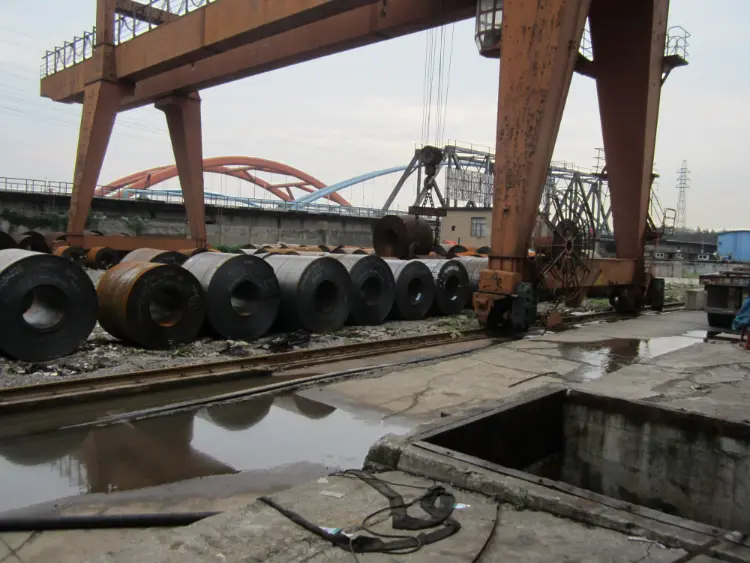
BV E460 Shipbuilding Steel Coil
BV E460 Shipbuilding Steel Coil | High Strength Marine Structural Plate
Complete material data for BV E460 shipbuilding steel coil: chemical composition, mechanical properties, thermal & electrical physical properties, worldwide equivalent grades, and practical application guidance for marine and offshore engineering.
Hot rolling; Thermo-mechanical controlled processing (TMCP) is the standard delivery route; normalising (N) or quenching & tempering (Q+T) can also be agreed for specific requirements
- Phone : +8618037372205
- Email : [email protected]
- WhatsApp: Contact via Whtsapp
- WeChat: +8618037372205
BV E460 Shipbuilding Steel Coil Introduction
BV E460 is a high-strength shipbuilding structural steel grade certified by Bureau Veritas (BV) under the Rules for the Classification of Steel Ships. It belongs to the 460 MPa minimum yield strength category with guaranteed impact toughness at -40°C (E-grade). The steel is primarily supplied in the form of hot-rolled coils or plates produced through thermo-mechanical controlled processing (TMCP), offering an excellent combination of high strength, good weldability, and reliable low‑temperature toughness. Typical applications include hull structures, deck plating, and critical structural members in ships and offshore installations. Its chemistry is microalloyed with Nb, V, Ti and strictly controlled carbon equivalent to ensure reliable toughness and weldability in heavy-gauge sections.
BV E460 Shipbuilding Steel Coil Chemical Composition
The chemical composition below follows IACS UR W11 limits for E460, as adopted by BV. The steel is fully killed and fine-grained treated with aluminium, and microalloyed with niobium, vanadium and titanium to achieve the specified strength and toughness. Carbon equivalent (CEV) is controlled to guarantee good weldability; typical CEV maximum is 0.45–0.48 % depending on thickness.
| Chemical Element | Standard Value (wt %) | Remarks |
|---|---|---|
| Carbon (C) | ≤ 0.18 | Max. |
| Manganese (Mn) | 0.90 – 1.70 | Range, higher Mn for thickness > 25 mm |
| Silicon (Si) | 0.10 – 0.50 | Range |
| Phosphorus (P) | ≤ 0.025 | Max. |
| Sulfur (S) | ≤ 0.025 | Max. |
| Aluminium (Al, acid soluble) | ≥ 0.015 | Min., fully killed |
| Niobium (Nb) | ≤ 0.05 | Max. |
| Vanadium (V) | ≤ 0.10 | Max. |
| Titanium (Ti) | ≤ 0.05 | Max., total Ti |
| Nickel (Ni) | ≤ 0.40 | Max. |
| Chromium (Cr) | ≤ 0.20 | Max. |
| Copper (Cu) | ≤ 0.30 | Max. |
| Molybdenum (Mo) | ≤ 0.08 | Max. |
| Nitrogen (N) | ≤ 0.012 | Max., product analysis ≤ 0.014 |
BV E460 Shipbuilding Steel Coil Thermal and Electrical Physical Properties
The following physical properties are typical for high-strength low-alloy (HSLA) structural steels at room temperature and thus representative of BV E460. Slight variations may occur depending on exact chemical composition and heat treatment.
| Property | Standard Value | Unit | Test Conditions |
|---|---|---|---|
| Density (ρ) | 7850 | kg/m³ | At 20 °C |
| Modulus of Elasticity (E) | 205 | GPa | At 20 °C |
| Shear Modulus (G) | 80 | GPa | Typical, at 20 °C |
| Poisson's Ratio (ν) | 0.3 | - | Typical |
| Thermal Expansion Coefficient (α) | 11.5 | 10⁻⁶ / K | Between 20 °C and 100 °C |
| Thermal Conductivity (λ) | 50 | W/(m·K) | At 20 °C |
| Specific Heat Capacity (cp) | 460 | J/(kg·K) | Typical, at 20 °C |
| Electrical Resistivity (ρe) | 0.25 | µΩ·m | At 20 °C |
BV E460 Shipbuilding Steel Coil Mechanical Properties
The mechanical properties are referenced to IACS UR W11 for E460 grade in the TMCP condition. Tensile tests are carried out on transverse specimens. Impact tests at -40°C are mandatory (E-grade) and may be requested either longitudinal or transverse. Values below apply to plate thickness ≤ 100 mm. Bending test requirements ensure formability without cracking.
| Property | Specification Value | Unit | Test Conditions / Remarks |
|---|---|---|---|
| Yield Strength (ReH) | ≥ 460 | MPa | Thickness ≤ 100 mm, transverse specimen |
| Tensile Strength (Rm) | 570 – 720 | MPa | Thickness ≤ 100 mm, transverse specimen |
| Elongation (A) | ≥ 17 | % | Gauge length L0 = 5.65√S0, transverse, thickness ≤ 100 mm |
| Bend Test (180° radius) | D = 3t | - | D = diameter of former, t = thickness; no cracking |
| Impact Energy (KV) -40°C, longitudinal | ≥ 31 | J | Charpy V-notch, average of 3 specimens |
| Impact Energy (KV) -40°C, transverse | ≥ 24 | J | Charpy V-notch, average of 3 specimens; when specified |
BV E460 Shipbuilding Steel Coil Fully Equivalent Material Standards and Replaceable Grades
| Country / Region | Standard / Body | Grade | Remarks |
|---|---|---|---|
| International | BV (Bureau Veritas) | E460 | Parent grade |
| USA | ABS (American Bureau of Shipping) | E460 | Direct equivalent |
| Norway / Germany | DNV (Det Norske Veritas) | E460 | DNV rules, identical toughness and strength |
| United Kingdom | LR (Lloyd's Register) | E460 | Direct equivalent |
| Japan | NK (ClassNK) | KE460 | ClassNK uses prefix K for high-strength grades |
| China | CCS (China Classification Society) | E460 | Direct equivalent |
| Korea | KR (Korean Register) | E460 | Direct equivalent |
| Italy | RINA (Registro Italiano Navale) | E460 | Direct equivalent |
| Russia | RMRS (Russian Maritime Register of Shipping) | E460 | Equivalent E-class 460 MPa grade |
| Europe (offshore) | EN 10225 | S460G2+M | Thermomechanically rolled, charpy -40°C ≥ 50 J; wider P & S limits may apply |
BV E460 Shipbuilding Steel Coil Application Introduction
BV E460 steel coils and plates are designed for welded structures in the marine and offshore industry where reduced weight and high load-bearing capacity are critical. Thanks to its controlled chemistry and fine-grained microstructure, it provides excellent weldability, good fracture toughness at low temperatures, and significant resistance to brittle fracture. Components fabricated from E460 steel reliably withstand harsh sea environments, dynamic loads, and fatigue conditions.
Product Applications: Ship hull plates, decks, bottom shells, side shells, and bulkheads, Offshore platform decks, bridge sections, and accommodation module structures, Monopile and transition piece cans for offshore wind turbines, Heavy-lift crane booms and pedestals, Floating production storage and offloading (FPSO) upper structural modules
Processed into products: Plates and webs for longitudinal / transverse framing and stiffeners, Stringer and web frames, brackets, and gussets, Deck coamings, hatch covers, and girder flanges, Column and bracing members for jacket structures, Rudder horns, stern frames, and engine foundations (when agreed with class), Transition piece flanges and weld-in lifting trunnions
Application industries: Shipbuilding (commercial vessels, navy ships, icebreakers), Offshore oil & gas platforms (topsides, jackets, floating structures), Wind energy offshore foundations (monopiles, transition pieces, jackets), Heavy marine structures (port cranes, mooring equipment, lock gates), Polar-class vessels and ice-going ship hulls
BV E460 Shipbuilding Steel Coil Similar / Comparable Alternative Material Grades
| Country / Region | Standard | Grade | Remarks |
|---|---|---|---|
| Europe | EN 10025-3 | S460N / S460NL | Normalised; S460NL impact at -50°C; similar yield but typically lower tensile range (540-720 MPa) |
| Europe | EN 10025-4 | S460M / S460ML | Thermomechanically rolled; S460ML -50°C; close to BV E460 but different product spec for structural steels |
| Europe | EN 10025-6 | S460Q / S460QL / S460QL1 | Quenched & tempered; QL/QL1 grades offer excellent low-temperature toughness (-40/-60°C) |
| USA | ASTM A572 / A709 | Grade 65 (A572) / 65W (A709) | Yield ≥ 450 MPa, not 460 MPa; requires supplementary impact testing for marine use |
| International | API 2W / 2Y / 2MT1 | Grade 50 (345 MPa) / 60 (415 MPa) | For offshore structures; strength lower than E460 unless ordering higher grades |
Notes:
Welding and fabrication considerations: Due to the low carbon equivalent (typical CEV ≤ 0.45%), BV E460 offers excellent weldability without excessive preheat. However, for heavier sections (thickness > 50 mm) or low ambient temperatures, a minimum preheat of 75–125°C may be recommended. Post-weld heat treatment (PWHT) is generally not required but could be specified. Supply conditions: Coils are usually supplied edge-trimmed and may be directly used for cut-to-length plates or formed profiles. Material certificates of BV (or recognized alternative) are mandatory with Charpy V-notch impact results at -40°C. Additional testing such as through-thickness tensile (Z-grade) or ultrasonic examination for internal soundness can be agreed upon for critical structural applications.
- Share



