
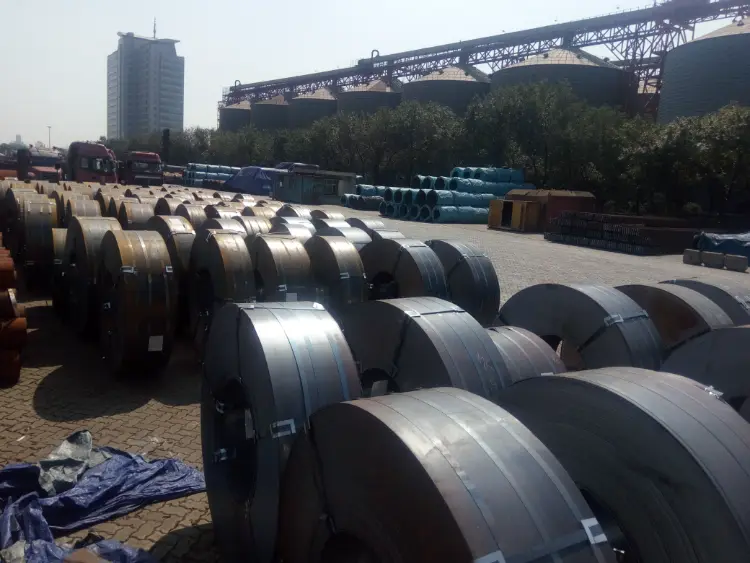
BV AH32 Shipbuilding Steel Coil
BV AH32 Shipbuilding Steel Coil - High Strength Hull Structural Steel
Detailed material data for BV AH32 shipbuilding steel coil: chemical composition, mechanical properties, and physical properties according to BV rules and IACS UR W11.
Hot rolling, normalizing (if required), cutting, welding, cold forming
- Phone : +8618037372205
- Email : [email protected]
- WhatsApp: Contact via Whtsapp
- WeChat: +8618037372205
BV AH32 Shipbuilding Steel Coil Introduction
BV AH32 is a high-strength hull structural steel certified by Bureau Veritas (BV) for marine applications. It belongs to the AH (Normal strength with higher yield) group under IACS Unified Requirement W11. Key attributes:
- Minimum yield strength of 315 MPa in sections up to 50 mm
- Good weldability and low-temperature toughness (Charpy impact tested at 0 °C)
- Controlled carbon equivalent (CEV ≤ 0.38%) to ensure cracking resistance
- Used extensively in ship hulls, decks, and structural members
This steel is supplied as rolled or normalized, often in coil form, and meets the stringent requirements of classification societies for seagoing vessels.
BV AH32 Shipbuilding Steel Coil Chemical Composition
Chemical requirements according to IACS UR W11 for Grade AH32. Ladle analysis limits: Carbon equivalent (CEV) = C + Mn/6 + (Cr+Mo+V)/5 + (Ni+Cu)/15 ≤ 0.38%. Fine grain practice requires Al (acid soluble) ≥ 0.015% or equivalent micro-alloying. Micro-alloy elements (Nb, V, Ti) may be used singly or in combination within the stated maxima.
| Chemical Element | Standard Value (wt%) | Remarks |
|---|---|---|
| Carbon (C) | ≤ 0.18 | Ladle analysis |
| Manganese (Mn) | 0.90 – 1.60 | Ladle analysis |
| Silicon (Si) | ≤ 0.50 | Ladle analysis |
| Phosphorus (P) | ≤ 0.035 | Ladle analysis |
| Sulfur (S) | ≤ 0.035 | Ladle analysis |
| Aluminum (Al, acid soluble) | ≥ 0.015 | For fine grain practice |
| Niobium (Nb) | ≤ 0.05 | Optional micro-alloy |
| Vanadium (V) | ≤ 0.10 | Optional micro-alloy |
| Titanium (Ti) | ≤ 0.02 | Optional micro-alloy |
| Copper (Cu) | ≤ 0.35 | Ladle analysis |
| Chromium (Cr) | ≤ 0.20 | Ladle analysis |
| Nickel (Ni) | ≤ 0.40 | Ladle analysis |
| Molybdenum (Mo) | ≤ 0.08 | Ladle analysis |
| Nitrogen (N) | ≤ 0.009 | If micro-alloyed with V or Nb |
BV AH32 Shipbuilding Steel Coil Thermal and Electrical Physical Properties
Representative physical properties for AH32 steel at room temperature (≈20 °C). These values are not specified by BV/IACS but are derived from typical structural steel data. Variations may occur depending on exact chemical composition and manufacturing route. For design calculations, use data from mill certificates or detailed material standards.
| Performance Item | Standard Requirement | Unit | Test Condition |
|---|---|---|---|
| Density (ρ) | 7.85 | g/cm³ | At 20 °C |
| Modulus of Elasticity (E) | 205 | GPa | At 20 °C |
| Shear Modulus (G) | ≈ 80 | GPa | At 20 °C |
| Poisson's Ratio (ν) | 0.3 | — | At 20 °C |
| Thermal Expansion Coefficient (α) | 12.0 | 10⁻⁶/K | Range 20 – 100 °C |
| Thermal Conductivity (λ) | 50 | W/(m·K) | At 20 °C |
| Specific Heat Capacity (c) | 460 | J/(kg·K) | At 20 °C |
| Electrical Resistivity (ρ_e) | 0.20 | 10⁻⁶ Ω·m | At 20 °C |
BV AH32 Shipbuilding Steel Coil Mechanical Properties
Mechanical properties as specified in IACS UR W11 for Grade AH32. Tensile and impact tests are required per heat and per rolling unit. All values are minimum unless a range is indicated. Charpy V-notch impact tests at 0 °C for longitudinal specimens; transverse values are typically 70% of longitudinal minimum. Bending test mandrel diameter depends on thickness.
| Performance Item | Standard Requirement | Unit | Test Condition |
|---|---|---|---|
| Yield Strength (ReH) | ≥ 315 | MPa | Thickness ≤ 50 mm |
| Yield Strength (ReH) | ≥ 315 | MPa | Thickness > 50 mm ≤ 70 mm |
| Yield Strength (ReH) | ≥ 305 | MPa | Thickness > 70 mm ≤ 100 mm |
| Tensile Strength (Rm) | 440 – 590 | MPa | All thicknesses |
| Elongation (A) | ≥ 22 | % | Gauge length 5.65√S₀, thickness ≤ 50 mm |
| Elongation (A) | ≥ 21 | % | Thickness > 50 mm ≤ 70 mm |
| Elongation (A) | ≥ 20 | % | Thickness > 70 mm ≤ 100 mm |
| Charpy Impact Energy (KV) | ≥ 34 (longitudinal) | J | At 0 °C, V-notch, average of 3 tests |
| Bend Test (180°) | 3t | Mandrel diameter | Thickness ≤ 25 mm |
| Bend Test (180°) | 4t | Mandrel diameter | Thickness > 25 mm ≤ 50 mm |
BV AH32 Shipbuilding Steel Coil Completely Equivalent Material Standards and Substitute Grades
| Country/Region | Standard | Grade | Remarks |
|---|---|---|---|
| Worldwide (IACS) | IACS UR W11 | AH32 | Unified requirement for all IACS classification societies |
| USA | ASTM A131 / A131M | AH32 | Structural steel for ships |
| European Union | EN 10025-4 | S355G8 (S355N) | Not a direct equivalent but with similar strength; verify toughness and CEV |
| Germany | DIN 17100 | St 52-3 | Obsolete – replaced by EN grades; requires careful assessment |
| Japan | JIS G 3106 | SM490A | Welding structural steel with similar tensile range; need 0 °C impact verification |
| China | GB 712 | AH32 | Same as IACS AH32 |
| Korea | KS D 3515 | SM490A | Similar strength; additional impact test needed |
| Russia | GOST 5521 | E32 | Marine steel with 315 MPa yield; check cold resistance requirements |
BV AH32 Shipbuilding Steel Coil Application Introduction
BV AH32 steel coils are primarily engineered for marine and offshore environments where high strength and good weldability are essential. Application considerations:
- Ideal for hull plates and stiffeners requiring 315 MPa yield strength.
- Can be formed and welded using standard shipyard practices; preheat may be needed for thick sections.
- Charpy impact guarantee at 0 °C makes it suitable for temperate and cold waters.
- Available in various thicknesses and widths as per BV certified mills.
Product Applications: Ship hull plating (side shell, bottom, deck, bulkhead), Longitudinal and transverse stiffeners, Ship frames and girders, Rudder and rudder horn castings/weldments, Deck machinery support plates, Offshore module structural beams, Piling pipe and sheet piles
Processed into products: Hull shell plates (midship, bow, stern), Deck plates and stringer plates, Bulkhead plates (transverse and longitudinal), Inner bottom plates, Web frames and floors, Hatch coamings and covers, Superstructure panels, Bollard and capstan foundations, Crane pedestal plates, Wind turbine tower sub-structures (marine environment)
Application industries: Shipbuilding (naval and commercial vessels), Offshore oil & gas platforms, Marine equipment manufacturing, Port and harbor construction, Bridge engineering (as structural steel)
BV AH32 Shipbuilding Steel Coil Similar / Near-Equivalent Substitute Materials
| Country/Region | Standard | Grade | Remarks |
|---|---|---|---|
| Worldwide | IACS UR W11 | AH36 | Higher strength (355 MPa min yield) with same toughness; can be substituted in thickness-sensitive designs |
| Worldwide | IACS UR W11 | DH32 | Same strength but impact tested at -20 °C; suitable for lower service temperatures |
| European Union | EN 10025-3 | S355N | Normalized structural steel with similar yield; ensure impact temperature class (e.g., NL for -50 °C) |
| European Union | EN 10225 | S355G7+M | Offshore structural steel with similar strength; enhanced through-thickness properties |
| USA | ASTM A572 / A572M | Grade 50 | High-strength low-alloy structural steel; verify marine suitability and impact requirements |
| Japan | JIS G 3106 | SM400A | Lower strength (400 MPa tensile), but may substitute for AH32 in some non-critical applications |
| International | ISO 4950-3 | E355 | High yield strength flat products; includes delivery conditions like N, M; compare CEV |
Notes:
Certification: All material should be supplied with BV inspection certificate (or equivalent classification society's certificate) as per BV Rules. Weldability: Carbon equivalent (CEV) limited to max 0.38%; for thicker plates, crack tip opening displacement (CTOD) tests may be required. Through-thickness properties: For structural components subject to high Z-direction stresses, request enhanced through-thickness properties (Z-quality), e.g., Z25 or Z35 to EN 10164. Surface condition: Coils may be supplied as hot-rolled, pickled and oiled, or blasted and primed according to shipyard requirements. Traceability: Full traceability from heat number to final part is mandatory.
- Share



