
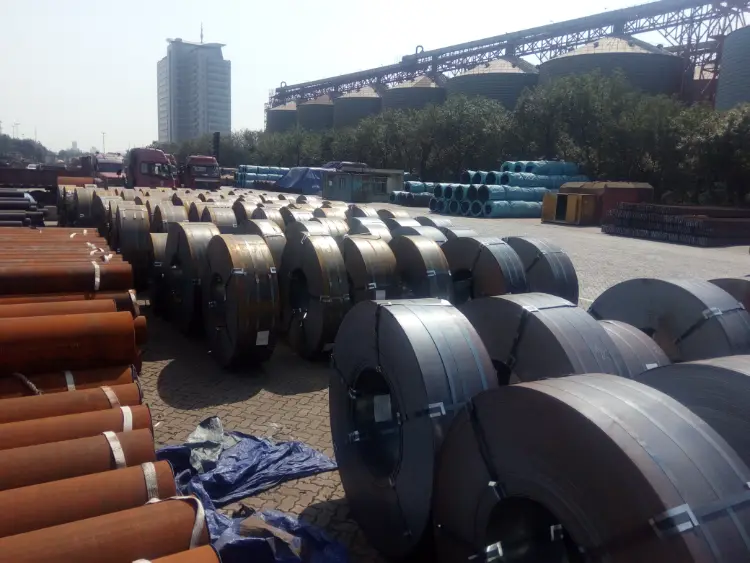
BV Grade E Shipbuilding Steel Coil
BV Grade E Shipbuilding Steel Coil - Chemical, Mechanical & Equivalents
Complete material data for BV Grade E shipbuilding steel coil: chemical composition, mechanical properties, thermal properties, and international equivalent grades.
Hot rolling, welding, cutting, forming, normalizing
- Phone : +8618037372205
- Email : [email protected]
- WhatsApp: Contact via Whtsapp
- WeChat: +8618037372205
BV Grade E Shipbuilding Steel Coil Introduction
BV Grade E is a normal strength hull structural steel specified by Bureau Veritas (BV) for shipbuilding. It offers excellent notch toughness at low temperatures, with mandatory impact testing at -40°C. Typically supplied as coils, plates, and profiles in normalized or thermo-mechanically controlled rolled (TMCP) condition, the steel is suitable for critical ship structures such as shell plating, decks, and stiffeners. Its chemical composition is controlled to ensure good weldability and consistent mechanical properties. The grade meets the strict requirements of the BV Rules for the Classification of Steel Ships and is functionally equivalent to E‑grade steels of other IACS classification societies.
BV Grade E Shipbuilding Steel Coil Chemical Composition
Chemical requirements as per BV Rules for normal strength hull structural steel Grade E. The analysis applies to ladle samples. Elements not listed (Cr, Ni, Cu, Mo, etc.) are considered residual and are limited by the standard.
| Element | Content (max or range %) | Remarks |
|---|---|---|
| Carbon (C) | ≤0.18 | Ladle analysis |
| Manganese (Mn) | 0.70 – 1.60 | Ladle analysis |
| Silicon (Si) | ≤0.50 | Ladle analysis |
| Sulfur (S) | ≤0.035 | Ladle analysis |
| Phosphorus (P) | ≤0.035 | Ladle analysis |
| Aluminium (Als) | ≥0.015 | When aluminium is used as grain refining element |
BV Grade E Shipbuilding Steel Coil Physical and Thermal Properties
Typical physical properties for carbon‑manganese structural steel, applicable to BV Grade E. These values are informative and represent the material at room temperature unless otherwise stated.
| Property | Typical Value | Unit | Test Condition |
|---|---|---|---|
| Density (ρ) | 7.85 | g/cm³ | at 20°C |
| Modulus of Elasticity (E) | 200 – 210 | GPa | at 20°C |
| Shear Modulus (G) | ≈80 | GPa | Approximate |
| Poisson's Ratio (ν) | 0.3 | – | – |
| Thermal Expansion Coefficient (α) | 11.5 | 10⁻⁶/K | 20 – 100°C |
| Thermal Conductivity (λ) | 50 | W/(m·K) | at 20°C |
| Specific Heat Capacity (c) | 460 | J/(kg·K) | at 20°C |
| Electrical Resistivity (ρ_e) | 0.20 – 0.25 | μΩ·m | at 20°C |
BV Grade E Shipbuilding Steel Coil Mechanical Properties
Required tensile and impact properties for BV Grade E shipbuilding steel for thicknesses up to 50 mm. The bend test is performed with a former diameter equal to twice the specimen thickness.
| Property | Requirement | Unit | Test Condition |
|---|---|---|---|
| Yield Strength (ReH) | ≥235 | MPa | t ≤ 50 mm |
| Tensile Strength (Rm) | 400 – 520 | MPa | t ≤ 50 mm |
| Elongation (A) | ≥22 | % | Gauge length 5.65√S₀, t ≤ 50 mm |
| Charpy V‑notch Impact (KV, longitudinal) | ≥34 | J | at -40°C |
| Charpy V‑notch Impact (KV, transverse) | ≥24 | J | at -40°C |
| Bend Test (180°) | No cracks | – | d = 2t, t ≤ 50 mm |
BV Grade E Shipbuilding Steel Coil Equivalent Grades and Standards for BV Grade E
| Country/Region | Standard | Grade | Remarks |
|---|---|---|---|
| International (IACS) | IACS UR W11 | Normal Strength Hull Structural Steel Grade E | Common basis for class societies |
| American | ABS Rules | ABS Grade E | Equivalent normal strength steel |
| British | Lloyd's Register Rules | LR Grade E | Equivalent |
| Norwegian | DNV Rules | DNV NV E | Equivalent |
| Chinese | CCS Rules | CCS E | Equivalent |
| Korean | KR Rules | KR Grade E | Equivalent |
| Japanese | NK Rules | NK Grade E | Equivalent |
| Italian | RINA Rules | RINA Grade E | Equivalent |
BV Grade E Shipbuilding Steel Coil Application Introduction
BV Grade E steel is widely used in marine and offshore structures that require good strength and reliable low‑temperature impact properties. Its good weldability and formability make it ideal for automatic panel lines and complex assemblies.
Product Applications: Hull structures of bulk carriers, container ships, tankers, and passenger vessels, Deck plating and bottom shell plating, Longitudinal stiffeners and transverse frames, Bulkheads and watertight doors, Barges and floating structures
Processed into products: Shell plates (side and bottom), Strength deck plates, Keel plates, Stiffeners (angle, bulb, flat bars), Web frames and girders, Transverse bulkhead panels, Hatch coaming inserts, Foundation plates for deck machinery
Application industries: Marine shipbuilding, Offshore engineering, Port and terminal equipment, Bridge fabrication (auxiliary use)
BV Grade E Shipbuilding Steel Coil Similar/Alternative Steels with Comparable Properties
| Country/Region | Standard | Grade | Remarks |
|---|---|---|---|
| Europe | EN 10025-2 | S235J2 (+N or +AR) | Similar yield strength but impact test at -20°C instead of -40°C; additional qualification needed for shipbuilding |
| International | ABS / DNV / LR Rules | EH36 (Higher Strength) | Yield ≥355 MPa, similar low‑temperature toughness; suitable when higher strength is acceptable |
Notes:
- Common delivery conditions: Normalized (N) or Thermo-Mechanical Controlled Process (M).
- Carbon equivalent (CEV) is often controlled to improve weldability; typical CEV ≤0.36% for Grade E.
- Additional requirements such as Z‑direction through‑thickness properties (e.g., Z25, Z35) can be specified.
- All welding consumables and procedures shall be approved in accordance with BV Rules.
- Ultrasonic testing is frequently requested for plates used in critical locations.
- Share



