
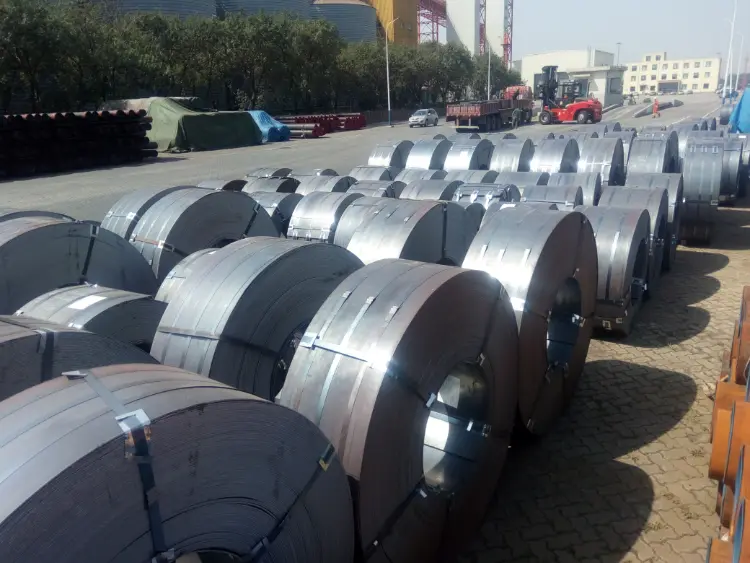
BV DH32 Shipbuilding Steel Coil
BV DH32 Shipbuilding Steel Coil – High-Strength Hull Structural Steel for Shipbuilding
Comprehensive technical data for BV DH32 shipbuilding steel coil with official chemical composition, mechanical properties, and typical physical properties. Ideal for marine hull construction.
Hot rolling, cold bending, cutting, welding, shearing, shot blasting, and priming
- Phone : +8618037372205
- Email : [email protected]
- WhatsApp: Contact via Whtsapp
- WeChat: +8618037372205
BV DH32 Shipbuilding Steel Coil Introduction
BV DH32 is a high-strength shipbuilding structural steel grade certified by Bureau Veritas (BV) according to the BV Rules for the Classification of Steel Ships. It is designed for critical hull structures, offering a minimum yield strength of 315 MPa and excellent weldability. The designation 'D' indicates impact toughness tested at -20°C, while 'H32' signifies high-strength grade 32 (yield 315 MPa). This steel is typically supplied as coils for further processing into plates and sections. Key features:
- Superior notch toughness at low temperatures, ensuring reliability in cold marine environments.
- Controlled chemical composition with fine grain practices (aluminum killed) and optional microalloying for enhanced mechanical properties.
- Compliance with strict BV rules for hull construction, widely accepted in international maritime regulations.
- Good machining, forming, and welding capabilities suitable for shipyard fabrication.
BV DH32 Shipbuilding Steel Coil Chemical Composition
Chemical composition according to BV Rules for normal/ordinary strength and high-strength hull structural steels (Grade DH32). NB: Values are maximum unless a range is indicated. Aluminum is required as grain-refining element; total microalloying elements (Nb+V+Ti) may be present but shall be within specified limits for carbon equivalent control.
- Carbon equivalent (Ceq) ≤ 0.38% (when required).
- Residual elements such as Cr, Ni, Cu, Mo are usually not specified but must be controlled to maintain weldability; typical residual max. levels are mentioned.
| Element | Standard Value (max % or range) | Remarks |
|---|---|---|
| Carbon (C) | ≤ 0.18 | Ladle analysis |
| Manganese (Mn) | 0.90 – 1.60 | Range |
| Silicon (Si) | ≤ 0.50 | |
| Phosphorus (P) | ≤ 0.035 | |
| Sulfur (S) | ≤ 0.035 | |
| Aluminum (Als) | ≥ 0.015 | Acid soluble Al, total Al typical |
| Niobium (Nb) | ≤ 0.05 (optional) | Microalloy, if added, sum Nb+V+Ti ≤ 0.12% |
| Vanadium (V) | ≤ 0.10 (optional) | Microalloy |
| Titanium (Ti) | ≤ 0.02 (optional) | Microalloy |
| Nitrogen (N) | ≤ 0.012 | If not killed with sufficient Al |
| Copper (Cu) | Residual ≤ 0.35 | Max when not deliberately added |
| Chromium (Cr) | Residual ≤ 0.20 | Max when not deliberately added |
| Nickel (Ni) | Residual ≤ 0.40 | Max when not deliberately added |
| Molybdenum (Mo) | Residual ≤ 0.08 | Max when not deliberately added |
| Carbon Equivalent (Ceq) | ≤ 0.38 (usually) | Ceq = C + Mn/6 + (Cr+Mo+V)/5 + (Ni+Cu)/15 |
BV DH32 Shipbuilding Steel Coil Thermal and Electrical Physical Properties
Representative physical properties for DH32 type carbon-manganese structural steel at ambient temperature. Not standardized specifications, but typical values used for engineering calculations. Values may vary slightly with exact composition and processing. Reference sources: Comparable to EN 10025-4 S355M/ML series and general weldable fine-grain structural steels.
- Density slightly varies with alloying.
- Thermal expansion coefficient is averaged over 20–100°C.
| Property | Typical Value | Unit | Test / Condition |
|---|---|---|---|
| Density (ρ) | 7850 | kg/m³ | Room temperature |
| Modulus of elasticity (E) | 210 | GPa | Ambient, static |
| Shear modulus (G) | ~ 80 | GPa | Calculated from E and ν |
| Poisson's ratio (ν) | 0.3 | — | Typical for steel |
| Thermal expansion coefficient (α) | 11.5 × 10⁻⁶ | K⁻¹ | 20 – 100°C range |
| Thermal conductivity (λ) | 50 | W/(m·K) | At 20°C, typical |
| Specific heat capacity | 460 | J/(kg·K) | At 20–100°C |
| Electrical resistivity (ρ_e) | 0.15 – 0.20 × 10⁻⁶ | Ω·m | Ambient temperature |
BV DH32 Shipbuilding Steel Coil Mechanical Properties
Mechanical properties as per BV Rules for Grade DH32 high-strength structural steel, tested on standard specimens (transverse or longitudinal as agreed). Test conditions: Room temperature tensile test, Charpy V-notch impact test at -20°C (longitudinal or transverse). Bend test with 180° bending on specimens with rolling surface retained. Note: Yield strength decreases slightly with plate thickness >50 mm. Values below are for thickness ≤50 mm (typical coil thickness range).
- Impact energy values are the minimum average of three specimens; one single value may be not less than 70% of the minimum average.
- Both longitudinal and transverse impact requirements are given.
| Property | Standard Requirement | Unit | Test Conditions |
|---|---|---|---|
| Yield strength (ReH) | ≥ 315 | MPa | t ≤ 50 mm, transverse |
| Yield strength (ReH) | ≥ 305 | MPa | 50 < t ≤ 70 mm, transverse |
| Yield strength (ReH) | ≥ 295 | MPa | 70 < t ≤ 100 mm, transverse |
| Tensile strength (Rm) | 440 – 570 | MPa | t ≤ 100 mm, transverse |
| Elongation after fracture (A) | ≥ 22 | % | t ≤ 50 mm, gauge length 5.65√So |
| Elongation after fracture (A) | ≥ 21 | % | 50 < t ≤ 70 mm |
| Elongation after fracture (A) | ≥ 20 | % | 70 < t ≤ 100 mm |
| Charpy impact energy (KV) longitudinal | ≥ 31 | J | -20°C, min. average |
| Charpy impact energy (KV) transverse | ≥ 24 | J | -20°C, min. average |
| Bend test | No cracks or defects | - | 180°, bend diameter = 3× thickness for t ≤ 35 mm |
BV DH32 Shipbuilding Steel Coil Fully Equivalent Steel Grades Across Major Classification Societies
| Country / Region | Standard | Grade | Remarks |
|---|---|---|---|
| International (ABS) | ABS Rules for Building and Classing Steel Vessels | ABS DH32 | Identical strength level, -20°C impact |
| International (DNV) | DNV Rules for Classification of Ships | DNV NV D32 | Equivalent high-strength hull steel (now D32 in DNV standards) |
| International (LR) | Lloyd's Register Rules and Regulations | LR DH32 | Same specification |
| International (NK) | ClassNK Rules for the Survey and Construction of Steel Ships | NK KE32 | Equivalent H32 steel |
| China | CCS Rules for Materials and Welding | CCS D32 | Chinese classification society equivalent |
| Italy (RINA) | RINA Rules for the Classification of Ships | RINA Grade D32 | High-strength grade D32 |
BV DH32 Shipbuilding Steel Coil Application Introduction
BV DH32 steel coils are specifically designed for marine structural applications requiring high strength and good low-temperature toughness. The steel is typically processed into flat products (plates, sheets) and sections. Due to its excellent weldability and formability, it is widely used in shipyards for both newbuilding and repair. Typical processing routes:
- Cutting: Plasma, laser, flame cutting or shearing.
- Forming: Cold and hot bending to form frames and stiffeners.
- Welding: All common arc welding processes, preheating may be required for thicker sections.
The controlled delivery condition (TMCP) provides uniform mechanical properties with reduced carbon equivalent, enhancing weldability and HAZ toughness.
Product Applications: Ship hulls, decks, bulkheads, and side shells, Offshore platform topside and jacket structures, Barge hulls, Marine cranes and lifting equipment, Polar class vessel structures (with appropriate grade selection)
Processed into products: Keel plates and bottom plates, Shell plates and strakes, Deck stringer plates, Longitudinal and transverse frames, Stiffeners and web frames, Bulkhead panels, Hatch coamings and covers, Boss plates and rudder horns
Application industries: Commercial shipbuilding (bulk carriers, container ships, tankers), Naval and defense vessels, Offshore oil & gas platforms and FPSO, Marine renewable energy structures (wind turbine foundations), Dredging and heavy floating equipment
BV DH32 Shipbuilding Steel Coil Similar / Alternative Grades with Comparable Performance
| Country / Region | Standard | Grade | Remarks |
|---|---|---|---|
| Europe | EN 10025-4 | S355ML (1.8834) | Thermo-mechanically rolled weldable fine-grain steel, similar yield (355 min) and -50°C impact; slightly higher strength, but not identical to shipbuilding certification. Not acceptable for BV-classed hull without special approval. |
| Europe | EN 10025-4 | S355M | Similar mechanicals, but impact test at -20°C (M) or 0°C (N); may serve as substitute for non-marine structural use. Care required for marine rules compliance. |
| International | IACS UR W11 | AH32 / DH32 / EH32 series | Grades from different class societies under IACS unified requirements; analogous properties but different certification. |
Notes:
The information presented is based on publicly available Bureau Veritas rules and typical steel mill datasheets for DH32. Certification: BV DH32 must be delivered with BV surveyor inspection and certification (material certificate 3.1 or 3.2 as per EN 10204). Surface condition: Coils may be supplied with mill scale; shot-blasted and shop-primed is common for shipbuilding. Further processing: Users should verify suitability for specific forming and welding procedures as per shipyard's qualified processes. Thickness ranges covered are typically up to 100 mm for plates; for coils, the maximum thickness is usually between 8 and 25 mm. This document serves as a technical reference and should not replace official material specifications for design or order.
- Share



