
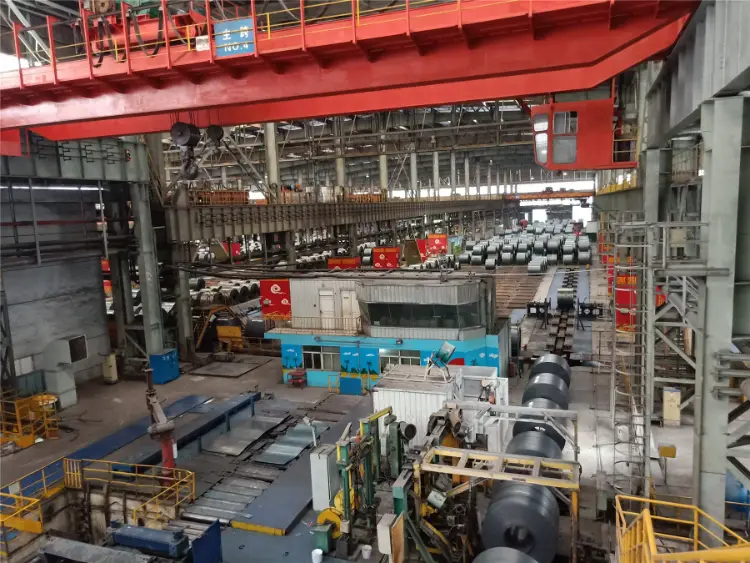
BS 5045 Type C Steel Coil for Gas Cylinders
BS 5045 Type C Steel Coil for Gas Cylinders: Comprehensive Material Data & Global Equivalents
Explore BS 5045 Type C steel coil material for gas cylinder manufacturing: chemical composition, mechanical properties, thermal behavior, international equivalents, and application guide.
Hot rolling, cold rolling, pickling, slitting, forming (spinning, pressing, rolling), welding (submerged arc, MIG/MAG), post-weld heat treatment (stress relieving)
- Phone : +8618037372205
- Email : [email protected]
- WhatsApp: Contact via Whtsapp
- WeChat: +8618037372205
BS 5045 Type C Steel Coil for Gas Cylinders Introduction
BS 5045 Type C Steel Coil is a carbon-manganese steel specifically designed for the fabrication of welded steel gas cylinders conforming to British Standard BS 5045-2. This grade combines good strength with excellent formability and weldability, making it ideal for high-pressure cylinder manufacturing. The steel is produced in coil form, allowing efficient processing into cylinder shells and components. Key properties include minimum yield strength of 330 MPa, tensile strength in the range 490–590 MPa, and elongation of at least 22%, ensuring ductile behavior under stress. The material is typically supplied in the normalized condition with a fine-grained microstructure, providing consistent mechanical properties and toughness down to -20°C. Its controlled chemistry with low sulphur and phosphorus contents enhances resistance to brittle fracture and improves weld soundness.
- Good balance of strength and ductility
- Excellent weldability
- Fine grain structure for toughness
- Low impurities for improved safety
BS 5045 Type C Steel Coil for Gas Cylinders Chemical Composition
The chemical composition of BS 5045 Type C steel is tightly controlled to ensure consistent mechanical properties and weldability. All values are ladle analysis according to BS 5045-2:1989. Microalloying elements (Nb, V, Ti) are used for grain refinement, while aluminium is added for deoxidation and to ensure fine grain.
- Low carbon for good weldability
- Controlled manganese for strength and toughness
- Low phosphorus and sulphur for cleanliness
| Chemical Element | Standard Value (wt%) | Remarks |
|---|---|---|
| C | ≤ 0.20 | Ladle analysis |
| Si | ≤ 0.35 | |
| Mn | 0.40 – 1.20 | |
| P | ≤ 0.025 | Ensures low brittleness |
| S | ≤ 0.025 | Improves weld soundness |
| Al (total) | ≥ 0.015 | For fine-grained microstructure |
| Nb + V + Ti | ≤ 0.10 | Grain-refining microalloys |
| Cr + Ni + Cu + Mo | ≤ 0.40 | Residual elements, not specification but typical limit |
BS 5045 Type C Steel Coil for Gas Cylinders Thermal and Electrical Physical Properties
The following physical properties are typical for carbon-manganese steels and are provided as a guide for design calculations. They are not part of the material specification but are representative of BS 5045 Type C steel in service.
| Property | Standard Required Value | Unit | Test Conditions |
|---|---|---|---|
| Density (ρ) | 7.85 | g/cm³ | At 20 °C |
| Elastic modulus (E) | 210 | GPa | At 20 °C |
| Shear modulus (G) | 80 | GPa | At 20 °C |
| Poisson's ratio (ν) | 0.3 | – | At 20 °C |
| Thermal expansion coefficient (α) | 11.5 | 10⁻⁶/K | 20 – 100 °C |
| Thermal expansion coefficient (α) | 12.0 | 10⁻⁶/K | 20 – 200 °C |
| Thermal expansion coefficient (α) | 12.5 | 10⁻⁶/K | 20 – 300 °C |
| Thermal conductivity (λ) | 50 | W/(m·K) | At 20 °C |
| Thermal conductivity (λ) | 45 | W/(m·K) | At 200 °C |
| Specific heat capacity | 460 | J/(kg·K) | At 20 °C |
| Electrical resistivity (ρₑ) | 0.20 | µΩ·m | At 20 °C |
BS 5045 Type C Steel Coil for Gas Cylinders Mechanical Properties
Mechanical properties are determined on transverse test pieces taken from the coil and shall meet the following requirements at room temperature, unless otherwise stated. The bending test is performed on a specimen with width equal to the specimen thickness, through 180°. Impact toughness is verified by Charpy V-notch tests at -20°C.
- Yield and tensile strengths guarantee pressure containment
- Elongation ensures ductility during forming and service
- Bend testing confirms formability and absence of surface defects
- Impact energy ensures resistance to brittle fracture at low service temperatures
| Property | Standard Required Value | Unit | Test Conditions |
|---|---|---|---|
| Yield strength (ReH) | ≥ 330 | MPa | For nominal thickness t ≤ 10 mm |
| Yield strength (ReH) | ≥ 320 | MPa | For nominal thickness t > 10 mm |
| Tensile strength (Rm) | 490 – 590 | MPa | All thicknesses |
| Elongation (A) | ≥ 22 | % | Lo=5.65√So, t ≤ 10 mm |
| Elongation (A) | ≥ 20 | % | Lo=5.65√So, t > 10 mm |
| Bending test | 180° bend, d = 3a | – | t ≤ 12 mm, a = thickness |
| Bending test | 180° bend, d = 4a | – | t > 12 mm |
| Impact energy (KV2) | ≥ 27 (mean) ≥ 20 (individual) | J | -20°C, Charpy V-notch |
BS 5045 Type C Steel Coil for Gas Cylinders Exact Equivalent Material Standards and Substitute Grades
| Country/Region | Standard | Grade | Remarks |
|---|---|---|---|
| United Kingdom | BS 5045-2:1989 | Type C | Original standard for welded gas cylinders |
| Europe | EN 10120:2017 | Type C | Direct European equivalent; identical technical requirements |
| International | ISO 22991:2020 | Grade C | International standard for welded cylinders |
BS 5045 Type C Steel Coil for Gas Cylinders Application Introduction
BS 5045 Type C steel coil is tailored for the high-volume production of welded steel gas cylinders. Its excellent formability supports deep drawing and spinning processes to create seamless-like cylinder bodies, while the controlled chemistry guarantees consistent weld quality and pressure containment.
- Ideal for serial production of cylinders up to 300 bar service pressure
- Suitable for service temperatures from −20°C to +60°C
- Can be welded using all common arc welding processes
- Post-weld stress relieving often employed for thick-walled vessels
Product Applications: Welded steel cylinders for oxygen, nitrogen, argon, carbon dioxide, acetylene, hydrogen, Liquefied petroleum gas (LPG) containers, Fire extinguisher bodies, Compressed natural gas (CNG) vehicle fuel tanks, Scuba and breathing apparatus cylinders (subject to further processing)
Processed into products: Cylinder shells (cylindrical sections), Domes and end caps, Valve boss inserts, Foot rings, Flanges and collars, Internal pickling liners
Application industries: Industrial Gas & Chemicals, Medical & Healthcare, Fire Protection, Energy (CNG, LPG), Beverage Carbonation (CO₂ cylinders)
BS 5045 Type C Steel Coil for Gas Cylinders Similar Alternate Material Recommendations
| Country/Region | Standard | Grade | Remarks |
|---|---|---|---|
| Japan | JIS G 3116 | SG295 | Slightly lower strength (Rm ≥ 440 MPa, ReH ≥ 295 MPa) but similar formability; used for LPG cylinders |
| Europe | EN 10120 | Type B | Lower strength grade (ReH ≥ 235 MPa) within same standard for less demanding applications |
| China | GB 6653 | HP295 | Chinese equivalent for welded gas cylinder steel; comparable mechanical properties |
| USA | ASTM A414 / A414M | Grade F | Commercial quality pressure vessel steel with similar tensile strength but not specifically a cylinder grade; may require qualification for gas cylinder service |
Notes:
For welded cylinder fabrication, preheat and post-weld heat treatment may be required depending on the thickness and service conditions. The steel is suitable for service temperatures down to -20°C; for lower temperatures, impact properties should be verified. Surface quality must be free from laminations, cracks, and injurious defects. The standard also specifies dimensional tolerances for coil thickness, width, and camber. Users should refer to BS 5045-2 for full design and inspection requirements.
- Share



