
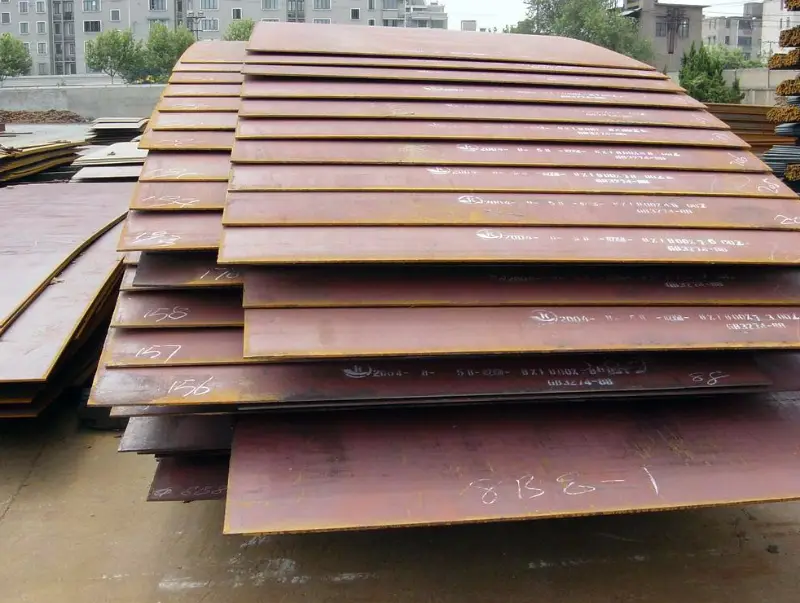
BS 5045 Type B Steel for Seamless Gas Cylinders
BS 5045 Type B Steel Coil for Gas Cylinder – High-Strength Cr-Mo Alloy Steel
Detailed material properties of BS 5045 Type B steel coil used for gas cylinder manufacturing, including chemical composition, mechanical and physical properties, and international equivalents.
Hot rolling, cold rolling, forming, welding, quenching and tempering
- Phone : +8618037372205
- Email : [email protected]
- WhatsApp: Contact via Whtsapp
- WeChat: +8618037372205
BS 5045 Type B Steel for Seamless Gas Cylinders Introduction
BS 5045 Type B is a quenched and tempered chromium-molybdenum alloy steel specifically designed for the manufacture of transportable gas cylinders. This steel offers an excellent combination of high tensile strength, good toughness, and resistance to high-pressure environments, making it suitable for seamless or welded gas containers. It is typically supplied in the form of steel coil for subsequent forming and welding processes. The grade is known for its reliability under repeated pressure loading and compliance with stringent safety standards.
BS 5045 Type B Steel for Seamless Gas Cylinders Chemical Composition
The chemical composition of BS 5045 Type B steel is strictly controlled to achieve the required mechanical properties and weldability. The main alloying elements, chromium and molybdenum, enhance hardenability and high-temperature strength. Low sulfur and phosphorus levels ensure good toughness and resistance to embrittlement.
| Element | Standard Value | Remarks |
|---|---|---|
| Carbon (C) | 0.26 - 0.34 | Typical for medium carbon alloy steel |
| Silicon (Si) | 0.15 - 0.35 | Deoxidizing element |
| Manganese (Mn) | 0.40 - 0.80 | Improves hardenability |
| Phosphorus (P) | ≤ 0.025 | Controlled for toughness |
| Sulfur (S) | ≤ 0.020 | Weldability and cleanliness |
| Chromium (Cr) | 0.80 - 1.15 | Primary alloying addition |
| Molybdenum (Mo) | 0.15 - 0.25 | Hardenability and creep strength |
| Nickel (Ni) | ≤ 0.30 | Residual only |
| Copper (Cu) | ≤ 0.35 | Residual only |
| Vanadium (V) | ≤ 0.05 | Trace element |
| Niobium (Nb) | ≤ 0.05 | Trace element |
| Titanium (Ti) | ≤ 0.05 | Trace element |
| Total others | ≤ 0.5 | Sum of all residuals |
BS 5045 Type B Steel for Seamless Gas Cylinders Thermal and Electrical Physical Properties
Physical properties are given for the quenched and tempered condition at room temperature unless otherwise noted. These values are representative for 0.30% C Cr-Mo alloy steel and are useful for thermal and structural calculations.
| Property | Standard Requirement | Unit | Test Condition |
|---|---|---|---|
| Density (ρ) | 7.85 | g/cm³ | 20 °C |
| Elastic Modulus (E) | 210 | GPa | Room temperature |
| Shear Modulus (G) | 81 | GPa | Calculated from E and ν |
| Poisson's Ratio (ν) | 0.3 | - | Room temperature |
| Thermal Expansion (α) | 12.2 | ×10⁻⁶/K | 20 – 100 °C |
| Thermal Expansion (α) | 13.5 | ×10⁻⁶/K | 20 – 300 °C |
| Thermal Conductivity (λ) | 42.6 | W/m·K | At 100 °C |
| Specific Heat Capacity | 460 | J/kg·K | At 100 °C |
| Electrical Resistivity (ρ_e) | 0.23 | ×10⁻⁶ Ω·m | Room temperature |
BS 5045 Type B Steel for Seamless Gas Cylinders Mechanical Properties
Mechanical properties of BS 5045 Type B are verified on specimens taken from the finished product or from a qualification test coupon. The values below represent minimum requirements after quenching and tempering. Impact toughness is measured at -20 °C to ensure safety in low-temperature service.
| Property | Standard Requirement | Unit | Test Condition |
|---|---|---|---|
| Yield Strength (ReH) | ≥ 685 | MPa | 0.2% offset, room temperature |
| Tensile Strength (Rm) | 880 - 1080 | MPa | Room temperature |
| Elongation (A) | ≥ 15 | % | L0 = 5.65√S0 |
| Reduction of Area (Z) | ≥ 45 | % | Room temperature |
| Impact Energy (KV) | ≥ 27 | J | -20 °C, Charpy V-notch |
| Hardness | 280 - 340 | HBW | Converted from tensile range |
| Bend Test (D) | No cracks | - | 180° bend over 3×thickness |
BS 5045 Type B Steel for Seamless Gas Cylinders Exact Equivalent Material Standards and Recommended Substitutes
| Country/Region | Standard | Grade | Remarks |
|---|---|---|---|
| USA | SAE J404 | 4130 | Slightly tighter Mn range (0.40–0.60) |
| USA | ASTM A519 | 4130 | Seamless mechanical tubing; chemical match |
| USA | UNS | G41300 | Unified Numbering System designation |
| Europe | EN 10297-1 | 34CrMo4 | C 0.30–0.37; Cr 0.90–1.20; Mo 0.15–0.30; comparable strength |
| Japan | JIS G3441 | SCM435TK | C 0.33–0.38; Mn 0.60–0.85; used for gas cylinder tube |
| China | GB/T 28884 | 30CrMo | C 0.26–0.34; Cr 0.80–1.10; Mo 0.15–0.25 |
| International | ISO 9809-1 | 30CrMo | Seamless steel gas cylinder design |
BS 5045 Type B Steel for Seamless Gas Cylinders Application Introduction
BS 5045 Type B steel is specifically engineered for the demanding requirements of high-pressure gas containment. Its balanced Cr-Mo alloy content, combined with the quenched and tempered condition, delivers high yield strength and excellent resistance to fracture. The material is supplied in coil form to enable efficient forming, welding, and cylinder production. It meets strict international regulations for transportable gas containers, ensuring safe operation under repeated pressurization cycles.
Product Applications: Seamless steel gas cylinders (up to 150 L water capacity), Welded steel gas cylinders (from coil, typically up to 15 L), High-pressure storage vessels, Cryogenic pressure containers (with additional testing)
Processed into products: Cylinder body (shell), Cylinder neck ring, End domes (for welded cylinders), Liners for composite overwrapped cylinders, Adapter bushings and base rings
Application industries: Industrial gas packaging, Medical oxygen supply, Breathing apparatus (SCBA), Alternative fuel vehicles (CNG / hydrogen), Fire extinguisher manufacturing, Aerospace emergency systems
BS 5045 Type B Steel for Seamless Gas Cylinders Similar / Approximate Alternative Material Recommendations
| Country/Region | Standard | Grade | Remarks |
|---|---|---|---|
| USA | SAE J404 | 4140 | Higher C (0.38–0.43) and Cr (0.80–1.10); higher strength but reduced weldability |
| Europe | EN 10083-3 | 42CrMo4 | C 0.38–0.45; higher hardenability; suitable for larger sections |
| Japan | JIS G4105 | SCM430 | C 0.28–0.33; Cr 0.90–1.20; Mo 0.15–0.30; slight compositional shift |
| Germany | DIN 17200 | 34CrMo4 | Similar to EN grade; often used in pressure vessel applications |
| China | GB/T 18248 | 37Mn | Carbon-manganese steel; lower strength, used in lower pressure cylinders |
Notes:
BS 5045 Type B may be referenced in older specifications as 'BS 5045-1 Type B' for seamless cylinders, but the same steel can be supplied as coil for welded cylinder fabrication under BS 5045-2 or later EN 13322.
Welding considerations: Preheat (150–250 °C) and post-weld heat treatment (PWHT) are recommended to avoid cold cracking.
Pressure test: Finished cylinders undergo a hydraulic proof test at 1.5x the working pressure.
Surface protection: External painting or galvanizing is common; phosphating may be applied for internal surfaces.
- Share



