
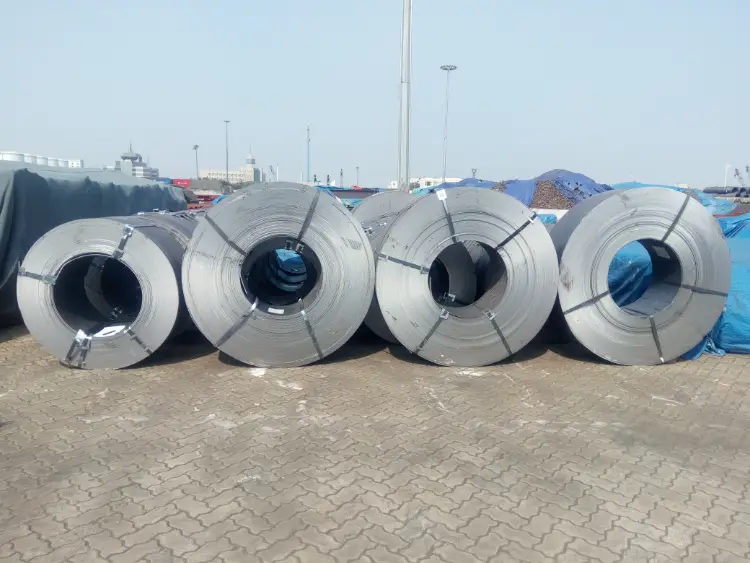
B510L Hot Rolled Steel Coil - High Strength Automotive Structural Steel
B510L Hot Rolled Steel Coil - High Strength Automotive Structural Steel | Baosteel Q/BQB 310
Detailed material data for B510L hot rolled steel coil under Baosteel standard Q/BQB 310-2009, including chemical composition, mechanical properties, thermal & electrical physical properties, equivalent international grades, and application guidance for automotive structural components.
Cold forming, stamping, bending, welding, punching, machining
- Phone : +8618037372205
- Email : [email protected]
- WhatsApp: Contact via Whtsapp
- WeChat: +8618037372205
B510L Hot Rolled Steel Coil - High Strength Automotive Structural Steel Introduction
B510L is a high-strength low-alloy (HSLA) hot rolled steel grade developed by Baosteel, specified in the enterprise standard Q/BQB 310-2009. It is primarily designed for automotive structural applications that require excellent formability, high fatigue strength, and good weldability. Key features:
- High yield strength (≥355 MPa) combined with a tensile strength range of 510–630 MPa, providing robust load-bearing capacity.
- Excellent elongation (≥24%) ensures good cold forming capability for complex shapes such as wheel rims and discs.
- Tightly controlled chemistry with low carbon, sulfur, and phosphorus for superior weldability and toughness.
- Fine-grained microstructure achieved through microalloying with niobium, titanium, or vanadium, resulting in improved strength and ductility.
It is supplied in the as-rolled or controlled-rolled condition, typically as hot rolled coils, sheets, or strips, and is widely adopted in the automotive industry for wheels, chassis frames, and other structural parts.
B510L Hot Rolled Steel Coil - High Strength Automotive Structural Steel Chemical Composition
The chemical composition of B510L steel is optimized for high strength, weldability, and formability. Carbon is kept low to ensure good toughness and welding characteristics, while manganese provides solid solution strengthening. Phosphorus and sulfur are strictly controlled for cleanliness. Microalloying elements such as niobium, titanium, or vanadium may be added for grain refinement and precipitation strengthening. Standard requirements per Q/BQB 310-2009:
| Element | Standard Value (wt%) | Remarks |
|---|---|---|
| C (Carbon) | ≤ 0.12 | Maximum |
| Si (Silicon) | ≤ 0.50 | Maximum |
| Mn (Manganese) | ≤ 1.60 | Maximum |
| P (Phosphorus) | ≤ 0.025 | Maximum |
| S (Sulfur) | ≤ 0.015 | Maximum |
| Alt (Total Aluminum) | ≥ 0.015 | Minimum, typically 0.020–0.060 |
| Nb (Niobium) | ≤ 0.09* | Optional, often used for grain refinement |
| Ti (Titanium) | ≤ 0.22* | Optional, for precipitation strengthening |
| V (Vanadium) | ≤ 0.10* | Optional, may be added alone or in combination |
| Nb+V+Ti | ≤ 0.22** | Sum of microalloying elements if used |
B510L Hot Rolled Steel Coil - High Strength Automotive Structural Steel Thermal and Electrical Physical Properties
Physical property data are typical for low-carbon HSLA steel at room temperature unless otherwise specified. These values are not mandatory in the standard but are useful for engineering calculations (e.g., welding simulation, springback prediction). Values may vary slightly with actual chemical composition and microstructure.
| Property | Typical Value | Unit | Test Condition / Remarks |
|---|---|---|---|
| Density (ρ) | 7.85 | g/cm³ | At 20 °C |
| Modulus of Elasticity (E) | 206 | GPa | Tensile modulus, room temperature |
| Shear Modulus (G) | 79.3 | GPa | Calculated from E and Poisson's ratio |
| Poisson's Ratio (ν) | 0.29 – 0.30 | - | Room temperature |
| Thermal Expansion Coefficient (α) | 12.0 × 10⁻⁶ | /K | Mean coefficient between 20 °C and 100 °C |
| Thermal Conductivity (λ) | 50 | W/(m·K) | At 100 °C, approximate value |
| Specific Heat Capacity (cₚ) | 460 | J/(kg·K) | At 20 °C, approximate |
| Electrical Resistivity (ρ_e) | 0.20 | µΩ·m | At 20 °C, typical for low-carbon steel |
B510L Hot Rolled Steel Coil - High Strength Automotive Structural Steel Mechanical Properties
Mechanical properties are determined on test pieces taken transverse to the rolling direction, in accordance with the specified standard test methods. The values below represent the minimum requirements for B510L steel per Q/BQB 310-2009. Actual values may be higher depending on processing. Test conditions include strain rate and specimen dimensions as per relevant ISO/GB standards.
| Property | Standard Requirement | Unit | Test Condition / Remarks |
|---|---|---|---|
| Yield Strength (ReL) | ≥ 355 | MPa | Lower yield strength; specimen gauge length L₀ = 50 mm or 80 mm depending on thickness |
| Tensile Strength (Rm) | 510 – 630 | MPa | Room temperature, transverse direction |
| Elongation after Fracture (A) | ≥ 24 | % | L₀ = 50 mm (thickness ≥ 3 mm); for thickness < 3 mm, L₀ = 80 mm with ≥ 22% elongation (reference) |
| Bend Test (Diam. of Mandrel) | d = 0.5a | - | Bend angle 180°, specimen width ≥ 40 mm, a = specimen thickness, for thickness ≤ 6 mm. No cracks allowed. |
B510L Hot Rolled Steel Coil - High Strength Automotive Structural Steel Fully Equivalent International Grades and Substitute Designations
| Country / Region | Standard | Grade | Remarks |
|---|---|---|---|
| China | GB/T 20887.1 (HR355) | HR355 | Under cold forming high strength steel sheet – similar yield class but may differ in tensile range |
| Japan | JIS G3134 | SPFH540 | Yield ≥ 355 MPa, tensile ≥ 540 MPa, elongation ≥ 23%; close match for many applications |
| Europe | EN 10149-2 | S420MC | Yield ≥ 420 MPa, tensile 480–620 MPa; slightly higher yield, may be used as upgrade with caution |
| International | ISO 6930-2 | FeE355TM | Thermo-mechanically rolled, minimum yield 355 MPa; partial equivalent in terms of strength class |
B510L Hot Rolled Steel Coil - High Strength Automotive Structural Steel Application Introduction
B510L hot rolled steel is specifically designed for automotive structural components that require high fatigue strength, good formability, and weldability. Its balanced combination of strength and ductility makes it ideal for complex press forming operations. Typical usage areas include:
Product Applications: Steel wheel rims and wheel discs for passenger cars, light trucks, and commercial vehicles, Chassis frames, cross members, and longitudinal beams, Suspension control arms and brackets, Truck trailer structural elements, Construction machinery boom and arm parts (medium stress areas)
Processed into products: Wheel rim (rolled and welded ring produced from strip), Wheel disc (pressed from coil or sheet), Longitudinal chassis beam (bent and welded), Cross member (stamped and welded assembly), Engine mounting bracket, Shock absorber support, Tow bar assemblies, Agricultural implement frames
Application industries: Automotive manufacturing (passenger cars and commercial vehicles), Heavy equipment and agricultural machinery, Railway vehicle structural parts, General engineering and metal fabrication
B510L Hot Rolled Steel Coil - High Strength Automotive Structural Steel Materials with Similar Performance Profile
| Country / Region | Standard | Grade | Remarks |
|---|---|---|---|
| Japan | JIS G3113 | SAPH440 | Automotive structural hot rolled steel, lower yield (~305 MPa) and tensile (~440 MPa); suitable for less demanding applications |
| Europe | EN 10149-2 | S355MC | Yield ≥ 355 MPa, tensile 430–550 MPa; similar yield but lower tensile range |
| Germany | DIN EN 10149-2 | QStE340TM | Yield ≥ 340 MPa, tensile 420–540 MPa; slightly lower strength, good formability |
| China | GB/T 3273 | 370L (Q370L) | Chinese automotive beam steel, yield ≥ 245 MPa? Actually 370L has higher yield, verify – for heavy trucks |
| USA | SAE J1392 | 045XLK | HSLA steel with yield ~310 MPa; lower than B510L but used in similar wheel applications after redesign |
Notes:
Additional processing notes:
- B510L can be readily welded by all common methods (MIG, TIG, resistance spot welding). Preheating is generally not required for thicknesses below 20 mm.
- For best surface quality, it is often supplied in pickled and oiled condition. If heavy forming is required, consider a hot-rolled pickled surface to avoid scale defects.
- Cold forming limits (e.g., minimum bending radius) should follow the recommendations in EN 10149 or BAOSTEEL technical guidelines; typically rmin ≥ 0.5 x thickness transverse to rolling direction.
- Post-forming heat treatment is not normally needed; the steel retains its strength through microalloy precipitation strengthening.
- Share



