
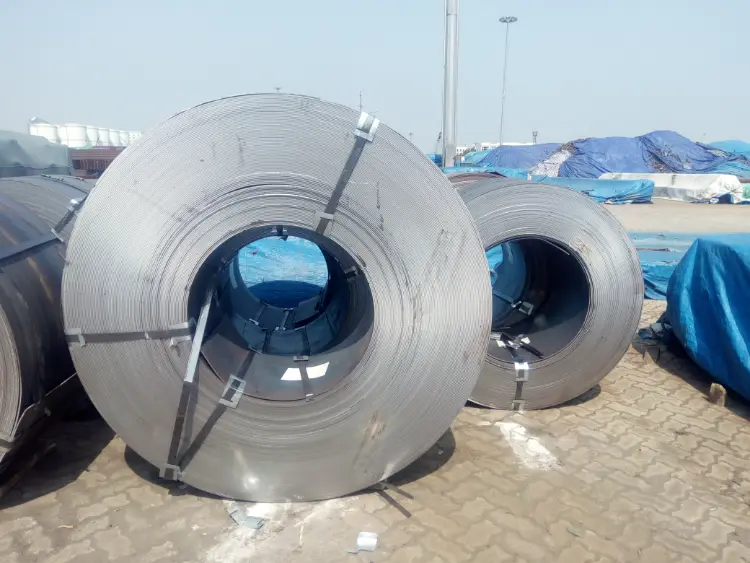
B420L Hot Rolled Steel Coil
B420L Hot Rolled Steel Coil - High Strength Low Alloy Automotive Structural Steel per Q/BQB 310-2009
Comprehensive material data for B420L hot rolled steel coil according to Baosteel standard Q/BQB 310-2009, including chemical composition, mechanical properties, physical characteristics, international equivalents, and application guidelines.
Cold forming, bending, welding, shearing, punching
- Phone : +8618037372205
- Email : [email protected]
- WhatsApp: Contact via Whtsapp
- WeChat: +8618037372205
B420L Hot Rolled Steel Coil Introduction
B420L is a high-strength low-alloy (HSLA) hot rolled steel grade primarily used for automotive structural components. Manufactured to Baosteel's corporate standard Q/BQB 310-2009, it delivers a minimum yield strength of 420 MPa combined with excellent cold formability and weldability.
The steel is microalloyed with niobium and/or titanium, which refine the grain structure and provide precipitation strengthening, enabling lightweight yet durable chassis and frame parts. Typical delivery condition is hot rolled and pickled, suitable for subsequent cold forming, bending, and welding. B420L is widely adopted in commercial vehicles for longitudinal beams, cross members, and reinforcement brackets.
B420L Hot Rolled Steel Coil Chemical Composition
B420L is a microalloyed steel with controlled additions of niobium and titanium for grain refinement and precipitation hardening. The maximum carbon equivalent restricts weldability issues. The composition meets the requirements of Q/BQB 310-2009 for improved formability and toughness.
| Chemical Element | Standard Value | Remarks |
|---|---|---|
| C | ≤0.12 | Max. |
| Si | ≤0.50 | Max. |
| Mn | ≤1.60 | Max. |
| P | ≤0.030 | Max. |
| S | ≤0.025 | Max. |
| Alt (total aluminium) | ≥0.015 | Min. |
| Nb | ≤0.09 | Grain refining element |
| Ti | ≤0.15 | Grain refining element |
B420L Hot Rolled Steel Coil Thermal and Electrical Physical Properties
The following physical properties are typical for HSLA steels at room temperature unless otherwise indicated. They are provided for engineering calculations and may vary slightly depending on exact composition and processing conditions.
| Property | Standard Value | Unit | Test Condition |
|---|---|---|---|
| Density (ρ) | 7.85 | g/cm³ | Room temperature |
| Modulus of elasticity (E) | 210 | GPa | Room temperature |
| Shear modulus (G) | 80 | GPa | Room temperature |
| Poisson's ratio (ν) | 0.3 | — | Room temperature |
| Thermal expansion coefficient (α) | 11.7 | 10⁻⁶/K | 20–100 °C |
| Thermal conductivity (λ) | ~50 | W/(m·K) | Room temperature |
| Specific heat capacity | ~460 | J/(kg·K) | Room temperature |
| Electrical resistivity (ρ_e) | ~0.18 | Ω·mm²/m (×10⁻⁶ Ω·m) | Room temperature |
B420L Hot Rolled Steel Coil Mechanical Properties
Mechanical properties are measured on transverse test pieces taken from hot rolled strip or plate. The listed values apply to thicknesses between 2.0 and 12.0 mm unless otherwise noted. Bending performance is evaluated by a 180° bend test. Impact toughness is not specified as the steel is intended for static or fatigue loading.
| Property | Standard Requirement | Unit | Test Condition |
|---|---|---|---|
| Yield strength (ReH) | ≥420 | MPa | Transverse specimen, thickness 2.0–12.0 mm |
| Tensile strength (Rm) | 520–670 | MPa | Transverse specimen, thickness 2.0–12.0 mm |
| Elongation after fracture (A, L₀=5.65√S₀) | ≥19 | % | Thickness >3.0 mm |
| Elongation after fracture (A₈₀) | ≥18 | % | Thickness ≤3.0 mm |
| Bend test (bending angle 180°) | No cracks | — | Mandrel diameter d=0.5a (a = specimen thickness) |
B420L Hot Rolled Steel Coil Completely Equivalent Standards and Replaceable Grades
| Country/Region | Standard | Grade | Remarks |
|---|---|---|---|
| China | Q/BQB 310-2009 | B420L | Original Baosteel specification |
| Europe | EN 10149-2 | S420MC (1.0980) | High yield strength steel for cold forming, chemical and mechanical requirements closely match B420L |
| Europe | EN 10149-2 | QStE420TM (1.0981) | Thermo-mechanically rolled fine grain steel with equivalent strength and forming characteristics |
| Japan | JFS A 420R | A 420R | Japanese automotive structural steel with comparable minimum yield strength, widely used for frames |
B420L Hot Rolled Steel Coil Application Introduction
B420L hot rolled steel is tailored for automotive structural applications where a balance of high strength, good formability, and weldability is required. It is typically used in thicknesses from 2.0 to 12.0 mm. The steel can be processed by cold bending, stamping, welding (MIG/MAG, spot, laser), and painting. Corrosion protection is usually achieved through e-coating or hot-dip galvanizing, and the grade is compatible with standard automotive surface treatments.
Product Applications: Truck chassis frames, Passenger car subframes, Bus body structural members, Trailer beams and cross members, Industrial racking systems
Processed into products: Longitudinal frame beams, Cross members, Engine mounting brackets, Spring hangers and shackle plates, Reinforcement plates for doors and pillars, Towing hitches
Application industries: Automotive (commercial and passenger vehicles), Transportation (trailers, semi-trailers), Agricultural machinery, Construction equipment
B420L Hot Rolled Steel Coil Similar/Alternative Materials Recommendation
| Country/Region | Standard | Grade | Remarks |
|---|---|---|---|
| China | GB/T 1591 | Q345B | Lower strength level (yield ≥345 MPa), can be considered for less demanding applications |
| Europe | EN 10149-2 | S355MC | Lower yield strength (≥355 MPa), suitable when 420 MPa is not required |
| China | GB/T 1591 | Q460C | Higher yield strength (≥460 MPa), may offer weight savings but with reduced formability |
| Europe | EN 10025-3 | S460N | Normalized structural steel with similar strength, weldable, but less optimized for cold forming than B420L |
Notes:
Processing guidelines: B420L can be severely cold formed; minimum bending radii should follow the steel supplier's recommendations (typically 1.0–1.5 × thickness). Welding procedures should consider the low carbon equivalent to avoid cold cracking, though preheating is generally not necessary for thicknesses below 30 mm. For long-term corrosion protection, coating or painting is required. The data provided are based on Q/BQB 310-2009 and typical mill certifications; actual properties may vary with thickness and process conditions.
- Share



