
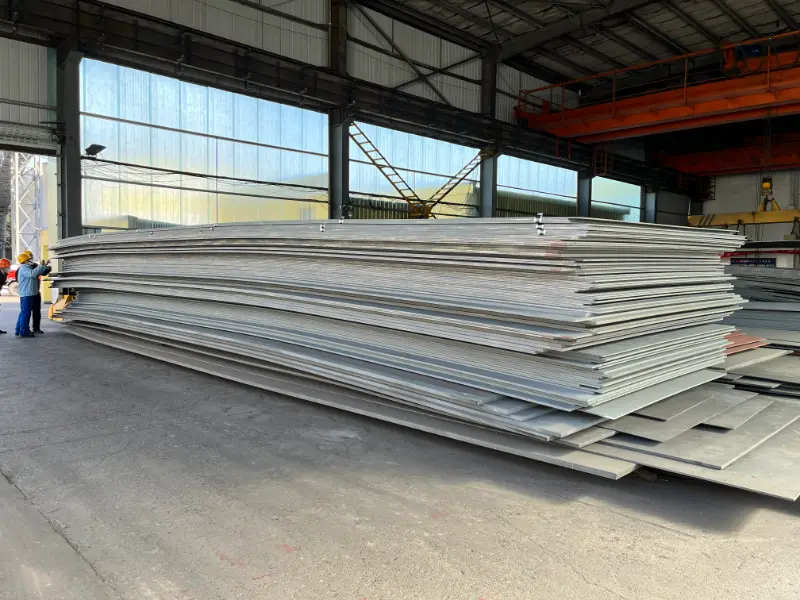
Austenitic XM-21 (S30452) Stainless Steel Plate/Coil
Austenitic XM-21 (S30452) Stainless Steel Plate/Coil: High-Strength Nitrogen-Enhanced Alloy
Comprehensive data for UNS S30452 (XM-21) austenitic stainless steel plate/coil: chemistry, mechanical and thermal properties, international equivalents, similar grades, and typical applications.
Hot rolling, cold rolling, annealing, pickling, cutting, forming, welding
- Phone : +8618037372205
- Email : [email protected]
- WhatsApp: Contact via Whtsapp
- WeChat: +8618037372205
Austenitic XM-21 Stainless Steel Plate/Coil Introduction
UNS S30452, designated as XM-21 in ASTM standards, is a nitrogen-enhanced austenitic stainless steel derived from the classic 304 (S30400) grade. The deliberate addition of nitrogen significantly improves the yield and tensile strength while maintaining excellent corrosion resistance, weldability, and formability. It is primarily supplied in the solution-annealed condition as plate, sheet, or coil, offering superior mechanical properties compared to standard 304 without compromising the characteristic ductility and toughness of austenitic stainless steels. This grade is widely used in applications requiring higher structural integrity, such as chemical processing equipment, architectural components, and transportation vessels. The higher strength permits gauge reduction and weight savings in fabricated products.
Austenitic XM-21 Stainless Steel Plate/Coil Chemical Composition
Chemical composition in accordance with ASTM A240/A240M for grade XM-21 (UNS S30452). The key strengthening element is nitrogen, which is carefully controlled to enhance mechanical properties without compromising corrosion resistance. Balance is iron (Fe).
| Chemical Element | Standard Value (%) | Remarks |
|---|---|---|
| Carbon (C) | ≤ 0.08 | |
| Manganese (Mn) | ≤ 2.00 | |
| Phosphorus (P) | ≤ 0.045 | |
| Sulfur (S) | ≤ 0.030 | |
| Silicon (Si) | ≤ 1.00 | |
| Chromium (Cr) | 18.0 – 20.0 | |
| Nickel (Ni) | 8.0 – 10.5 | |
| Nitrogen (N) | 0.16 – 0.30 | Primary strengthening addition |
| Iron (Fe) | Balance | Approximately 66–74% |
Austenitic XM-21 Stainless Steel Plate/Coil Thermal & Electrical Physical Properties
Typical physical properties for annealed XM-21 (S30452) austenitic stainless steel at room temperature unless otherwise indicated. These values are representative for alloy in the solution-annealed condition and may vary slightly with processing history.
| Property | Value | Unit | Test Condition / Remarks |
|---|---|---|---|
| Density (ρ) | 8.0 | g/cm³ | 20 °C |
| Modulus of elasticity (E) | 193 | GPa | Tension, 20 °C |
| Shear modulus (G) | 77 | GPa | Calculated, 20 °C |
| Poisson's ratio (ν) | 0.29 | – | 20 °C |
| Thermal expansion coefficient (α) | 17.3 | 10⁻⁶ / K | 20–100 °C |
| Thermal expansion coefficient (α) | 18.0 | 10⁻⁶ / K | 20–500 °C |
| Thermal conductivity (λ) | 16.2 | W/(m·K) | at 100 °C |
| Thermal conductivity (λ) | 21.5 | W/(m·K) | at 500 °C |
| Specific heat capacity | 500 | J/(kg·K) | 0–100 °C |
| Electrical resistivity (ρ_e) | 720 | nΩ·m | 20 °C |
Austenitic XM-21 Stainless Steel Plate/Coil Mechanical Properties
Room-temperature tensile properties for solution-annealed plate, sheet, and coil as specified in ASTM A240/A240M. The high nitrogen content gives XM-21 higher strength than standard 304, while maintaining good elongation. Values are minima unless noted as maximum.
| Property | Value | Unit | Test Condition / Remarks |
|---|---|---|---|
| Yield strength (0.2% offset) | 205 min | MPa | Transverse; thickness ≤ 200 mm |
| Tensile strength (Rm) | 515 min | MPa | Transverse; thickness ≤ 200 mm |
| Elongation (A) in 50 mm (2 in.) | 40 min | % | Transverse; thickness ≤ 19 mm |
| Elongation (A) in 50 mm (2 in.) | 35 min | % | Transverse; 19 mm < thickness ≤ 25.4 mm |
| Hardness | 92 HRB / 201 HBW max | – | Solution annealed condition |
Austenitic XM-21 Stainless Steel Plate/Coil Full Equivalent Material Standards & Substitute Grades
| Country/Region | Standard | Grade/Designation | Remarks |
|---|---|---|---|
| USA | ASTM A240/A240M | XM-21 (UNS S30452) | Original grade definition |
| USA | ASTM A666 | XM-21 (UNS S30452) | For annealed or cold-worked flat products |
| International | ISO 15510 | – | No direct equivalent; similar to X2CrNiN18-9 variants |
| Japan | JIS G 4304 | SUS304N1 | Closest equivalent; N: 0.10–0.25%, other elements slightly broader |
| Europe | EN 10088-2 | 1.4315 (X2CrNiN18-9) | Approximate; N: 0.12–0.22%, C ≤0.03% |
| China | GB/T 20878 | 06Cr19Ni10N (S30458) | Approximate; N: 0.12–0.22%, C ≤0.08% |
Austenitic XM-21 Stainless Steel Plate/Coil Application Introduction
XM-21 (S30452) is selected when higher strength than conventional 304 is desired without radically altering fabrication practices. The nitrogen addition boosts yield and tensile strength, allowing for material gauge reduction and lighter structures. It retains excellent weldability, forming characteristics, and corrosion resistance comparable to 304 in most environments. Common applications include:
Product Applications: Pressure vessels and storage tanks, Structural profiles and custom fabrications, Heat exchangers and evaporators, Architectural cladding and curtain wall systems, Sanitary tubing and fittings, Ductwork and flue components
Processed into products: Welded tank shells and heads, Flanges and fittings, Bolting and fasteners (where strength and corrosion needed), Spring elements (after cold working), Load-bearing brackets and supports, Conveyor components in food processing
Application industries: Chemical processing (tanks, vessels, piping), Food and beverage (storage silos, conveyors, processing equipment), Architecture (structural facades, canopies, handrails), Transportation (rail car bodies, trailer tanks), Pharmaceutical and sanitary equipment, Water treatment plants
Austenitic XM-21 Stainless Steel Plate/Coil Comparable / Similar Substitute Materials
| Country/Region | Standard | Grade/Designation | Remarks |
|---|---|---|---|
| USA | ASTM A240 | 304 (S30400) | No intentional N; lower strength (min YS 205 MPa, min TS 515 MPa similar to min but typical TS ~585 MPa for 304 vs ~620 MPa for XM-21) |
| USA | ASTM A240 | 304N (S30451) | Contains N 0.10–0.16%; intermediate strength between 304 and XM-21 |
| USA | ASTM A240 | 304L (S30403) | Low carbon for improved weld corrosion resistance; strength slightly lower |
| USA | ASTM A666 | 301 (S30100) | Cold-work hardening grade; similar annealed strength, but different composition and work-hardening rate |
| Europe | EN 10088-2 | 1.4301 (X5CrNi18-10) | Standard 304, without additional nitrogen |
| Europe | EN 10088-2 | 1.4311 (X2CrNiN18-10) | Low-carbon with nitrogen; strength higher than 304L, lower than XM-21 |
Notes:
Fabrication considerations: Welding methods (TIG, MIG, SAW, resistance) for XM-21 are similar to those for 304 stainless steel. Intergranular corrosion resistance after welding is generally not an issue in thin sections, but for heavy sections or aggressive environments, a low-carbon (304L) or stabilized grade may be preferred. In the solution-annealed condition, the alloy has a fully austenitic, non-magnetic microstructure.
Cold working: XM-21 exhibits a higher work-hardening rate than 304, enabling the production of high-strength tempers (1/4 hard, 1/2 hard, etc.) per ASTM A666. These tempers are used in applications such as springs and structural parts where weight saving is critical.
Corrosion resistance: General atmospheric and chemical corrosion resistance is largely equivalent to type 304. The higher nitrogen content may marginally improve pitting resistance, but for severe chloride environments, higher molybdenum grades (e.g., 316/316L) are more suitable.
- Share



