
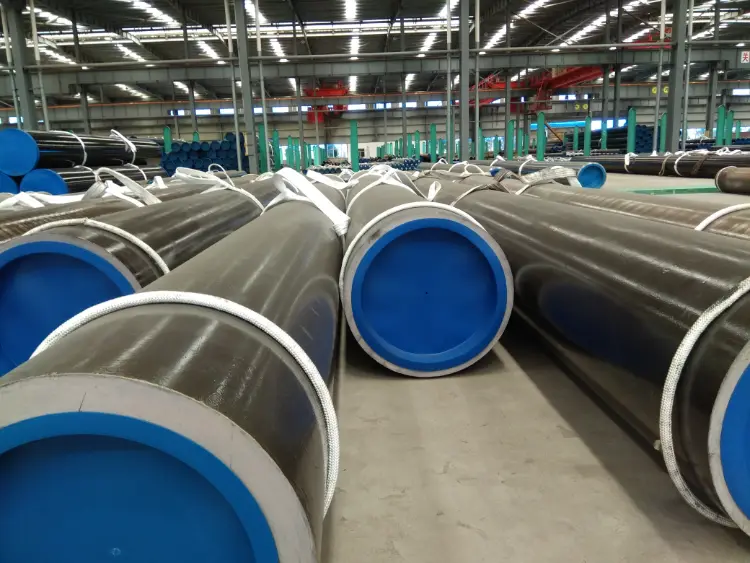
JIS G3106 SM490C Steel for LSAW Pipes
JIS G3106 SM490C Steel for LSAW Pipes: Properties, Equivalents & Applications
In-depth analysis of JIS G3106 SM490C steel used in LSAW pipes, including chemical composition, mechanical and physical properties, international equivalents, and application guidance.
Hot rolling, controlled rolling, normalizing, cold forming, submerged arc welding (SAW), gas metal arc welding (GMAW), shielded metal arc welding (SMAW), plate cutting, beveling, and pipe forming (UOE, JCOE methods)
- Phone : +8618037372205
- Email : [email protected]
- WhatsApp: Contact via Whtsapp
- WeChat: +8618037372205
JIS G3106 SM490C Steel for LSAW Pipes Introduction
JIS G3106 SM490C is a high-strength, weldable structural steel grade primarily used in welded structures such as LSAW (Longitudinal Submerged Arc Welded) pipes, bridges, ships, and buildings. It belongs to the SM490 series under the Japanese Industrial Standard JIS G3106, where 'SM' stands for 'Steel Marine' or general structural steel. The 'C' designation indicates the impact test requirement at 0°C with a minimum absorbed energy of 27 J, ensuring good notch toughness at low temperatures.
Key features include:
- Minimum yield strength of 325 MPa for thicknesses up to 16 mm, with tensile strength ranging from 490 to 610 MPa.
- Excellent weldability facilitated by controlled carbon equivalent (≤0.44%) and low impurity levels.
- Good formability and overall toughness, suitable for cold bending and high-stress structural applications.
- Available in various delivery conditions such as hot-rolled, controlled rolled, or normalized, depending on thickness and customer requirements.
This grade is widely used for manufacturing large-diameter LSAW pipes for oil and gas transportation, pressure vessels, and heavy civil engineering structures.
JIS G3106 SM490C Steel for LSAW Pipes Chemical Composition
The chemical composition of JIS G3106 SM490C is carefully controlled to achieve a balance of strength, weldability, and low-temperature toughness. The maximum limits ensure good weldability with a carbon equivalent (CE) typically ≤0.44% for thicknesses up to 50 mm, and an additional requirement of PCM ≤0.24% for thicker sections when specified. All values are maximum unless otherwise indicated.
| Element | Standard Value (max, %) | Remarks |
|---|---|---|
| Carbon (C) | ≤0.18 | Ensures weldability and strength |
| Silicon (Si) | ≤0.55 | Deoxidizer, contributes to strength |
| Manganese (Mn) | ≤1.60 | Enhances toughness and wear resistance |
| Phosphorus (P) | ≤0.035 | Kept low to avoid brittleness |
| Sulfur (S) | ≤0.035 | Minimizes hot cracking during welding |
| Additional elements (Cr, Ni, Cu, etc.) | May be present in small residual amounts | Not specified, but can be added for specific properties as agreed between manufacturer and purchaser |
JIS G3106 SM490C Steel for LSAW Pipes Thermal and Electrical Physical Properties
The physical properties for SM490C steel are typical for low-alloy structural steels with a density close to that of pure iron. These values are valid at ambient temperature unless otherwise specified, and may vary slightly with actual chemical composition and heat treatment condition. They are essential for thermal stress analysis, heat transfer calculations, and electrical applications.
| Property | Typical Value | Unit | Test Condition / Remarks |
|---|---|---|---|
| Density (ρ) | 7.85 | g/cm³ | 20°C |
| Modulus of elasticity (E) | 205 | GPa | 20°C, tension |
| Shear modulus (G) | 80 | GPa | Estimated from E and ν |
| Poisson's ratio (ν) | 0.29 | — | Elastic range, room temperature |
| Thermal expansion coefficient (α) | 11.8 ×10⁻⁶ | K⁻¹ | From 20°C to 100°C |
| Thermal expansion coefficient (α) | 12.6 ×10⁻⁶ | K⁻¹ | From 20°C to 200°C |
| Thermal expansion coefficient (α) | 13.5 ×10⁻⁶ | K⁻¹ | From 20°C to 400°C |
| Thermal conductivity (λ) | 48 ~ 53 | W/(m·K) | At 100°C |
| Thermal conductivity (λ) | 44 ~ 48 | W/(m·K) | At 200°C |
| Specific heat capacity (cp) | 460 ~ 480 | J/(kg·K) | At 20 ~ 100°C |
| Electrical resistivity (ρ_e) | 0.25 ~ 0.30 | µΩ·m | At 20°C |
JIS G3106 SM490C Steel for LSAW Pipes Mechanical Properties
The following mechanical properties are based on JIS G3106 for SM490C plates and strips in as-rolled or normalized condition. Tensile and yield test specimens are taken transverse to the rolling direction. Charpy V-notch impact tests are conducted at 0°C in the longitudinal direction. Bend test specimens are bent 180° around a designated mandrel diameter without cracking.
| Property | Standard Requirement | Unit | Test Condition / Thickness Range |
|---|---|---|---|
| Yield strength (ReH) | ≥325 | MPa | Thickness ≤16 mm |
| Yield strength (ReH) | ≥315 | MPa | 16 mm < Thickness ≤40 mm |
| Yield strength (ReH) | ≥295 | MPa | 40 mm < Thickness ≤75 mm |
| Yield strength (ReH) | ≥295 | MPa | 75 mm < Thickness ≤100 mm |
| Yield strength (ReH) | ≥285 | MPa | 100 mm < Thickness ≤160 mm |
| Yield strength (ReH) | ≥275 | MPa | 160 mm < Thickness ≤200 mm |
| Tensile strength (Rm) | 490 ~ 610 | MPa | Thickness ≤100 mm |
| Tensile strength (Rm) | 470 ~ 610 | MPa | 100 mm < Thickness ≤200 mm |
| Elongation (A), gauge length 5.65√So | ≥22 | % | Thickness ≤5 mm |
| Elongation (A) | ≥18 | % | 5 mm < Thickness ≤16 mm |
| Elongation (A) | ≥17 | % | 16 mm < Thickness ≤50 mm |
| Elongation (A) | ≥23 (for JIS No.1A specimen) | % | Thickness >50 mm (Reference: A=23% for 14A specimen) |
| Bend test (180°) | Mandrel diameter: 0.5×thickness | — | Thickness ≤16 mm |
| Bend test (180°) | Mandrel diameter: 1.0×thickness | — | 16 mm < Thickness ≤100 mm |
| Bend test (180°) | Mandrel diameter: 1.5×thickness | — | 100 mm < Thickness ≤160 mm |
| Charpy impact energy (KV2) at 0°C | ≥27 J (average of 3 specimens) | J | All thicknesses (unless otherwise agreed) |
JIS G3106 SM490C Steel for LSAW Pipes Fully Equivalent Material Standards and Replaceable Grades
| Country/Region | Standard | Grade | Remarks |
|---|---|---|---|
| European Union | EN 10025-2:2019 | S355J0 | Same yield class (min 355 MPa for t≤16mm), impact test at 0°C, 27J minimum |
| China | GB/T 1591-2018 | Q355C | Equivalent strength, 0°C impact test (≥34J), similar weldability |
| International | ISO 630-2:2011 | S355J0 | Equivalent chemical and mechanical requirements for structural steels |
| USA | ASTM A572/A572M-21 | Grade 50 [50S] (with supplementary impact requirement at 0°C) | Base strength level matches, but Charpy impact must be specified separately (e.g., A572 Gr.50 with ASTM A6 S5 supplemental requirement) |
| Korea | KS D 3515 | SM490C | Adopted directly from JIS G3106, identical specifications |
| India | IS 2062:2011 | E350C (Fe 490C) | Closest equivalent with minimum yield of 350 MPa for thin sections and 0°C impact test |
JIS G3106 SM490C Steel for LSAW Pipes Application Introduction
SM490C LSAW pipes combine high strength, excellent weldability, and reliable impact toughness at 0°C, making them ideal for demanding structural and pressure-containing applications. Their thick-wall capability (up to 160 mm in plate form) and wide diameter range (up to 1626 mm for LSAW) serve heavy industries. Below are typical industries, finished products, and specific machined components derived from this material.
Product Applications: LSAW (Longitudinal Submerged Arc Welded) line pipes for crude oil, natural gas, and slurries, Pressure vessels and storage tanks rated up to moderate temperatures, Structural hollow sections (round, square, rectangular) for columns and trusses, Piling pipes and caissons for marine foundations, Penstocks and hydroelectric water conduits, Jack-up rig legs and offshore platform substructures
Processed into products: Pipe spools, bends, tees, reducers (fabricated from plates via cold forming and welding), Flanges and blind flanges cut from thick plates, Stiffening rings and support brackets for pipelines, Base plates and anchoring plates for wind turbine towers, Crane boom sections and heavy equipment chassis, Steel shells for monopile transition pieces
Application industries: Oil & Gas Transmission (onshore and offshore pipelines), Petrochemical and Chemical Process Plants, Civil and Infrastructure Engineering (bridges, high-rise buildings, stadiums), Shipbuilding and Offshore Engineering (jackets, decks, platforms), Water and Sewage Treatment Plants (large-diameter penstocks), Wind Energy (monopile foundations, transition pieces)
JIS G3106 SM490C Steel for LSAW Pipes Similar or Alternative Material Recommendations
| Country/Region | Standard | Grade | Remarks |
|---|---|---|---|
| Japan | JIS G3106 | SM490A | Lower toughness grade, not suitable for low-temperature or dynamic loading where C-grade impact properties are required |
| Japan | JIS G3106 | SM490B | Impact test at 0°C but with no guaranteed minimum energy unless specified; generally 27J typical, but SM490C is more reliable |
| Japan | JIS G3106 | SM490YA/YB | Higher yield strength (≥365 MPa for t≤16mm), but with slightly reduced elongation; suitable for weight savings where strength governs |
| European Union | EN 10025-2 | S355J2 | Impact test at -20°C (superior to SM490C), often interchangeable in low-temperature applications |
| USA | ASTM A572/A572M | Grade 50 (without impact) | Same strength, but lack of impact requirement limits its use in critical welded structures; may be replaced if toughness is not essential |
| China | GB/T 1591 | Q355D | Impact test at -20°C, better low-temperature toughness than SM490C; can be used when more stringent service conditions are expected |
Notes:
- For LSAW pipe production, plates are ordered to specific chemistry with controlled Ceq ≤0.44% to ensure sound welds; supplementary testing (such as ultrasonic inspection and drop-weight tear test) is often required for sour service or arctic applications.
- SM490C can be certified to additional standards like API 5L Grade X52 (with adjustments in tensile and impact requirements) when used for line pipes.
- When painting or hot-dip galvanizing, the surface preparation of SM490C should follow the same protocols as for mild structural steels; silicon content is within a range that does not cause excessive coating thickness.
- Heat treatment (normalizing) may be mandatory for thicknesses above 40 mm to refine the grain structure and meet impact test values.
- Share



