
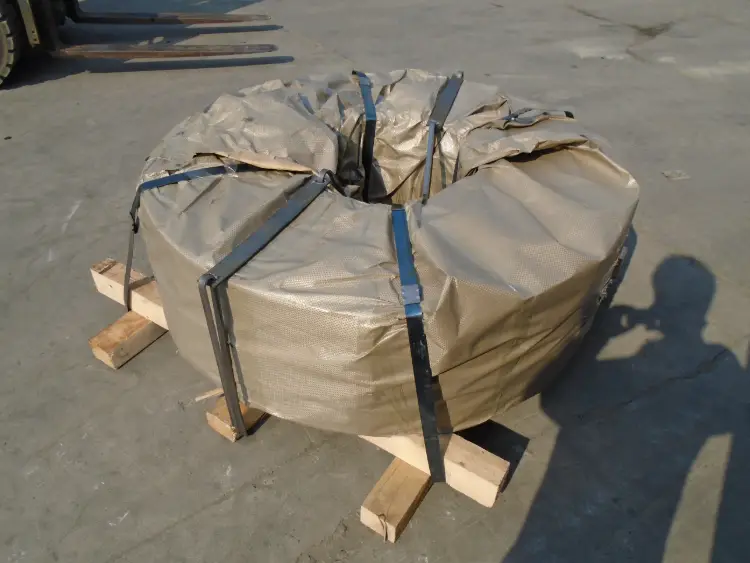
CCS DH32 Shipbuilding Steel Coil
CCS DH32 Shipbuilding Steel Coil | High-Strength Hull Structural Steel with Excellent Low-Temperature Toughness
CCS DH32 is a high-strength shipbuilding steel coil certified by China Classification Society, widely used for hull structures and offshore platforms. It offers minimum yield strength 315 MPa and guaranteed Charpy impact energy at -20°C.
Hot rolling, controlled rolling (TMCP), normalizing, cutting, cold forming, welding, machining
- Phone : +8618037372205
- Email : [email protected]
- WhatsApp: Contact via Whtsapp
- WeChat: +8618037372205
CCS DH32 Shipbuilding Steel Coil Introduction
CCS DH32 is a normalized or thermo-mechanically controlled processed high-strength shipbuilding steel grade designed for hull and offshore structures. Certified under the China Classification Society (CCS) Rules, it fully complies with GB/T 712-2011 and the International Association of Classification Societies (IACS) UR W11 for ordinary high-strength structural steel.
Key characteristics include:
- Minimum yield strength of 315 MPa and tensile strength ranging from 440 to 570 MPa, providing excellent strength-to-weight ratio.
- Low-temperature impact toughness: guaranteed Charpy-V impact energy of at least 31 J (longitudinal) at -20°C, suitable for cold environments and ice-class vessels.
- Good weldability controlled by low carbon equivalent (typically ≤0.36% for thin plates) and fine grain practice, reducing preheating requirements.
- Excellent formability and fair corrosion resistance, allowing cold bending, flanging, and hot forming without cracking.
- Supplied in the form of hot-rolled coils with mill edge or trimmed edge, and applicable for a wide range of thicknesses from 3 mm to 50+ mm.
The designation 'DH' indicates delivery condition normalized or controlled rolled and impact testing at -20°C, while '32' denotes the minimum yield stress class.
CCS DH32 Shipbuilding Steel Coil Chemical Composition
Chemical composition of CCS DH32 conforms to CCS Rules and GB/T 712-2011. Residual elements are strictly controlled to ensure weldability and low-temperature toughness. Microalloying elements such as Nb, V, Ti may be added optionally for grain refinement and precipitation strengthening. For thinner products (≤12.5 mm) carbon equivalent (CEV) is typically ≤0.36%.
| Element | Standard Value (%) | Remarks |
|---|---|---|
| C | ≤ 0.18 | Maximum allowed |
| Si | ≤ 0.50 | Deoxidizer, contributes to strength |
| Mn | 0.90 - 1.60 | Main strengthening element |
| P | ≤ 0.025 | Maximum; low for toughness |
| S | ≤ 0.025 | Maximum; low for lamellar tearing resistance |
| Als (acid-soluble aluminum) | ≥ 0.015 | Minimum for grain refining; total Al if used |
| Ceq (Carbon Equivalent) | ≤ 0.36 (t ≤ 12.5 mm) | Calculated as Ceq = C + Mn/6 + (Cr+Mo+V)/5 + (Ni+Cu)/15; varies with thickness |
| Nb | ≤ 0.05 (optional) | Grain refiner and precipitation strengthener |
| V | ≤ 0.10 (optional) | Grain refiner; typical max when added |
| Ti | ≤ 0.02 (optional) | Grain refiner; nitrogen binding |
| Ni | ≤ 0.40 (residual) | May be present from scrap; not usually added |
| Cr | ≤ 0.20 (residual) | Generally not required |
| Mo | ≤ 0.08 (residual) | Not intentionally added |
| Cu | ≤ 0.35 (residual) | Residual from scrap; limited to avoid hot shortness |
CCS DH32 Shipbuilding Steel Coil Thermal and Electrical Physical Properties
The following data represent typical physical properties of low-carbon high-strength structural steel. Values are relevant for general engineering calculations, not part of the mandatory classification requirements. Minor variations may occur based on actual chemistry and microstructural condition.
| Property | Typical Value | Unit | Test Condition / Remarks |
|---|---|---|---|
| Density (ρ) | 7.85 | g/cm³ | At 20°C |
| Modulus of Elasticity (E) | 206 | GPa | At room temperature |
| Shear Modulus (G) | 79.3 | GPa | Derived from E and Poisson's ratio |
| Poisson's Ratio (ν) | 0.30 | – | Elastic range |
| Thermal Expansion Coefficient (α) | 11.5 | 10⁻⁶/K | 20 – 100°C |
| Thermal Expansion Coefficient (α) | 12.5 | 10⁻⁶/K | 20 – 400°C |
| Thermal Conductivity (λ) | 52 | W/(m·K) | At 100°C |
| Thermal Conductivity (λ) | 47 | W/(m·K) | At 300°C |
| Specific Heat Capacity (c) | 486 | J/(kg·K) | At room temperature |
| Electrical Resistivity (ρₑ) | 0.14 | Ω·mm²/m | At 20°C |
CCS DH32 Shipbuilding Steel Coil Mechanical Properties
Mechanical properties shall be tested on specimens taken from the parent material in the delivered condition. The values below are based on the requirements of CCS Rules and GB/T 712-2011 for DH32 grade. Impact test temperature is -20°C. Elongation is measured on a gauge length of 5.65√S₀. Bending test is required to ensure formability without cracking.
| Property | Required Value | Unit | Test Condition / Remarks |
|---|---|---|---|
| Yield Strength (ReH) | ≥ 315 | MPa | All thicknesses; 0.2% offset proof strength if non-proportional |
| Tensile Strength (Rm) | 440 - 570 | MPa | Over the full thickness range |
| Elongation (A) | ≥ 22 | % | Gauge length 5.65√S₀; longitudinal specimen |
| Bending Test | d=2a (t ≤ 25 mm) | – | Bend angle 180°; no cracks; a = specimen thickness |
| Bending Test | d=3a (t > 25 mm) | – | Bend angle 180°; for thicker materials |
| Charpy Impact Energy (KV₂) | ≥ 31 (average) | J | Longitudinal; at -20°C; single minimum ≥ 22 J |
| Charpy Impact Energy (KV₂) | ≥ 22 (single) | J | At -20°C; only one value below average allowed per set |
| Hardness (optional) | ≤ 160 HB | – | Typical for normalized DH32, not mandatory in standard |
CCS DH32 Shipbuilding Steel Coil Fully Equivalent Material Standards and Substitutable Grades
| Country / Region | Standard / Classification Body | Grade | Remarks |
|---|---|---|---|
| International | IACS UR W11 | DH32 | Unified Requirement for Ordinary High-Strength Hull Structural Steel |
| USA | ABS (American Bureau of Shipping) | ABS DH32 | Fully equivalent in chemical and mechanical requirements |
| UK | LR (Lloyd's Register) | LR DH32 | Identical properties; mutually recognized |
| Norway/Germany | DNV (Det Norske Veritas) | DNV DH32 | Recognized by DNV; former GL DH32 also equivalent |
| Germany | GL (Germanischer Lloyd, now part of DNV) | GL DH32 | Historical equivalent; now covered under DNV rules |
| France | BV (Bureau Veritas) | BV DH32 | Same strength class and impact temperature |
| Japan | NK (Nippon Kaiji Kyokai, ClassNK) | NK DH32 | Complies with IACS UR W11 |
| Korea | KR (Korean Register) | KR DH32 | Equivalent in all respects |
| Italy | RINA (Registro Italiano Navale) | RINA DH32 | Identical designation and requirements |
| China | GB/T 712-2011 | DH32 (CCS) | National standard aligned with CCS rules |
| Russia | RMRS (Russian Maritime Register of Shipping) | D32 (high-strength) | Comparable; D32 denotes impact at -20°C, strength 315 MPa |
| India | IRS (Indian Register of Shipping) | IRS DH32 | Equivalent to IACS DH32 |
CCS DH32 Shipbuilding Steel Coil Application Introduction
CCS DH32 steel coil is primarily employed in the construction of ship hulls and marine structures where moderate high strength and guaranteed low-temperature toughness are required. It is suitable for both newbuilding and repair of ocean-going vessels, inland watercraft, and offshore engineering. Its good weldability allows for efficient fabrication using automated welding processes.
Typical applications and deliverables:
Product Applications: Hull side shell, bottom shell, and deck plating, Longitudinal and transverse bulkheads, Web frames, stiffeners, and girders, Hatch covers and coamings, Offshore platform deck plates and structural members, Pressure hull components for submersibles and underwater vehicles
Processed into products: Ship hull plates and strips (flame-cut, beveled, and rolled), Stiffening ribs and angles (cold-formed or built-up sections), Brackets and gusset plates, Welded T-beams and built-up sections, Offshore wind turbine tower internal platforms and flanges (non-certified welding required), Pile sleeves and transition pieces for jacket foundations
Application industries: Shipbuilding and ship repair, Offshore oil & gas (platform secondary structures, accommodation modules), Marine civil engineering (cofferdams, lock gates), Port and harbor equipment (crane booms, gantry girders), Icebreaker and arctic vessel construction, Barge and floating crane manufacture
CCS DH32 Shipbuilding Steel Coil Similar or Alternative Materials for Consideration
| Country / Region | Standard / Classification Body | Grade | Remarks |
|---|---|---|---|
| China / IACS | IACS UR W11 | AH32 | Same strength but impact at 0°C; cost-effective for non-arctic service |
| China / IACS | IACS UR W11 | EH32 | Higher low-temperature toughness: impact at -40°C |
| China / IACS | IACS UR W11 | FH32 | Superior toughness: impact at -60°C, with additional fine-grain requirements |
| International | EN 10025-3 / EN 10025-4 | S315M / S315ML | Structural steel with minimum yield 315 MPa, normalized; not ship-class certified but suitable for offshore fixed structures |
| China | GB/T 1591-2018 | Q345D | General structural steel, impact at -20°C, yield ≥ 345 MPa; not for ship hull unless specifically approved |
| Japan | JIS G 3106 | SM400B / SM400C | Welding structural steel; lower strength 245 MPa yield but good toughness; can substitute for non-critical marine structures |
| USA | ASTM A131 / A131M | Grade DH32 | Same generic designation; chemically and mechanically aligned; widely used in marine construction |
Notes:
- Weldability: DH32 is usually supplied with low carbon equivalent and fine grain size, enabling welding without preheat for moderate thicknesses (<25 mm) under normal conditions. For thicker sections or low ambient temperature, a preheat of 75–125°C may be recommended. Consumables matching the strength level (AWS E7018, E71T-1, or equivalent) are suitable.
- Heat treatment: In cases where hot forming exceeds 650°C, a subsequent normalizing treatment is required to restore mechanical properties. Stress relief annealing should be performed at 580–620°C.
- Certification: Products are delivered with CCS certificate or with the endorsement of other IACS classification societies through mutual recognition. Test certificates to EN 10204 3.1 or 3.2 are standard.
- Finishing: Surface is generally as-rolled, shot-blasted and shop-primed for corrosion protection during construction. Zinc-rich or epoxy primers are commonly applied.
- Dimensions: Coil thicknesses from 3 mm to 25 mm, widths up to 2,600 mm, and hot-rolled plate from 6 mm to 100 mm are available. Please consult the rolling program for exact dispatch conditions.
- Share



