
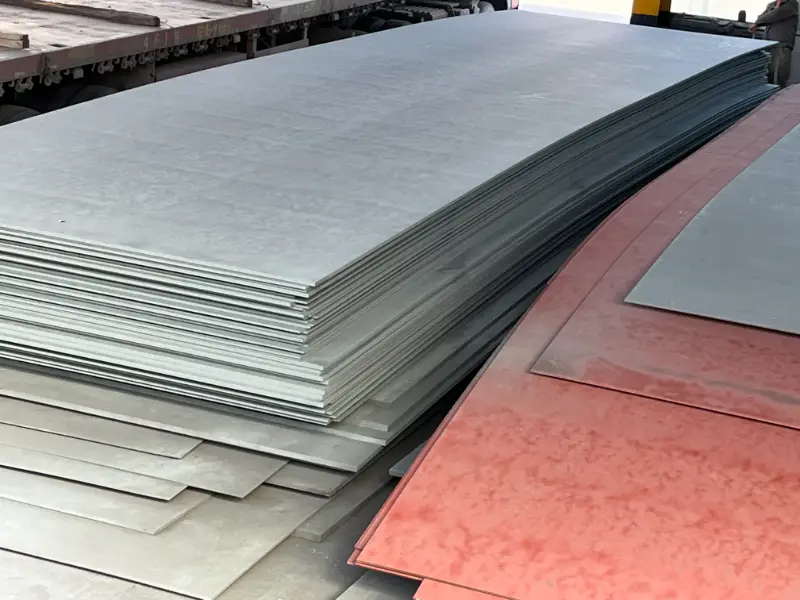
Austenitic Stainless Steel 317L (UNS S31703) Plate/Coil
Austenitic Stainless Steel 317L (UNS S31703) Plate/Coil - Complete Datasheet & Equivalents
Comprehensive technical data for 317L austenitic stainless steel plate/coil, including chemical composition, mechanical & physical properties, international equivalents, and application guidance.
Hot rolling, Cold rolling, Annealing, Pickling, Descaling, Forming, Welding, Machining
- Phone : +8618037372205
- Email : [email protected]
- WhatsApp: Contact via Whtsapp
- WeChat: +8618037372205
Austenitic Stainless Steel 317L Plate/Coil Introduction
317L (UNS S31703) is a low-carbon austenitic stainless steel with enhanced corrosion resistance compared to standard 316L, achieved by a higher molybdenum addition (3-4%).
This grade offers excellent resistance to pitting and crevice corrosion in chloride-containing environments, as well as good resistance to sulfuric acid, phosphoric acid, and organic acids. Its low carbon content minimizes the risk of intergranular corrosion after welding or heat treatment.
The alloy maintains high toughness, ductility, and non-magnetic properties in the annealed condition. Typical product forms include plates, sheets, and coils, supplied in solution-annealed and descaled condition according to ASTM A240 and corresponding international standards.
Austenitic Stainless Steel 317L Plate/Coil Chemical Composition per ASTM A240
The chemical composition of 317L stainless steel is carefully controlled to maximize corrosion resistance while ensuring good weldability and formability.
Values are in weight percent (mass fraction) unless otherwise stated. The low carbon content (≤0.030%) prevents sensitization during welding.
| Element | Standard Range (min-max) | Remarks |
|---|---|---|
| Carbon (C) | ≤ 0.030 | Minimum achievable; low carbon grade |
| Manganese (Mn) | ≤ 2.00 | |
| Phosphorus (P) | ≤ 0.045 | |
| Sulfur (S) | ≤ 0.030 | |
| Silicon (Si) | ≤ 0.75 | |
| Chromium (Cr) | 18.00 - 20.00 | Key element for corrosion resistance |
| Nickel (Ni) | 11.00 - 15.00 | Stabilizes austenitic structure |
| Molybdenum (Mo) | 3.00 - 4.00 | Improves pitting and crevice corrosion resistance |
| Nitrogen (N) | ≤ 0.10 | |
| Iron (Fe) | Balance | Remainder |
Austenitic Stainless Steel 317L Plate/Coil Thermal & Electrical Physical Properties
Physical properties are provided for design and heat transfer calculations. Data represent typical values at room temperature unless a range is given. Properties may vary slightly depending on exact composition and heat treatment.
| Property | Standard Value | Unit | Test Conditions |
|---|---|---|---|
| Density (ρ) | 8.00 | g/cm³ | At 20 °C |
| Elastic Modulus (E) | 193 | GPa | Tension, room temperature |
| Shear Modulus (G) | 77 | GPa | Calculated from E and Poisson's ratio |
| Poisson's Ratio (ν) | 0.27 - 0.30 | — | Estimate for wrought condition |
| Thermal Expansion Coefficient (α) | 16.0 | µm/m·°C | 0 - 100 °C |
| Thermal Expansion Coefficient (α) | 16.5 | µm/m·°C | 0 - 315 °C |
| Thermal Expansion Coefficient (α) | 17.0 | µm/m·°C | 0 - 538 °C |
| Thermal Conductivity (λ) | 14.6 | W/m·K | At 100 °C |
| Thermal Conductivity (λ) | 16.1 | W/m·K | At 300 °C |
| Thermal Conductivity (λ) | 17.5 | W/m·K | At 500 °C |
| Specific Heat Capacity | 500 | J/kg·K | At 0 - 100 °C |
| Electrical Resistivity (ρe) | 0.74 | µΩ·m | At room temperature |
| Melting Range | 1370 - 1400 | °C | Approximate solidus/liquidus |
Austenitic Stainless Steel 317L Plate/Coil Mechanical Properties - Solution Annealed Condition
Mechanical properties for 317L plate/coil comply with ASTM A240 requirements.
All values are minimum unless otherwise noted, tested at room temperature and in the solution-annealed condition.
Higher values may be achieved depending on exact processing; hardness is maximum.
| Property | Standard Value | Unit | Test Conditions / Remarks |
|---|---|---|---|
| Tensile Strength (Rm) | 515 (75) | MPa (ksi) | At room temperature; transverse direction |
| Yield Strength (ReH, 0.2% offset) | 205 (30) | MPa (ksi) | At room temperature; transverse direction |
| Elongation (A) in 50 mm (2 in.) | 40 | % | For thickness up to 19 mm (0.75 in.) |
| Elongation (A) in 50 mm (2 in.) | 35 | % | For thickness > 19 mm (0.75 in.) |
| Hardness, Brinell (HBW) | ≤ 217 | — | Typical maximum |
| Hardness, Rockwell B (HRB) | ≤ 95 | — | Typical maximum |
| Impact Toughness (KV) | Not specified | J | Generally high toughness; tested on request |
Austenitic Stainless Steel 317L Plate/Coil Complete International Equivalents of 317L
| Country/Region | Standard | Grade/Designation | Remarks |
|---|---|---|---|
| USA | ASTM A240 / ASME SA240 | UNS S31703 (317L) | Plate, sheet, strip |
| European Union | EN 10088-2 / EN 10028-7 | 1.4438 - X2CrNiMo18-15-4 | Same nominal composition |
| Japan | JIS G4304 / G4305 | SUS317L | Hot-rolled / cold-rolled plate & sheet |
| China | GB/T 3280 / GB/T 4237 | 022Cr19Ni13Mo3 (S31703) | Modern designation |
| International | ISO 15510 | X2CrNiMo18-15-4 | ISO equivalent |
Austenitic Stainless Steel 317L Plate/Coil Application Introduction
317L stainless steel plate and coil are extensively used where superior corrosion resistance to standard 316L is required, especially in environments containing chlorides, sulfur compounds, and organic acids. Its low carbon content allows as-welded use in many corrosive applications.
Key advantages: Excellent pitting resistance, good high-temperature strength, and ease of fabrication.
Product Applications: Heat exchangers (plate-and-frame or shell-and-tube), Pressure vessels and storage tanks (ASME code construction), Piping systems (process lines, manifolds), Coils for HVAC or industrial cooling/heating, Clad plate for corrosion barrier, Welded tube and pipe, Custom-fabricated equipment (columns, reactors)
Processed into products: Reactor internals (baffles, impellers), Pump and valve bodies, trim, Flanges, gaskets, and fasteners, Nozzles, manways, and sight glasses, Filter housings and strainers, Expansion joints and bellows, Structural shapes for corrosive environments (angles, channels)
Application industries: Chemical processing (reactors, storage tanks, piping), Petrochemical & refinery equipment (heat exchangers, columns), Pulp & paper (bleaching equipment, digesters), Food & beverage processing (sanitary tubing, vessels), Pharmaceutical manufacturing (sterile process equipment), Marine & offshore (seawater handling, desalination), Flue gas desulfurization (scrubbers, ducting), Power generation (condenser tubing)
Austenitic Stainless Steel 317L Plate/Coil Similar & Alternative Stainless Steels to 317L
| Country/Region | Standard | Grade | Remarks / Comparison |
|---|---|---|---|
| Global | ASTM A240 | 317 (S31700) | Higher carbon (≤0.08%); may require post-weld annealing |
| Global | ASTM A240 | 316L (S31603) | Lower Mo (2-3%); less resistant to chlorides but more economical |
| Global | ASTM A240 | 316Ti (S31635) | Ti-stabilized; used for high-temperature or sensitized service |
| Global | ASTM B625 | 904L (N08904) | Higher Ni, Mo, Cu; superior in reducing acids, premium cost |
| Global | ASTM A240 | 317LMN (S31726) | Higher N for strength; similar corrosion resistance |
Notes:
Welding: 317L can be welded using common methods (SMAW, GTAW, GMAW, SAW) with matching or over-alloyed filler (e.g., ER317L, E317L-15/16). Post-weld heat treatment is not required for most service conditions.
Forming: Excellent cold formability; hot working range 950-1200 °C, followed by rapid cooling.
Corrosion: PREN (Pitting Resistance Equivalent Number) = %Cr + 3.3x%Mo + 16x%N ≈ 24-27 (minimum). This provides better pitting and crevice corrosion resistance than 316L (PREN ~23). Avoid prolonged exposure at 540-815 °C to prevent sigma phase embrittlement.
- Share



