
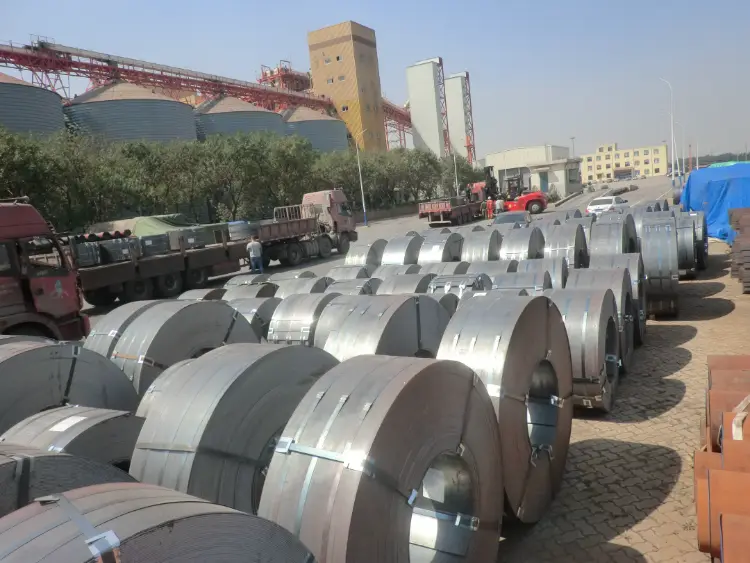
RINA F32 Shipbuilding Steel Coil
RINA F32 Shipbuilding Steel Coil - High Strength Hull Structural Steel Grade
RINA F32 is a high strength hull structural steel under RINA Rules, with minimum yield strength 315 MPa, excellent low-temperature toughness, and typical delivery as coil or plate. Equivalent to IACS UR W11 FH32.
Hot rolling, controlled rolling, normalizing, TMCP
- Phone : +8618037372205
- Email : [email protected]
- WhatsApp: Contact via Whtsapp
- WeChat: +8618037372205
RINA F32 Shipbuilding Steel Coil Introduction
RINA F32 is a high strength hull structural steel grade specified by the Italian classification society RINA (Registro Italiano Navale) in its Rules for the Classification of Ships, Part D, Materials and Welding. It belongs to the F32/FH32 family, indicating a minimum yield strength of 315 MPa and guaranteed impact properties at -60°C. The steel is designed for critical structural components in shipbuilding and offshore engineering where high strength, excellent weldability, and superior low-temperature toughness are required.
Key characteristics include:
- Minimum yield strength of 315 MPa (thickness ≤ 50 mm)
- Tensile strength in the range 440–590 MPa
- Fine-grained microstructure achieved through controlled rolling or normalizing
- Excellent notch toughness down to -60°C (longitudinal KV ≥ 31 J)
- Good formability and weldability with standard shipbuilding procedures
RINA F32 is typically supplied as hot-rolled coils, plates, or sheets and can be delivered in as-rolled, normalized, or thermo-mechanically controlled processed (TMCP) conditions. It fully complies with the IACS UR W11 requirements for FH32 and is internationally accepted across major classification societies.
RINA F32 Shipbuilding Steel Coil Chemical Composition
The chemical composition of RINA F32 is controlled to achieve the required mechanical properties and weldability. The ladle analysis must conform to the limits in the RINA Rules, with typical grain-refining elements such as Al, Nb, and V.
Note: Ceq = C + Mn/6 + (Cr+Mo+V)/5 + (Ni+Cu)/15 is commonly used to assess weldability but is not a mandatory part of the specification.
| Element | Standard Value (max unless range) | Remarks |
|---|---|---|
| Carbon (C) | ≤ 0.16 | Ladle analysis |
| Silicon (Si) | ≤ 0.50 | Ladle analysis |
| Manganese (Mn) | 0.90 – 1.60 | Ladle analysis |
| Phosphorus (P) | ≤ 0.025 | Ladle analysis |
| Sulfur (S) | ≤ 0.025 | Ladle analysis |
| Aluminum (Al, acid soluble) | ≥ 0.015 | Grain refining |
| Niobium (Nb) | 0.02 – 0.05 | Microalloying |
| Vanadium (V) | 0.05 – 0.10 | Microalloying |
| Titanium (Ti) | ≤ 0.02 | Grain refining |
| Copper (Cu) | ≤ 0.35 | Residual element |
| Chromium (Cr) | ≤ 0.20 | Residual element |
| Nickel (Ni) | ≤ 0.40 | Residual element |
| Molybdenum (Mo) | ≤ 0.08 | Residual element |
| Nitrogen (N) | ≤ 0.009 | If combined with Al |
RINA F32 Shipbuilding Steel Coil Physical Properties
The following physical properties are typical for normalized or TMCP fine-grained structural steels comparable to RINA F32. They are not specified in the standard but are useful for design calculations and processing. Actual values may vary slightly depending on the exact chemical composition and processing route.
| Physical Property | Typical Value | Unit | Conditions |
|---|---|---|---|
| Density (ρ) | 7.85 | g/cm³ | Ambient temperature |
| Modulus of Elasticity (E) | 205 | GPa | Ambient temperature |
| Shear Modulus (G) | 80 | GPa | Ambient temperature |
| Poisson's Ratio (ν) | 0.30 | – | Ambient temperature |
| Thermal Expansion Coefficient (α) | 11.5 × 10⁻⁶ | K⁻¹ | 20 – 100 °C |
| Thermal Expansion Coefficient (α) | 12.5 × 10⁻⁶ | K⁻¹ | 20 – 200 °C |
| Thermal Expansion Coefficient (α) | 13.5 × 10⁻⁶ | K⁻¹ | 20 – 400 °C |
| Thermal Conductivity (λ) | 51 | W/(m·K) | 20 °C |
| Thermal Conductivity (λ) | 48 | W/(m·K) | 200 °C |
| Specific Heat Capacity (cp) | 460 | J/(kg·K) | 20 °C |
| Specific Heat Capacity (cp) | 500 | J/(kg·K) | 200 °C |
| Electrical Resistivity (ρe) | 0.22 × 10⁻⁶ | Ω·m | 20 °C |
RINA F32 Shipbuilding Steel Coil Mechanical Properties
Mechanical properties are determined on test pieces taken in the longitudinal direction and at room temperature, unless otherwise specified. The required values depend on product thickness. Yield strength decreases with increasing thickness above 50 mm. Impact tests are performed at -60°C for the F32 (FH32) grade, with a minimum average absorbed energy of 31 J for full-size Charpy V-notch specimens (10×10 mm).
| Property | Required Value | Unit | Test Condition / Thickness |
|---|---|---|---|
| Yield Strength (ReH) | ≥ 315 | MPa | t ≤ 50 mm, longitudinal, room temperature |
| Yield Strength (ReH) | ≥ 305 | MPa | 50 < t ≤ 70 mm, longitudinal, room temperature |
| Yield Strength (ReH) | ≥ 255 | MPa | 70 < t ≤ 100 mm, longitudinal, room temperature |
| Tensile Strength (Rm) | 440 – 590 | MPa | t ≤ 100 mm, longitudinal, room temperature |
| Elongation (A) | ≥ 22 | % | t ≤ 50 mm, 5.65√So gauge length |
| Elongation (A) | ≥ 21 | % | t > 50 mm, 5.65√So gauge length |
| Charpy Impact Energy (KV) | ≥ 31 (longitudinal) | J | t ≤ 50 mm, -60°C, full-size (10×10 mm) |
| Bend Test (180°) | d = 3a | – | t ≤ 25 mm, no cracks |
| Bend Test (180°) | d = 4a | – | t > 25 mm, no cracks |
RINA F32 Shipbuilding Steel Coil Exact Equivalent Material Standards and Replaceable Grades
| Country / Region | Standard / Specification | Grade | Remarks |
|---|---|---|---|
| International | IACS UR W11 | FH32 | Unified requirement for ordinary and high strength hull structural steels |
| Italy | RINA Rules Part D | F32 | Original designation |
| USA | ABS Rules | FH32 | American Bureau of Shipping |
| France | BV Rules | FH32 | Bureau Veritas |
| China | CCS Rules | FH32 | China Classification Society |
| Norway / Germany | DNV Rules | FH32 | DNV (former DNV GL) |
| South Korea | KR Rules | FH32 | Korean Register |
| United Kingdom | LR Rules | FH32 | Lloyd's Register |
| Japan | NK Rules | FH32 | Nippon Kaiji Kyokai (ClassNK) |
| Russia | RS Rules | F32 | Russian Maritime Register of Shipping |
RINA F32 Shipbuilding Steel Coil Application Introduction
RINA F32 (FH32) is primarily used in welded structures of ships and offshore installations where high strength and guaranteed low-temperature toughness at -60°C are essential. It is suitable for all conventional shipbuilding fabrication methods, including cutting, forming, and welding.
Typical applications:
Product Applications: Bulk carriers, Container ships, Tankers (oil / chemical / LNG), Offshore platforms and floating production units (FPSO, FLNG), Barges and pontoons, Offshore wind substructures (monopiles, jackets)
Processed into products: Hull shell plates and longitudinal stiffeners, Main deck and strength deck plating, Transverse bulkheads and watertight compartments, Keel and bottom structures, Hatch coamings and covers, Brackets and gusset plates, Heavy lift crane pedestals and foundations, Ice-strengthened regions (if approved for ice class)
Application industries: Shipbuilding (merchant vessels, naval ships), Offshore oil & gas (jackets, topsides, modules), Marine & coastal construction (ports, locks, breakwaters), Renewable energy (offshore wind turbine foundations), Heavy engineering for low-temperature service
RINA F32 Shipbuilding Steel Coil Similar / Closely Related Alternative Materials
| Country / Region | Standard / Specification | Grade | Remarks |
|---|---|---|---|
| International | IACS UR W11 | AH32 / DH32 / EH32 | Same strength level (min 315 MPa), but higher impact test temperatures (0°C / -20°C / -40°C) |
| International | IACS UR W11 | AH36 / DH36 / EH36 | Higher yield strength (min 355 MPa) with similar toughness grades; can be considered for weight reduction when approved by classification society |
| Italy | RINA Rules Part D | A32 / D32 / E32 | RINA equivalents to AH32/DH32/EH32; suitable if service temperature allows |
| Europe | EN 10025-4 | S460ML, S460MLO | Thermo-mechanically rolled fine-grain structural steels; higher strength but require careful weldability assessment and classification acceptance |
Notes:
Delivery condition of RINA F32 coils and plates must be clearly agreed upon purchase. For F32 grade, normalizing or TMCP is normally required to achieve the -60°C impact toughness. Welding: Preheating is generally not required for thicknesses below 30 mm when using low-hydrogen processes; interpass temperature should be controlled. Post-weld heat treatment (PWHT) is rarely applied, but if required, the mechanical properties must be verified. Certification: All materials must be supplied with RINA (or equivalent) inspection certificates 3.1 or 3.2 in accordance with EN 10204. Ultrasonic testing may be required for critical applications as per classification rules.
- Share



