
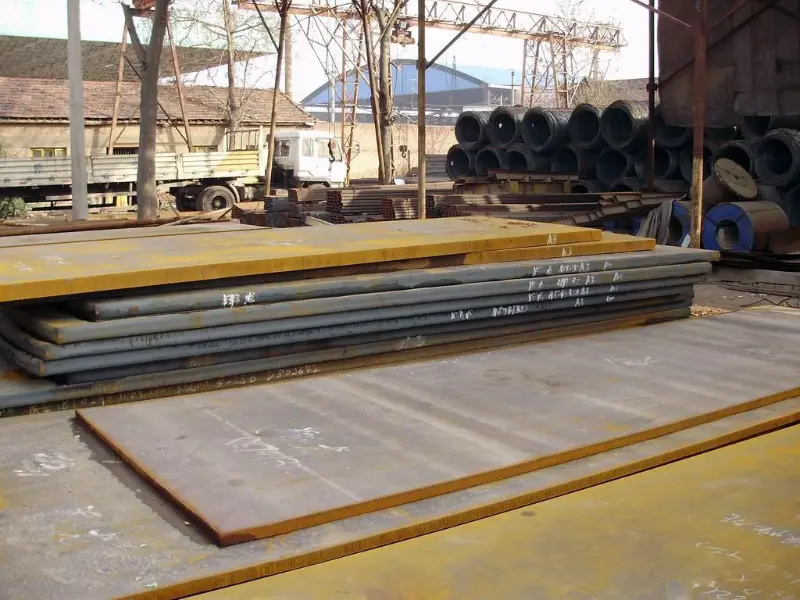
Austenitic Stainless Steel 302 (S30200) Plate/Coil
Austenitic 302 (S30200) Stainless Steel Plate & Coil – Superior Strength & Formability
Explore the properties of 302 (S30200) stainless steel plate/coil: high tensile strength, excellent corrosion resistance, and outstanding formability. Widely used in springs, wire mesh, and food processing equipment.
Cold rolling, hot rolling, drawing, stamping, bending, welding, machining
- Phone : +8618037372205
- Email : [email protected]
- WhatsApp: Contact via Whtsapp
- WeChat: +8618037372205
Austenitic Stainless Steel 302 Plate/Coil Introduction
Austenitic 302 stainless steel (UNS S30200) is a chromium-nickel alloy with a higher carbon content compared to 304, providing increased strength and hardness while maintaining good corrosion resistance. It is non-magnetic in the annealed condition, but may become slightly magnetic after cold working. This grade exhibits excellent formability and weldability, making it suitable for various sheet, plate, and coil applications. Typical uses include springs, wire forms, screens, and food handling equipment where higher strength is required.
Austenitic Stainless Steel 302 Plate/Coil Chemical Composition
The chemical composition of 302 stainless steel as per ASTM A240/A240M for plate, sheet, and strip. It is characterized by a chromium content of 17.0–19.0% and nickel 8.0–10.0%, with a higher carbon allowance (up to 0.15%) than 304, which enhances strength after cold working. All values are maximum unless a range is indicated.
| Element | Standard Value | Notes |
|---|---|---|
| Carbon (C) | ≤0.15 | Higher than 304 (<0.08) for increased strength |
| Manganese (Mn) | ≤2.00 | |
| Phosphorus (P) | ≤0.045 | |
| Sulfur (S) | ≤0.030 | |
| Silicon (Si) | ≤1.00 | Typically 0.30–0.75 for optimum formability |
| Chromium (Cr) | 17.0–19.0 | Provides corrosion resistance |
| Nickel (Ni) | 8.0–10.0 | Stabilizes austenitic structure |
| Nitrogen (N) | ≤0.10 | Optional residual element |
| Iron (Fe) | Balance |
Austenitic Stainless Steel 302 Plate/Coil Thermal and Electrical Physical Properties
Physical properties of 302 stainless steel in the annealed condition. These are typical values and may vary slightly depending on exact processing and composition. Data are based on published technical sources and ISO/EN references. Electrical resistivity is at room temperature unless noted.
| Property | Typical Value | Unit | Test Condition |
|---|---|---|---|
| Density (ρ) | 7.9–8.0 (commonly 7.93) | g/cm³ | At 20°C |
| Elastic Modulus (E) | 193 (28×10³) | GPa (ksi) | At 20°C, tension |
| Shear Modulus (G) | 77 (11.2×10³) | GPa (ksi) | Calculated from E and Poisson's ratio |
| Poisson's Ratio (ν) | 0.30 | - | Room temperature |
| Thermal Expansion Coefficient (α) | 16.0 | 10⁻⁶/K | 20–100°C |
| Thermal Expansion Coefficient (α) | 16.6 | 10⁻⁶/K | 20–200°C |
| Thermal Expansion Coefficient (α) | 17.7 | 10⁻⁶/K | 20–600°C |
| Thermal Conductivity (λ) | 16.2 | W/m·K | At 100°C |
| Thermal Conductivity (λ) | 21.5 | W/m·K | At 500°C |
| Specific Heat Capacity (cₚ) | 500 | J/kg·K | At 20°C |
| Electrical Resistivity (ρₑ) | 72 | µΩ·cm | At 20°C |
Austenitic Stainless Steel 302 Plate/Coil Mechanical Properties
Mechanical properties of 302 stainless steel plate/coil in the annealed condition according to ASTM A240/A240M. Requirements apply to standard thicknesses. Note that cold working significantly increases strength and reduces elongation. The values below are minimums (except hardness which is maximum) unless stated otherwise.
| Property | Standard Requirement | Unit | Test Condition |
|---|---|---|---|
| Tensile Strength (Rm) | ≥515 (≥75) | MPa (ksi) | Room temperature, annealed plate/coil |
| Yield Strength (ReH) 0.2% offset | ≥205 (≥30) | MPa (ksi) | Room temperature, annealed |
| Elongation (A) | ≥40 | % | In 50 mm (2 in) gauge length, plate/coil ≤ 5/8 in. (15.9 mm) thick |
| Elongation (A) | ≥35 | % | In 50 mm, plate/coil > 5/8 in. (15.9 mm) thick (expected for thicker sections) |
| Brinell Hardness (HBW) | ≤201 | - | Annealed |
| Rockwell Hardness (HRB) | ≤92 | - | Annealed |
Austenitic Stainless Steel 302 Plate/Coil Fully Equivalent Material Standards and Substitute Grades
| Country/Region | Standard | Grade | Notes |
|---|---|---|---|
| USA | ASTM A240/A240M | 302 (UNS S30200) | Original specification for plate/coil |
| USA | ASME SA-240 | 302 | Same as ASTM, for pressure vessel applications |
| China | GB/T 20878 | 12Cr18Ni9 | Chemically equivalent; used for plate/coil |
| Japan | JIS G4304/G4305 | SUS302 | Rolled stainless steel plate/coil |
| International | ISO 15510 | X10CrNi18-8 | Closest ISO designation for 302 |
Austenitic Stainless Steel 302 Plate/Coil Application Introduction
302 stainless steel plate and coil are selected when higher strength than 304 is required while maintaining good corrosion resistance. Its ability to be cold worked to high strength levels makes it ideal for formed parts that must resist deformation. Typical applications span numerous industries.
Product Applications: Springs and wire forms, Stainless steel screens and sieves, Fasteners (bolts, nuts, screws), Deep-drawn vessels and sinks, Architectural fascia and railings, Processing tanks and pressure vessels, Heat exchangers (when strength is prioritized over corrosion)
Processed into products: Spring clips and retaining rings, Stamped brackets and housings, Fine wire mesh and strainers, Cold-headed bolts and studs, Kitchen countertops and sinks, Exhaust system clamps, Surgical clamps and dental tools
Application industries: Food processing and kitchen equipment, Chemical and petrochemical processing (moderate environments), Spring and fastener manufacturing, Architectural and construction (trim, panels), Medical devices and surgical instruments, Automotive (exhaust components, clamps), Wire mesh and filtration
Austenitic Stainless Steel 302 Plate/Coil Recommended Similar or Alternative Materials
| Country/Region | Standard | Grade | Notes |
|---|---|---|---|
| USA | ASTM A240 | 304 (S30400) | Lower carbon (≤0.08%), better corrosion resistance but slightly lower strength. Most common substitute. |
| USA | ASTM A240 | 304L (S30403) | Extra-low carbon for improved weldability; stress relief not required after welding. |
| USA | ASTM A240 | 301 (S30100) | Lower carbon and slightly lower chromium/nickel; higher work-hardening rate, often used for springs. |
| European | EN 10088-2 | 1.4310 (X10CrNi18-8) | Similar carbon range (0.05-0.15) but slightly different Cr/Ni limits; commonly used for strip and wire. |
| European | EN 10088-2 | 1.4301 (X5CrNi18-10) | Equivalent to 304; better corrosion resistance, lower carbon. |
| China | GB/T 24511 | 06Cr19Ni10 (S30408) | 304 equivalent; widely used where 302 is specified but strength is not critical. |
Notes:
302 stainless steel is not recommended for applications involving temperatures above 425°C (800°F) due to potential carbide precipitation and loss of corrosion resistance. For enhanced weldability, consider 304L or 302B (with added silicon) for high-temperature service. Magnetic permeability may increase after cold working; this should be evaluated if non-magnetic properties are critical.
- Share



